Finding Comfort in a Life-Threatening Sport
Does skydiving hit different for people living with depression?

Listen to the story:
When Jeremy Trillaud jumps out of a plane, he’s not afraid of dying.
Trillaud, 29, is a skydiving coach and instructor in Upstate New York with grey Einstein-frizz shooting from his skull. He has been skydiving for a decade and now teaches first-jump courses and performs tandem jumps.
While risky, doing a tandem — strapping himself to a passenger at the shoulder and hips and guiding them through a leap of faith — is hardly a reckless job. To keep himself and his students safe, Trillaud executes the same steps the same way, perfectly, every time.
During each tandem jump at 10,000 feet, he triple-checks his parachute and emergency chute handles and tightens his harness one last time. He steps one foot out onto the aircraft’s tiny metal step — his passenger following suit — tilts his head upward, arches his back, and then pauses for a moment as the wind snaps his synthetic blue pants. And then he leaps.
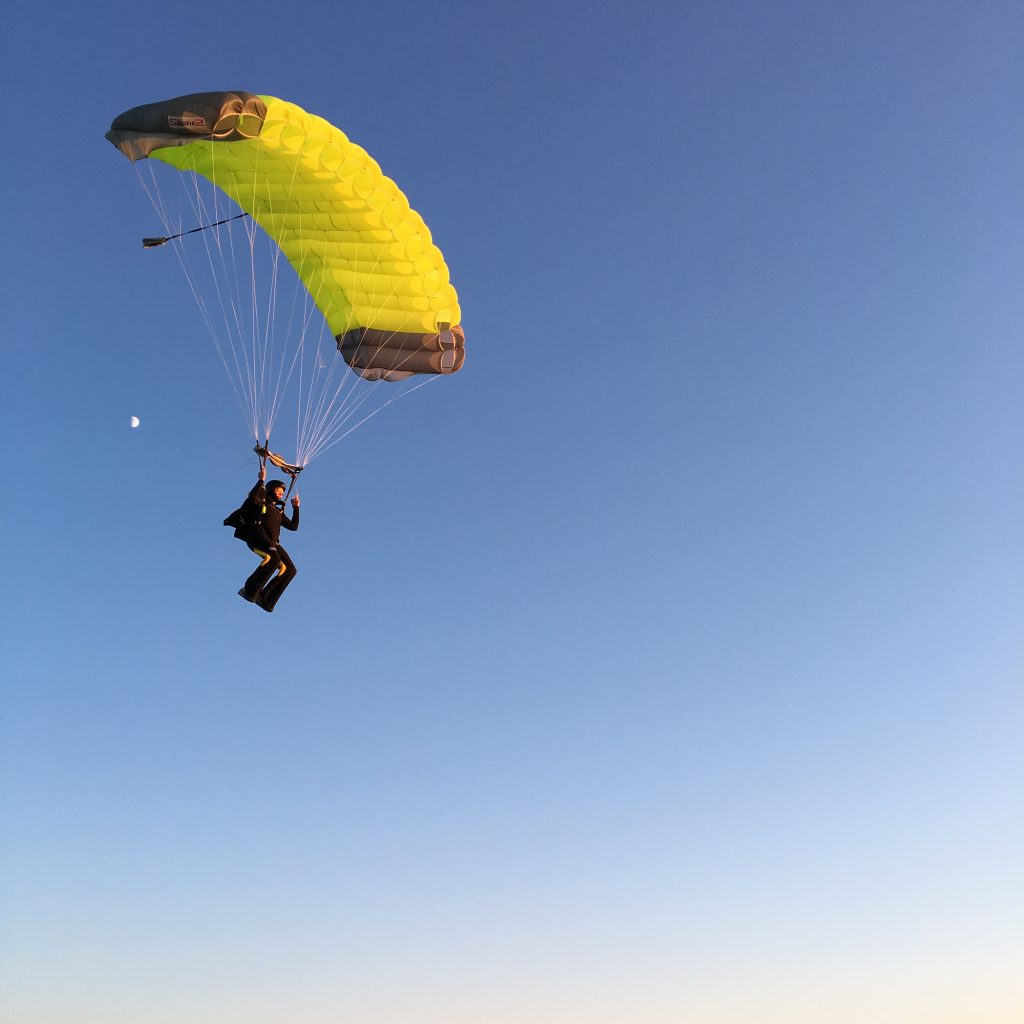
After freefalling for about 20 seconds, Trillaud looks at the altimeter on his wrist, eyes fixed as it rapidly counts down the altitude for one, two, three seconds, until it hits 5,500 feet. If there are others in the sky, he signals he’s about to deploy his parachute, maintains his body position and then releases it, revealing a billow of primary colours.
Even when perfectly following protocol, every jump has risks. On tandem jumps, the instructor has to manage a series of factors in real time: the position of the body, a sudden gust — or an unexpected loss — of wind. Even a lazy foot out of place can send him and his student barreling out of control. Trillaud’s had rough landings himself, but he’s grateful he’s never hurt anyone.
Despite how stressful this all sounds, after 10 years and more than 2,100 jumps, he says “the only time I feel solace in this sport is in the sky.”
Trillaud has dealt with depression for most of his life, but when he dropped out of college, it got bad. He says he hated his computer databasing program and the idea of where his future was headed. During that time he said he wanted to die.
“I was in a gutter,” he said. He didn’t work, didn’t cut his hair, didn’t do anything. Then he decided to try skydiving.
Trillaud was playing video games one night in his best friend Ryan’s basement when the pair began discussing doing something crazy. Trillaud had always loved a thrill. As a kid he’d scuff his arms skateboarding down hills. In college, he joined the adventure club: a group that went on hikes and did other outdoor activities. He remembers looking up to a guide on a whitewater rafting trip, thinking I wish I had his life. After watching skydiving videos on YouTube and hyping each other up, the pair registered for a tandem jump that June.
Trillaud remembers feeling scared, stepping out of the plane and holding his breath, bracing himself for the first time.
“And then I was like, oh shit, this is peaceful,” he said. “It was just the raw power of nature.”
He doesn’t remember much else, except that when he landed he shot his fist into the sky. When the instructor asked him how it went, he was so full of adrenaline, instead of throwing the rock on sign, Trillaud accidentally flipped him off. He and Ryan immediately registered for the next accelerated freefall program, starting two weeks later. Trillaud became licensed to dive solo that same season.
According to WebMD, when a person skydives, the extreme level of stress caused by leaping from the plane releases adrenaline and cortisol, heightening arousal. Once the parachute halts the freefall, this sensation is resolved with a release of dopamine and endorphins. The rapid shift from threat to relief activates the brain’s reward pathways, which feels good and emotionally uplifting.
For Trillaud, diving is relief. He compares it to the comfort of putting on a favourite childhood movie. The minute he leaves the plane, all of his stress disappears.
“It’s like a sandy beach. Everything erodes away,” he said. Performing a jump forces him to focus his thoughts and energy into a single 30-second moment.
In a freefall, the only sensation is the wind. “There’s nothing. It’s weightless and it’s free,” he said. His favourite feeling is “the hill,” the curve skydivers follow upon jumping out of the aircraft when they transition from a forward motion to a falling motion. It lasts five-to-10 seconds. “I find that moment very turbulent and very freeing,” Trillaud said.
If skydiving feels so biologically and emotionally rewarding, is it possible that people with depression, like Trillaud, seek it out more? And are there others — like him — who live with depression and skydive frequently?
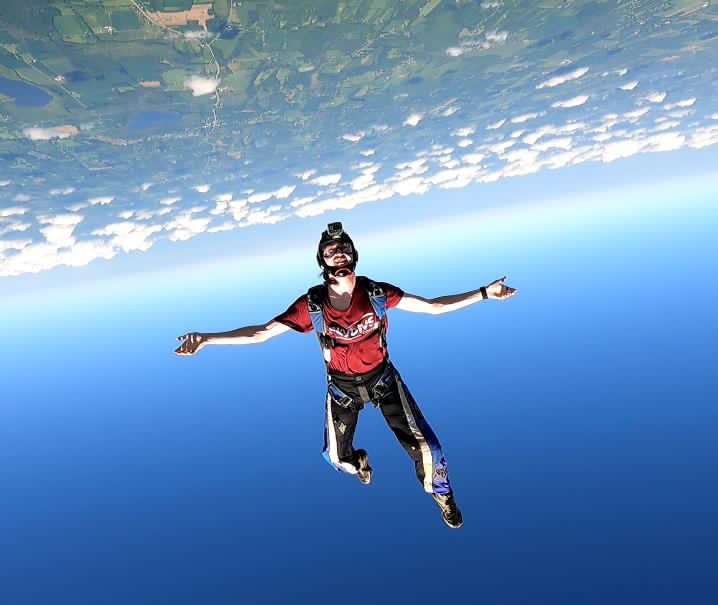
Swedish-based sport parachutist and social media strategist Leah Agar, 29, decided she would become a skydiver at eight years old.
She remembers sitting sprawled on a dark green couch as her mother’s best friend put on a DVD of her tandem jump. In an opening pixelated montage of professional tricks, one diver swoops just above a body of water, his foot touching it. I wanna do that, she thought.
When the pandemic hit, Agar, who was struggling with seasonal depression through the long Swedish winter, decided to register for a solo skydiving course. “I needed something to look forward to in the spring,” she said. She’s been skydiving since.
In 2021, she went to the emergency room, thinking something was wrong with her. It turned out to be a panic attack. Her job at the time was very stressful. “I was online 24/7, leading a team,” Agar said. “I was being overworked and it was just hell.”
She recalls leaving work early one day, taking the train to her skydiving club. At that time she was skydiving on evenings and weekends. “I was feeling so, so, so, anxious,” she said. Agar arrived just in time for the last jump of the evening as the sun was setting.
As soon as the plane door opened, the stress was gone. All she could think about was the jump. “You feel constant physical and mental anxiety, just like eating at you, and then suddenly it goes away. It’s like, oh my God — relief.”
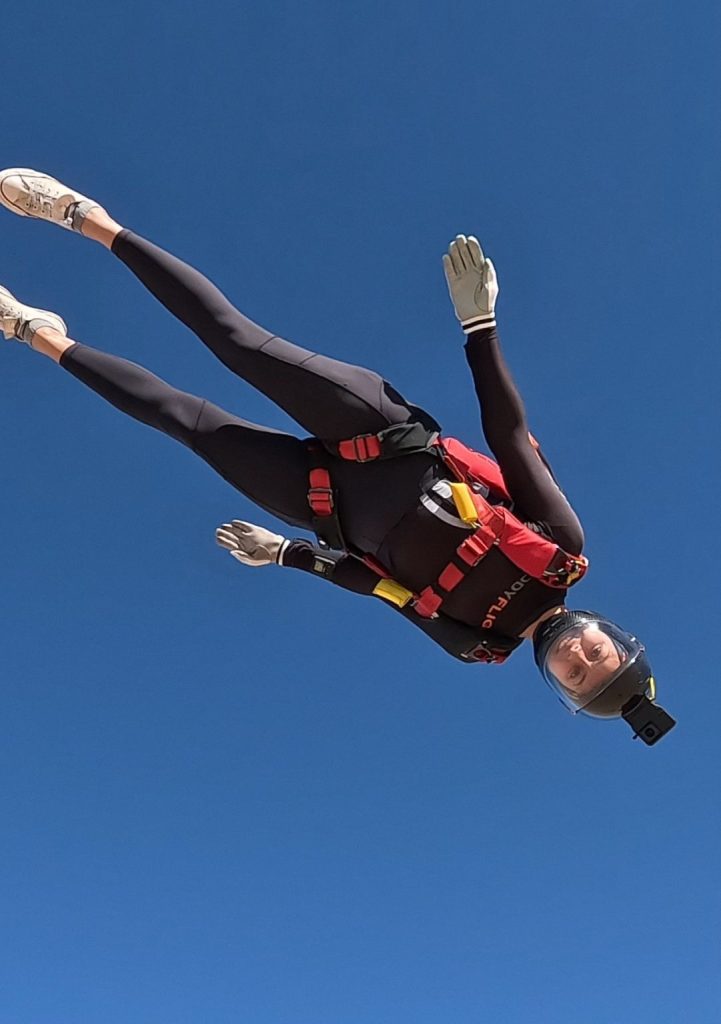
Now she says skydiving is the most important thing in her life. Whenever she feels burnt out after work and goes for a jump, it resets her. In 2025 she quit her job and travelled to Brazil in the winter to extend the skydiving season. “[It’s] helped me through every aspect of my life,” said Agar. “It’s the only thing that kept me going.”
Agar posts about skydiving on social media. When she talks about her mental health struggles online, she says she’s surprised to see how many people comment that they feel the same way.
While there’s plenty of research on the effects of skydiving on the mind and the body, there’s little data available on mental health in the sport. A quick Google search serves up dozens of blog posts from dropzones (skydiving locations), but few reliable resources. One dropzone in Old Sarum, England, conducted a mental health survey among 320 customers who jumped over the past three years. Ninety-four per cent said the skydive had a positive impact on their mental health.
The most recent scientific study I could find analyzing depression in skydivers is from 1973, and it’s more focused on examining the overall personality traits of skydivers. It found that sport parachuters reported fewer symptoms of anxiety, phobias, and depression than the comparison group.
But the data that led to these results raises some questions about the study’s reliability. All participants were male and 73 per cent had prior military experience. Fifty years ago, talking about mental health was not as common as it is today, and I wonder if this demographic might have been less likely to self-report symptoms.
What we know for sure about skydiving is that most people never try it. The dropzone Alberta Skydive Central estimates that 35,000 Canadians (less than one per cent of the population) try skydiving for the first time each year. While most people will never cheat death for fun by jumping out of plane, for those who do, it’s usually more of a bucket list kind of experience: something to mark a graduation, a momentous birthday, or beating cancer.
But there are outliers, people who get hooked like Trillaud and Agar. So what is the difference between someone who’s satisfied checking off the box, and someone who feels they must do it again? Is there something different about a frequent skydiver’s brain?
In 2013, a group of Polish researchers decided to explore that very question. In a study seeking a common psychological characteristic in parachute jumpers, they examined features of temperament, need for stimulation, and tendency toward risky behaviour, among other things. Though the study failed to define one trait, it did identify three groups it called “risk avoiders,” “moderates,” and “sensation-seekers.”
They didn’t invent these labels; American psychologist Marvin Zuckerman pioneered sensation-seeking theory in 1979 while trying to discover mind control. In his book on the subject, Sensation Seeking: Beyond the Optimal Level of Arousal, he defined the personality trait of high sensation seekers as “the need for varied, novel, and complex sensations and experiences and the willingness to take physical and social risks for the sake of such experiences.”
Zuckerman developed a scale for determining people’s aptitude for sensation-seeking. The forty-item questionnaire assesses the personality traits of thrill and adventure seeking, disinhibition, experience seeking, and susceptibility to boredom. While his scale has since been modified to reflect modern times and language, it’s still used today.
Thirty-nine per cent of participants in the Polish study showed a stronger tendency toward sensation-seeking. This group also reported higher levels of anxiety after completing a jump. While this might at first sound like the opposite of an adrenaline junkie, the publication points out that for high sensation-seekers “taking risks and feeling the anxiety connected with them is a way to stimulate and sustain the desired high level of pleasant stimulation.”
Clinical psychologist Dr. Ken Carter has researched sensation-seeking extensively, publishing the book Buzz! Inside the Minds of Thrill-Seekers, Daredevils, and Adrenaline Junkies.Through collecting personal stories from high sensation-seekers, Carter explains the psychology and neurology behind the behavior. He believes no one scoring low on Zuckerman’s scale is skydiving repeatedly, so sensation-seeking is a good framework for understanding the relationship between skydiving and depression.
“I think it’s not necessarily the case that people who are depressed find skydiving, and that it helps them,” said Carter, “[but] that there’s a subset of people that are high sensation-seekers that, whether or not they’re depressed, skydiving sort of fuels a piece of their personality.”
He says a lot of high sensation-seekers are going to crave these types of high-intensity experiences, but they may not become skydivers. Instead, they participate in other kinds of highly chaotic or highly energized experiences. “They’re going to be driving fast or doing other things, because it’s easier to do those things than to skydive,” said Carter.
Carter says sensation-seekers have higher levels of monoamine oxidase (MAO), a chemical in the brain that breaks down other neurotransmitters like serotonin, dopamine, and norepinephrine — the hormone that activates the body’s “fight-or-flight” response. This in turn causes them to be less sensitive, explaining why sensation-seekers need more stimulation to reach their optimal level of arousal.
“A lot of the people I’ve talked to and interviewed that have that high sensation-seeking personality, the first time they do those kinds of things, they… they feel really amazing, not just after that, but for weeks after they’ve done it,” said Carter.
Additionally, high sensation-seekers have very low levels of cortisol, the chemical involved in the stress response — that fight, flight, or freeze response. When a sensation-seeker goes on a jump, “they’re not necessarily scared when they’re doing it, but they’re sort of, like, vibing on the dopamine, right? And there’s not a lot that gives them that combination of things,” said Carter.
Agar described her first jump as “the most calm I’ve ever felt in my life.” Trillaud says skydiving gives him a mental reset. Sometimes if he’s in a bad mood or mental state coming into work, he’ll perform a solo jump before any customers arrive.
Zuckerman’s research can explain why some people find skydiving therapeutic, but how long can that feeling last?
Kaneena Vanstone, a 44-year-old Cree skydiver from Manitoba, flips through the pages of the teal logbook she’s used to track her 864 jumps. The 2025 section is empty. She didn’t log anything that season because of her depression. Vanstone has been a part of the skydiving community since her first assisted solo jump in 1999, in Gimli, Manitoba. Now she’s the president of the Canadian Sport Parachuting Association.
While she did go skydiving three or four times in 2025, she says she didn’t record them because the jumps didn’t feel right. “I did [those jumps] because I wanted to feel all of those amazing feelings that come with the jump,” she said. But it wasn’t the same as it used to be. So, Vanstone stepped away from the sport. “I shied away from it because I wasn’t well and I was needing to get better,” she said.
For Trillaud the highs didn’t last either. “There was a point in my life where skydiving got boring,” he said. He’d accomplished everything he wanted to in the sport. He could jump solo or tandem, pack gear, and teach others how to do the same, but diving wasn’t giving him the same rush it once had. “I wanted to chase the next high, like an addict,” he said.
While the expression “adrenaline junkie” is common, recognizing adrenaline addiction in the world of psychology is still a relatively new idea and is not yet officially codified in diagnostic manuals. But research shows that regularly experiencing high dopamine can affect the brain’s reward pathways the same way substance addiction can, and regular exposure to high-adrenaline activities can make people feel increasingly numb. This is known as anhedonia, the reduced ability to experience pleasure.
One study conducted by researchers at Cardiff Metropolitan University found that when rock climbing athletes abstained from the sport, they appeared to experience withdrawal symptoms comparable to individuals with substance and behavioural addictions, including cravings, anxiety, depression, sadness, and notably, anhedonia.
When Trillaud began the sport, he was certain skydiving was his purpose, but with limited ways to advance his skills, the sport grew boring. Then in 2022, Trillaud got his tandem rating, allowing him to perform tandem jumps at his dropzone. Seeing people react to their first jump — excited, crying, soaking in the beauty — he realized a new kind of feeling that came from seeing the experience through other people’s eyes. “It makes me tear up,” he said.
While Trillaud may not get the same thrills as he did in the beginning, he’s happy being a tandem instructor, and he feels like he’s changing people’s lives. “I’m servicing that feeling to other people now,” he said. Trillaud compares himself to the whitewater rafting guide from his days in the adventure club. When a customer tells him it’s the craziest thing they’ve done in their life, he knows he’s done a good job. “I’m like piggybacking off their emotions,” he says.
It’s undeniable that skydiving is an extremely emotionally and chemically rewarding experience, but there’s more than chemistry affecting its athletes’ mental health. Connection is vital for our well-being. Researchers at the University of Wisconsin–Madison found in a 2023 study that individuals with a negative sense of community were significantly more likely to report depression, anxiety, and stress symptoms.
All the skydiver’s I talked to spoke about how tight-knit the community was. Both Agar and Vanstone have met their partners through the sport. One study called “The impact of extreme sports on mental health”, explains why this might be: “[E]xperiencing risk together builds strong interpersonal bonds, which has a positive effect on mental health.”
Vanstone says the skydiving community is very open to talking about mental health. Because there’s so much planning involved, sport parachuters ask each other about their hydration, sleep, and mental preparedness before performing a jump. She says asking about mental health is a natural extension of that.
In Canada, there are more than 3,000 skydivers registered with the association, and sport parachutists travel a lot and visit each other at their dropzones. “It’s like a small-town feel where everybody knows everybody,” said Vanstone.
While safety has improved drastically over the last 20 years, and fatalities have dramatically decreased, skydiving is still an extreme sport and accidents still happen. When they do, it shakes the community.
At an institutional level, mental health in skydiving still has room for improvement. At least in Canada, Vanstone says there aren’t any frameworks from the national association where people can reach out to their local health authorities if they’re having mental health issues, although they are actively working on some. “We’re evolving right now as a sport and as an association, because people are growing and evolving and having different needs,” said Vanstone.
While some skydivers report that the sport has helped them cope with depression, a 45-second freefall is no replacement for professional help.
“When we’re feeling down and out and unwell, we want something from skydiving that we really need to figure out internally on our own, whether it be with therapy or medicinally or whatever,” said Vanstone.
Trillaud says his mental health ebbs and flows, but he’s better at managing it now. “Life has its ups and downs,” he said, “and when the down part [does] come, [I’ll] deal with it.” He doesn’t like to dwell.
“I think why skydiving is so important is because it forces you into the present moment,” Trillaud said. “If you could apply that to everything in life, [you] would probably be so much happier and better.”
He’s coming up on his 11th year in the sport. Most people last five. While he’s still trying to get better at specific skills like freefalling head-down, he’s also noticing the physical toll on his body. His back hurts, and he sees a chiropractor twice a week in skydiving season.
Sometimes Trillaud thinks about his future: maybe going back to school and becoming an electrician, getting a nice union job, potentially becoming a provider as a husband and a father — but he doesn’t have any plans.
For now, he’s happy diving.