Vincent Jensen’s Masculinity Adventure
Incels, looksmaxxers, and pick-up artists – what draws young men to these communities? Follow me as I descend into the depths of the Manosphere to learn what it truly takes to become a Top G.
Listen to this story:
A few years ago, before it was taken down, I stumbled upon the incel subreddit and was alarmed by what I saw. As a person who is terminally online, I’ve seen my share of disturbing stuff, but over the past years I’ve noticed how misogyny — and some of the other worst parts of internet culture — has bled into the real world. The other shocking thing is how easy it is for young men to get sucked into toxic spaces without even realizing it. The content moves from benign self-improvement to horrifying places before many people realize what is happening. Before long the worldview they are immersed in — which they might have clocked as problematic at one point — seems like reality. As a 32-year-old male, I get inundated with invitations to engage with this world, but thankfully some key life experiences have given me the wherewithal to avoid the pit.
but what if I didn’t?
Blackpilled
Late one night, I was scrolling through hate speech on the incels.is forum. The forum is dedicated to the “involuntary celibate,” self-defined as “people who lack a significant other.” It’s the end point for people who blame society, and women, for their inability to find a partner. There are some interesting thread titles on the “must read” section:
“Never trust a woman when it comes to your insecurities she WILL use that against you.”
“Women are a net loss for the state, and the gap is funded by men, we are paying women to exist.”
Scrolling down, I come across a slightly angrier post:
“Women did this to us. With revenge in mind women reduced us to level of insects. They WILL pay for what they’ve done with punishments worse than death.”
Today, I see these messages for what they are: hateful ramblings. But I can’t help but wonder if I could have written something like this had my life gone differently.
I was obsessed with finding a partner ever since I was five or six. It drove me into despair that I did not have a girlfriend at twelve years old. I lost my mom around that time, and I was wanting to fill the void. I was convinced I was unlovable — that the world and the people in it hated me on a fundamental level. Time and self-reflection changed that. I learned my actions have consequences; my pain and fury did not excuse my hostility, nor did they entitle me to anything from anybody else. I was not owed rewards for good behaviour, or for suffering the most.
There were key moments in my life where I could have stayed angry at the world, and I chose to move past that. I’m not patting myself on the back. Reasonable people do this all the time. This incel forum is filled with people who have the emotional pain of my twelve-year-old self, but hold on to their anger. I had no validation; these people have only each other. The voice echoing across those posts says to the angry child, you were right, you are worthless, the world is full of hate, compliments are thinly veiled insults, and there is no future for you.
I am beyond those anxieties now, but I can’t say the same for the people on this board. For many, it’s the only community they have left. The world they live in on these boards poisons their personal relationships and leaves them seeking out this group that they believe understands them. They have found a form of painful comfort in one another. Anybody on the board who achieves the goal they all aspire to, finding a partner, is ostracized, for then they must never have been a true incel. It’s a self-selecting process, weeding out the uncertain and leaving only the most devout believers. The people on this forum believe they did not get the life they were owed.
So, how does anyone end up in such a toxic and hostile mindset?
The path leading to these boards is manufactured by the “manosphere” — an entire community of influencers, grifters, and personalities dedicated to preying on the loneliness and insecurities of young men. Some do this for ideological reasons and social clout, others for profit. There have been different groups, ideologies, beliefs, and habits that constitute the online manosphere across the past twenty years. Many of these groups conflict ideologically, even if all are rooted in some level of traditional gender norms and values. From pick-up artists, to men’s rights activists, to looksmaxxers and incels, there is no shortage of misogynistic messaging out there.
Signing Up
Curious to know more about how people get into these spaces, I created an online persona to explore the world of toxic masculinity. I made accounts across video hosting platforms, social media platforms, and message boards. My goal was to see how quickly I would come across some disturbing content if I imagined I was a young man on a self-improvement journey. While not exactly a scientific experiment, I did gain some interesting insight.
Meet Vincent Jensen, username VJ (yes, those are my middle initials).
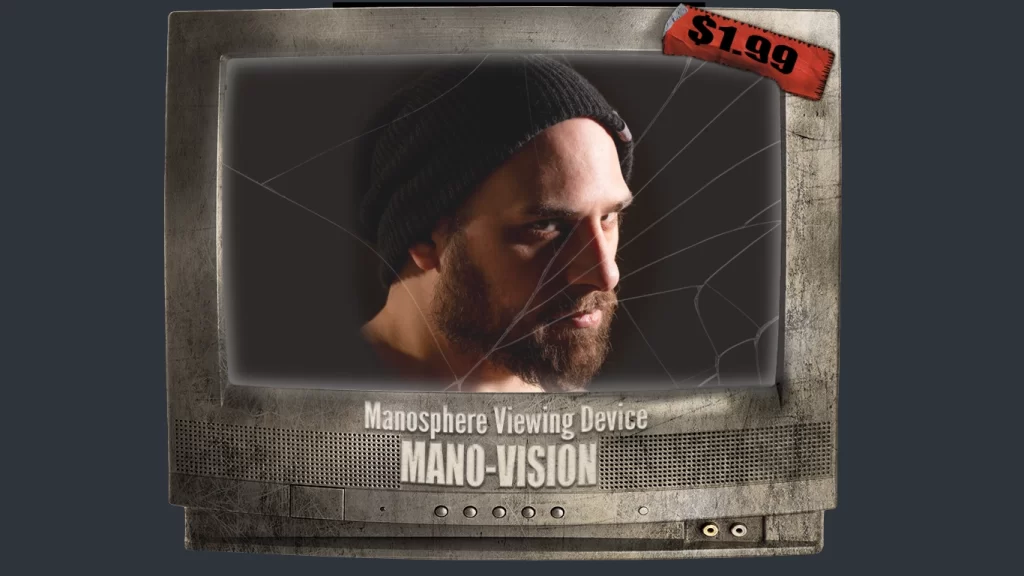
VJ logs into his new self-improvement YouTube account, and types:
“How to get girls to like you.”
After clicking around some shorts and podcast videos recommended by the algorithm, this is what VJ’s home page looks like:
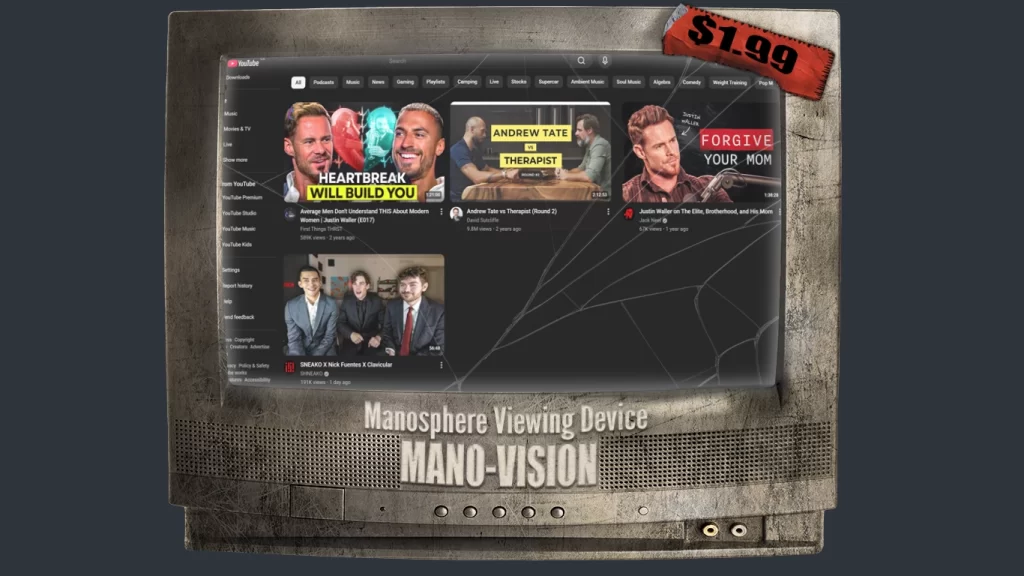
From left to right, we have Justin Waller, a former associate of Andrew Tate. Next is Andrew Tate, a former kickboxer, current influencer, entrepreneur, and alleged sex trafficker. In the bottom left, we have a smorgasbord of awful people. There’s Sneako, a content creator who routinely makes antisemitic comments and jokes; Nick Fuentes, host of livestream America First and a self-proclaiming white supremacist, incel, and Christian nationalist; and Clavicular, a looksmaxxer influencer and self-described “gigachad,” or top-tier attractive man.
Remember, the only search I have used on VJ’s account so far is asking for advice about getting girls to like me. I got to this homepage solely through clicking on recommended videos. If you’d like to know more about how this works, YouTube’s VP of engineering breaks down the recommendation system on YouTube’s blog.
Moral of the story: if you look up dating advice on YouTube, or self-improvement, or videos catering toward success for men, the algorithm recommends an alleged sex trafficker and his peers; all because other people who watched videos about dating or male self-improvement ended up finding these influencers as well.
These are the figures running the dating advice scene.
While some of them are banned from posting on YouTube directly, their content can be found through reposts. Before long VJ finds a video with Clavicular, Fuentes, Tate, and Sneako having a disturbing conversation about women. Another video from the same livestream shows them partying to Ye’s banned song “Heil Hitler.”
While some of these people are generally unknown to the wider public, most might recognize the name Andrew Tate. Maybe you’ve seen a TikTok video or YouTube Short with him, or perhaps a news story covering the charges laid against him.
Andrew Tate is probably the most notorious. He epitomizes a specific kind of male influencer. He’s loud, abrasive, condescending, and a proud misogynist.
Imagining I was VJ, I listened to hours of Andrew Tate giving impassioned motivational speeches set to looping royalty-free music. It’s the audio equivalent of a punch in the face. In one video, he asks his listeners to imagine a different version of themselves:
“There’s a version of you that never sleeps in, never skips training, never wastes time. There’s a version of you who never fails… Imagine what you would look like, imagine where you would live, imagine the car you would drive, imagine how much your woman would respect you. Imagine the love you would see in her eyes when she looks at you with adoration, like a king.”
This is what Andrew Tate describes as a “Top G.” It’s what he believes himself to be. Written out like this, it looks like an unadulterated stream-of-consciousness mess — and it is. This is Andrew Tate’s brain straight to the bloodstream. After hours of Andrew Tate bullying VJ to believe he can be a Top G, I imagine VJ is sold. He wants to be a Top G. He wants all the success he can imagine. Even if VJ didn’t buy into the blatant misogyny, he would likely be intrigued. Tate makes his audience feel understood. His words feel like tough love.
This is the Andrew Tate his followers believe in. No matter the news headlines about the charges against him, he’s a former kickboxer and a millionaire, who surrounds himself with cars and women.
Before long, VJ comes across Tate’s online course designed to teach him how to be a Top G: The Real World.
The Real World
Formerly known as Hustler’s University, The Real World promises to teach you vital life lessons and provide mentorship from multimillionaires. There are nine different programs, including e-commerce, stock and crypto trading and investing, copywriting, AI content creation, and fitness.
Oh look! It’s on sale!
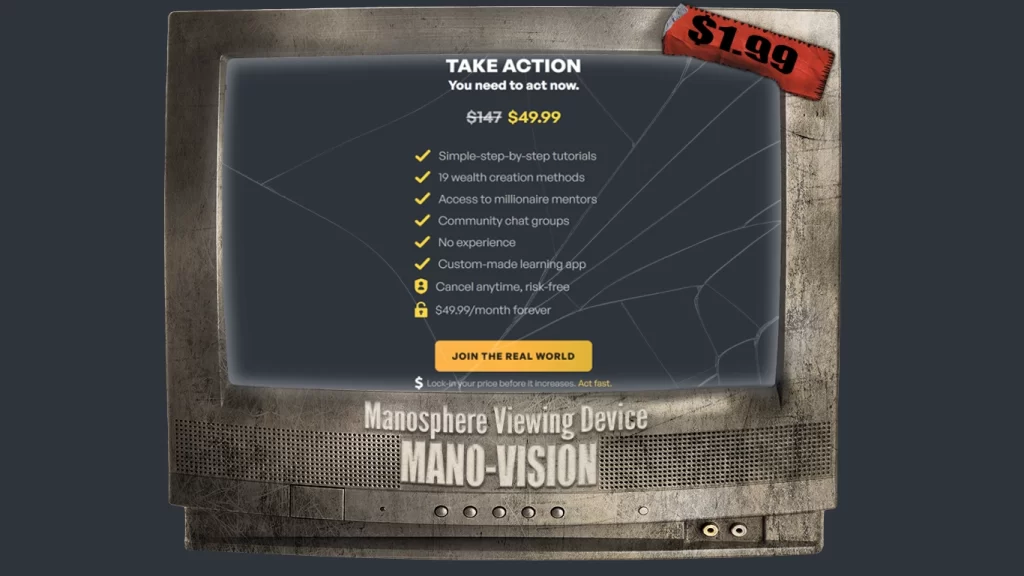
$49.99 per month? Forever?
But when I click to the next page, I realize my choices are $99 a month or $499 a month for the premium version.
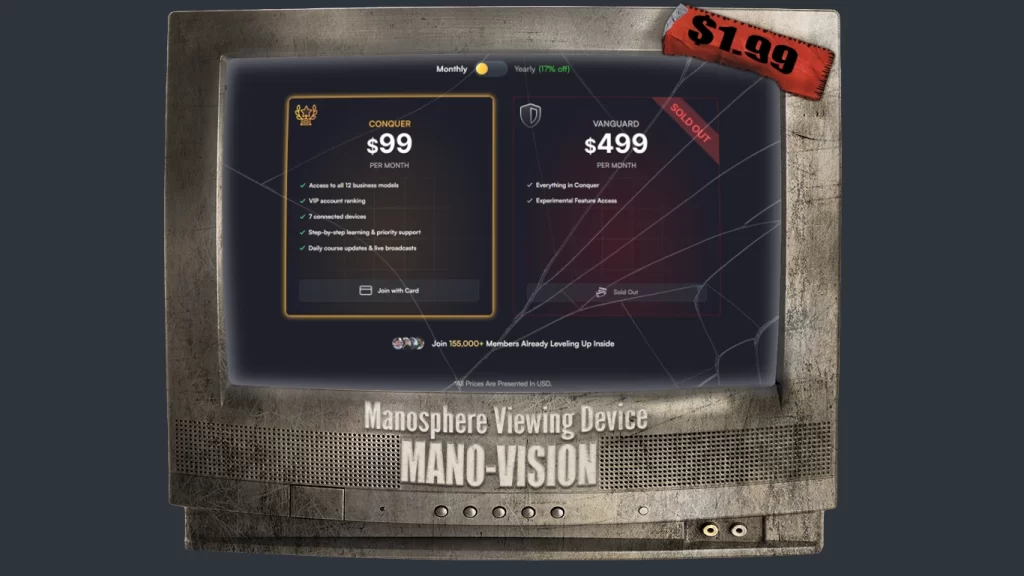
I do not want to give Andrew Tate any money. Fortunately for me, I don’t have to.
In November 2024, The Daily Dot reported that The Real World suffered a data breach. Not the first, and not the last, the leaked data was uploaded to Distributed Denial of Secrets, a non-profit run by journalists and activists that archives leaked data. Major reporting on this breach focused on videos from The War Room, Tate’s “networking group” connected to allegations of abuse and trafficking. Less reported are the chat logs from The Real World, which give us an idea of what it’s like to be in the chat rooms that your average user, such as VJ, would be participating in if they purchased the course.
The main structure of The Real World is like Discord or Slack. There are various channels that members have access to, depending on the course they signed up for. Some are for discussions, and some are reserved specifically for streams or videos of Tate. Tate is rarely involved; he only shows up occasionally to drop a video with motivational nonsense. Mentors are moderating and running the board.
Mentors also run programs and challenges for members. One channel and several rooms were dedicated to the Positive Masculinity Challenge, a 30-day self-improvement challenge where people worked out, stopped watching porn and browsing social media. This is where participants start to become a Top G, “a man who dominates all realms of human endeavour, especially MASCULINITY.” The endeavours listed are mindset and physicality, relationships with men and women, and money.
The line between a cult and community is oddly thin, and The Real World skates on it. Partcipating in the challenge gave users a massive “account score bonus,” a metric indicating how accomplished you were within the community.
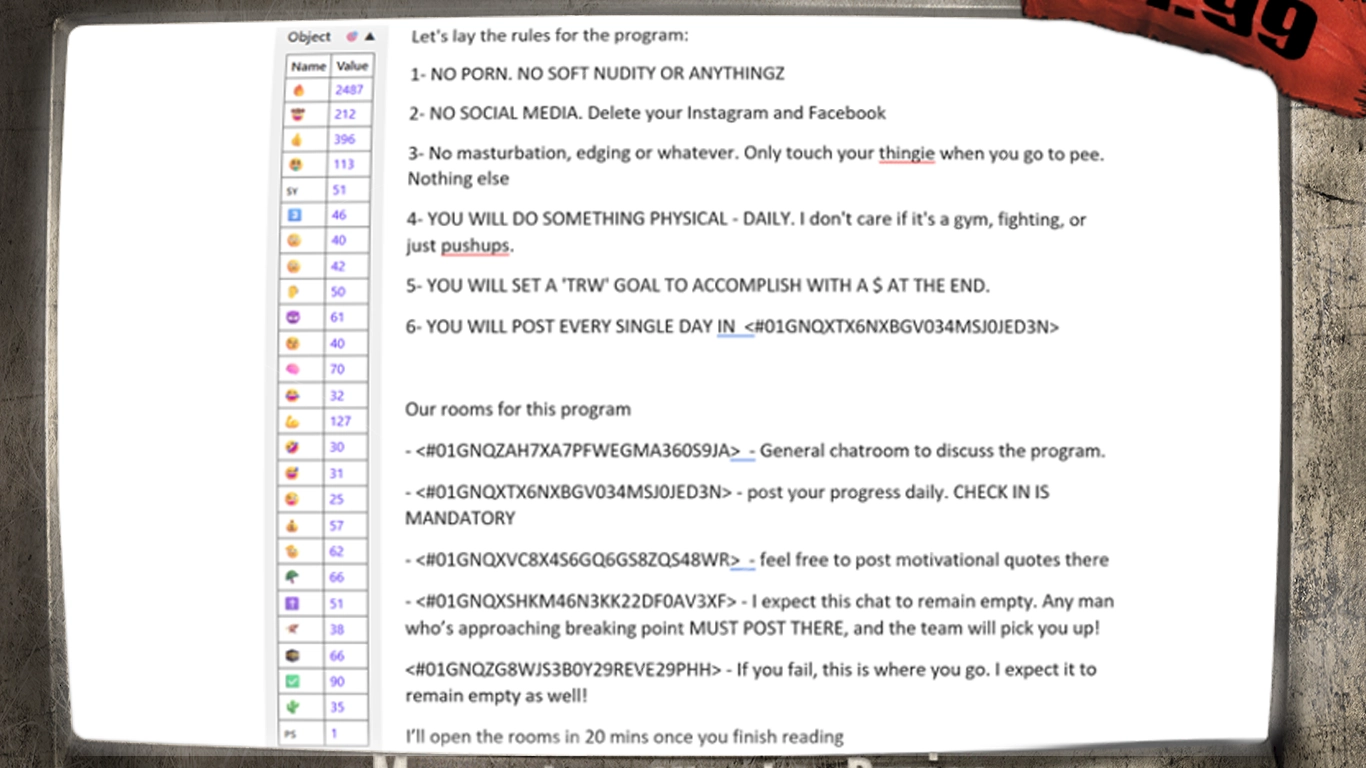
I had VJ participate in this challenge. I was curious to see if there would be any notable improvement in my life. I successfully eliminated social media. I didn’t uninstall the apps, because I did need them for work and school, but I didn’t do any mindless scrolling on TikTok or Facebook. I had an injury, so I didn’t work out constantly over the 30 days, but I did my best.
The most surprising thing about the chat logs this challenge was a part of is how positive they are. I expected infighting and toxicity like on the incel board, but from my brief glimpse, people were supportive of one another. One person, who signed up after seeing a Tate ad about how there’s more to life than partying, shared a photo of a bridge they considered jumping off regularly. They talked about how things changed for them after joining the challenge: they quit smoking, were eating better, working out regularly, and their social life had improved. Here are some quotes without usernames (withheld to protect privacy, especially since some users declared themselves to be underage):
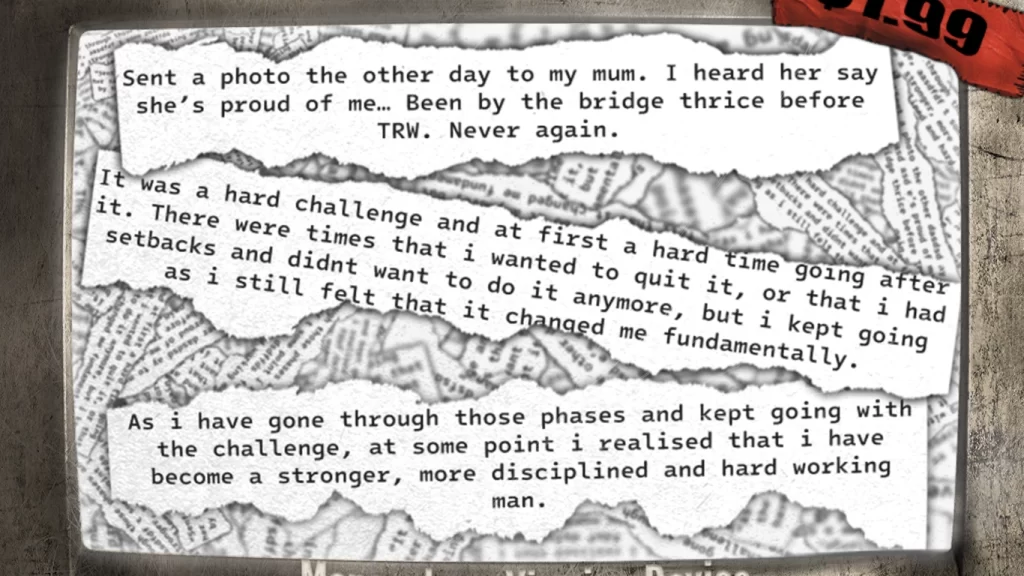
I felt empathy, joy, and sorrow reading about users’ accomplishments. I too have struggled with suicidal ideation, and seeing other people come out the other side made me happy. I didn’t expect something good to come from this challenge.
These are people who hoped to improve themselves, and experienced real change after a personal journey.
I could relate. And yet these spaces are deeply problematic. The positive changes these users experienced come from a grift. While these threads can be oddly wholesome, the context is not. When you adopt seemingly positive messaging of a controversial figure like Tate, it becomes much easier to swallow the dangerous messages — and there’s a lot of dangerous messages within Tate’s worldview.
Communities like the one in The Real World are fostered in part out of anxieties about the place men hold in society. In Lisa Sugiura’s book The Incel Rebellion, she discusses how spaces in the manosphere promote the narrative that modern masculinity is in crisis due to an abandonment of traditionally masculine values and the disruption of the working class. While she applies this observation to the incel community, it’s observable in the challenge too — in the celebration of discipline and strength and financial success.
I honestly did feel a lot better after finishing that challenge. Working out was hard; I hadn’t done it in a long time. I felt a little more confident. The line between the online persona I created and my actual self was blurring.
Remember Justin Waller? There’s a video in the leaks titled “Justin Speaking at WarRoomEvent” where Tate and Waller are discussing managing your partner. Tate talks about not letting your partner “catch you slipping” — here meaning losing control of yourself, physically or emotionally. Waller’s response is chilling to me:
“I had a moment with my girl, where she caught me [slipping], and she’s sitting there on the couch, and she starts crying, and she goes, ‘I would say something, but I know you’ll just replace me.’ She’s got to feel that. She’s got to know.”
For Waller, women are possessions. And if you can achieve anything by trying hard enough and buying the right courses, then it stands to reason you can possess women too. But even if you make all these changes, it won’t guarantee that women will find you attractive or interesting.
Men in these spaces are primed to believe that they’ve done enough personal work to make themselves appealing to someone. The first time they get rejected, they may hold on to these ideas, continuing the self-improvement journey, believing they have more work to do. There are plenty of people out there trying to teach the secret to finding a partner. But some discard the idea of dating all together, and go with a different approach.
The Path to the Incel
The promises of success that Tate offers are impossible to achieve unless you have the ability, means, and stomach to completely subjugate another person. Relationships are about domination in this context. In the leaked video, “Justin, Stirling & Andrew Speaking at War Room Event,” Tate says:
“If you set it up in the way that benefits you the most, she’s going to at some point cry, be upset [and say], ‘this is not what I want, why are you doing this to me, I was a good woman to you, why’d I have those kids?’”
VJ, like everyone, would eventually experience rejection, and Andrew Tate will not have answers except that he lacks control of the people around him.
If we dig into the rest of the people on VJ’s algorithm and feed, we’ll see them offer many tips to attract women. There’s looksmaxxing: optimizing one’s appearance with everything from exercise to self-induced skeletal injuries in the hopes of reshaping facial structure. There’s also “game,” including tricks like negging — using mild insults to undermine a woman’s self-worth. Guides on becoming an “alpha” and “sigma” male will suggest ways to be confident, charismatic, bold, or stoic.
There are also people on VJ’s feed who don’t bother with dating at all. VJ’s homepage already shows him Nick Fuentes, a self-proclaimed incel. This is where VJ, if primed by rejection in real life, might look up an incel group.
Incels offer an explanation when all other attempts to succeed at dating fail: the blackpill. It’s characterized quite nicely in The Incel Rebellion as the acceptance of the incel’s lot in life — that they will never get the woman they want, so they reject women, relationships, and equality. It explains the experience of rejection in a way that absolves the incel of responsibility. All women, everywhere, are deserving of your hatred because they have not given you the sex or relationship you feel entitled to. The solution to this realization is generally apathy, violence, or suicide.
In 2023, The BBC hunted down the owner of several forums, including incel forums, who used online spaces to funnel depressed incels to a second forum where he sold suicide kits. In 2023, there were 50 deaths connected to these forums in the UK alone. This is one endpoint. Elliot Rodger, who went on a killing spree known as the 2014 Isla Vista Killings, is another endpoint of the incel ideology — his manifesto spoke openly of his hatred and resentment of women. He’s often referenced in incel circles; people talk about him as either “Saint Elliot” or “ER.” “Going ER” is to go on a killing spree.
The incel forums hold a lot of horrible blackpilled perspectives. Some of the more disgusting posts include accusing women of secretly craving bestiality, fantasizing about systemic abuse toward women, and calling for slavery or mass murder.
Seeing such dark fantasies is horrifying, but the longer I spend in these spaces as VJ, the more desensitized I become.
Deradicalization
As a kid in middle school, I would have been susceptible to some of these ideas. I never reached the point of disdain for women, but there was a time I became distrustful and hateful. I based my value on having friends and having a relationship, but I had no idea how to be a good friend or partner. I had internalized the idea that I had failed as a man if I was not in a relationship, and that is the core of the blackpill. I’m thankful I grew out of that.
The late 2000s were the start of a lot of online discourse about how to meet women. One of the women I met during my teens suggested I check out a redpill subreddit for dating advice; unlike the blackpill, the redpill promotes ideas claiming there are proven and tested tactics to dating. She was a feminist and hadn’t seen that board much, and we talked about some of the advice I found. We ended up dating for a time, and it was through that connection that I began to undo some of my more insidious beliefs and ideas about relationships. She challenged me on my behaviour in previous relationships and educated me on my misconceptions about feminism. I stopped believing my worth was in my relationship status or that I was entitled to one. Basic concepts of feminism, equity, and social justice began to take shape in my mind.
While positive relationships with women can help pull people away from incel communities and the manosphere at large, Sugiura’s book states that men need to act as role models and healthy supports for one another to promote healthier ideas about masculinity and women.
So, what can we learn from VJ?
Aside from allowing some degree of anonymity while exploring these darker spaces, I think VJ is a common type of guy: lonely and well-intentioned, but awkward and socially inept. He’s desperate for connection and validation, and stumbles across it in the worst places. He takes rejection hard, even though it’s a common part of life.
VJ represents who I was as a teenager. I didn’t have the influences that affect young men today; I was born in the early ’90s. If I were born ten or fifteen years later, there is a good chance I would have encountered the manosphere, and possibly been intoxicated by it the way many teenagers are today.
I saw users who claimed to be 14 years old posting in the challenge and on the forums. I’ve omitted their accounts entirely because, frankly, I would not want my own teenage thoughts to be published. They are children who are trying to find their identities and are looking in dark places.
In these spaces, the line between myself and VJ thins, and it gets ever thinner as I struggle to maintain the distance from the kid I used to be when I dip back into these dark places and am reminded of the mindset I once had that is fully on display. I see the angry child I used to be. He was cold, violent, and self-absorbed; passively cruel and unable to recognize how he hurt other people.
In my actual life, I’m not that person anymore — and I’m grateful for that. I no longer hate myself. My life got better when I let go of my anger, when I stopped focusing on myself and began to see others more clearly. I work to find peace and contentment. I try to help the people around me. I learn that I can be loved.
I don’t need Andrew Tate to become a Top G.