Correction Cycle
Many women in the criminal justice system remain stuck in a cycle where the odds are stacked against them. For Tryli Anderson, the cycle went something like this: Arrest. Release. Arrest. Release. Repeat. But now, Anderson is trying to break free.
Listen to this story:
When Tryli Anderson’s brother died, she couldn’t turn to alcohol and drugs the way she had when her dad and sister died years before. This time, she was behind bars, serving a six-and-a-half-year sentence for trafficking drugs, possessing a prohibited firearm, and breaking court orders on her lifetime weapon prohibition.
She watched her brother’s funeral online from the Edmonton Institution for Women. This wasn’t her first time being incarcerated; she’s been in and out of correctional institutions since she turned 18. Not being able to be with her family — and not having access to substances — became a turning point for Anderson, 44. Without the numbing effects of drugs and alcohol, she said she started really grieving for the first time.
“I was always taught while growing up never to cry. Bottle things up,” said Anderson. “I’ve always been stuck in the system ever since I was eight years old,” she said, noting her time in the Child and Family Services system.
Anderson’s experience reflects a wider pattern of incarcerated women who have cycled from foster care into the prison system. The Department of Justice reported that youth who age out of the child welfare system are at increased risk of homelessness, poverty, substance abuse, and being involved with the criminal justice system.

After being in and out of correctional institutions for more than 20 years, Anderson began turning things around after her brother’s death in 2024. She’s no longer abusing substances, she got her high school diploma, her kids visited her at the Eagle Women’s Lodge recently, and she’s working toward getting her children back after release — but it hasn’t been easy. For many people the correctional system doesn’t correct much, and it can even perpetuate the harm it’s supposed to address.
While Anderson stands out as an incarcerated person who is making changes, many women in the criminal justice system remain stuck in a cycle where the odds are stacked against them.
Anderson’s Early Years
Understanding what brought Anderson into the legal system starts with her upbringing.
Anderson, who is Ojibwa, was around six years old when she started going to day school in the late 1980s at her hometown, Pinaymootang First Nation. Day schools were similar to Indian residential schools; except day schools were in a students’ community and students went home to their families at the end of the day.
Anderson was eight years old when she entered the child welfare system.
People in care “are often set up for failure rather than success,” said a report called Niigan nakeyaa Oshkinawe, which means “forward youth” in Anishinaabemowin. The report developed by Manitoba Advocate for Children and Youth said many people leave the system with “more trauma than they came in with.”
“I missed my dad. I wanted to go home, even though everything wasn’t all that good,” said Anderson.
Sad about being separated from her siblings, she regularly ran away from her foster homes, sometimes picking up some of her siblings who were placed in different homes and trying and get back to her family home.
She remembers once walking with two of her little brothers and two sisters through the ditch of a highway, trying to keep a low-profile as they tried to get home. Anderson didn’t know where she was going and was following her memory. RCMP spotted them, picked them up and returned them back to their foster homes.
Because of her repeated escapes, she was bounced from home to home. She first started drinking after her dad died when she was 12. Her dad, who she said often smelled like beer, died from alcohol poisoning. By age 14, she was unhoused on the streets of Winnipeg and drinking regularly.
“It numbed the pain I was feeling then. It brought me closer to people on my level. After a while, I just got addicted to it,” she said.
Tasha Banfield, executive director at the Elizabeth Fry Society Manitoba (EFSM), said housing is important for stability because in the streets, people are worried about survival, safety, and where to find their next meal. It’s a fight or flight struggle.
Substances are part of life for many unhoused people. For some, meth becomes part of survival. One of the reasons people use that particular drug is because it keeps them awake, which is important for safety when you are on the streets, said Banfield. But staying awake also distorts someone’s sense of time, making it harder to attend important appointments like court hearings.
Anderson gave birth to the first of her eight children in her teens, but it wasn’t long before her kids were in the Child and Family Services system. She was also having run-ins with the law. She’s got a record for dozens of criminal convictions as an adult according to court documents from Jan. 20, 2026.
Anderson describes her early involvement with the law as a revolving door: getting arrested, serving a couple months in jail, returning to her kids briefly, and repeat. Addiction was a big factor. She said at times she would black out and find herself behind bars again.
The cycle of re-offending, which is called recidivism, isn’t unique to Anderson. Twelve per cent of women offenders in total re-offend within two years, but 19.7 per cent of Indigenous women re-offend, according to a Correctional Service Canada study.
“It’s because I was a single parent trying to support my kids…. The only way I knew how to do that was shoplifting to get groceries, but I would always get caught,” said Anderson.
A Space Built for Men
As a woman, mother, and Survivor of abuse and day schools, Anderson’s experience inside various institutions is complicated by her layers of experience.
The majority of Indigenous women entering institutions carry histories of trauma with them. According to Justice Canada, 63 per cent of Indigenous women have experienced physical or sexual violence in their lifetime.
Frank Cormier, a criminologist from the University of Manitoba, said prisons and jails are “one-size-fits-all,” and they don’t factor in complex needs.
Most women “tend to be arrested and convicted of less serious” crimes than men, according to the Department of Justice’s website on women’s experiences in the legal system, and are far less likely to be accused of violent crime. Many social and economic conditions affect women more than men, like single parenting, childcare, poverty, employment opportunities and unstable housing. It also explains how most women who have been in the system have experience with trauma, abuse, or substance use.
“Prisons were designed with men in mind,” said Cormier. “All the services have always been designed for men.”
Anderson wishes there was more access to parenting programs and video visits with her kids.
“I couldn’t do things for my kids that I should’ve been doing. When they had problems, I couldn’t be there for them. I felt a lot of guilt, and shame,” said Anderson. “They remember so many things they shouldn’t even remember — moments when I got arrested or when cops put handcuffs on me.”
In order to get her life on track, Anderson needed new habits, or rehabilitation. So what is the role of the prison system in doing that?
Inside the Institution
Cormier said the main reason for locking offenders up is punishment — it’s not necessarily to protect society from them. He adds that institutions are challenging environments for someone trying to become a better person. One challenge is being surrounded by other criminals.
“There are other people with the same issues, the same problems, the same criminogenic needs, and perhaps the same bad attitudes. When you think about who you surround yourself with, that’s what you’ll learn to be like,” said Cormier.
The environment, along with overcrowding, can lead to tensions and long waitlists for programs in institutions.
Anderson said she shared a cell with up to three women in the Women’s Correctional Centre (WCC). Some beds were close to the toilet, so the top of an inmate’s head would be almost at the foot of the toilet bowl.
Anderson says the institutions she’s been in smell stale, musky, and of chlorine.
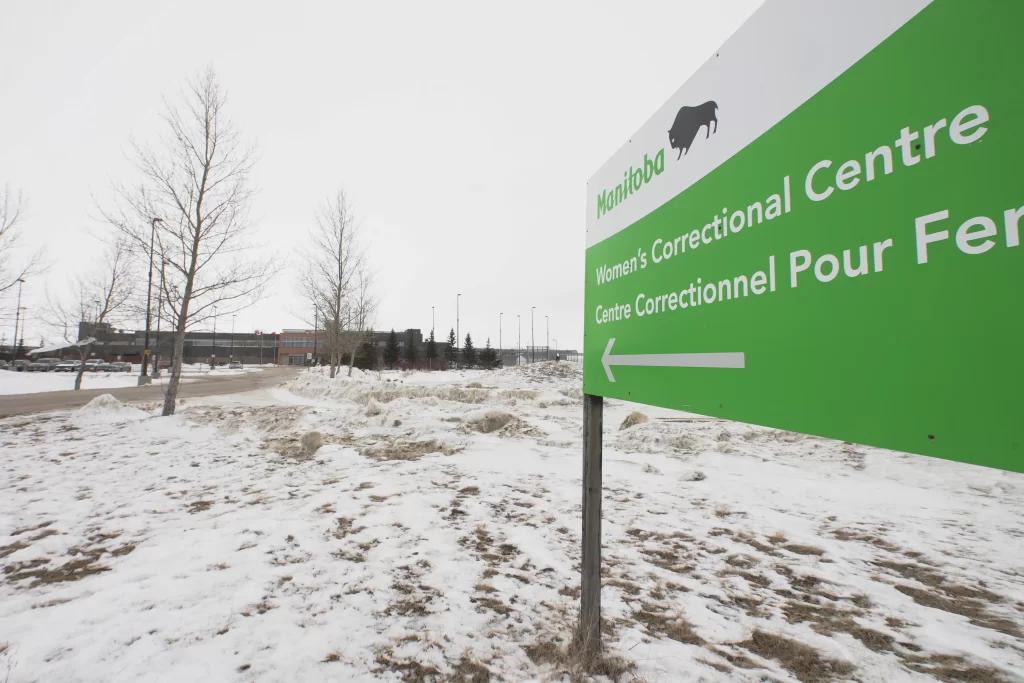
As of Jan. 9, 2026, there were 311 people at the WCC in Headingley, Manitoba, but the capacity for the centre is 196 people, according to an email from a provincial spokesperson.
Anderson said that her time in the WCC was just like a jail in the movies. There are lights on all night, sounds of slamming doors, surveillance cameras, and people fighting. She could be in a cell for 21 to 23 hours a day — something she believes took a toll on her mental health.
Quinn Saretsky, co-chair at the EFSM, a non-profit that supports and advocates for incarcerated women, said it’s easy to get into conflict with cellmates because of the cramped quarters.
“Any of us would start to lose our patience and snap. When you’re in custody, your bad days are public,” said Saretsky. “All of us have the benefit of having bad days at home by ourselves where we’re not on display and we’re not being judged for them. You don’t get that luxury in an institution.”
A correctional officer from the WCC said many incarcerated women are used to difficult living conditions because of their past experiences.
“For the most part, they seem to understand [overcrowding]. They come from the streets too, so they understand what’s going on,” said the correctional officer, during an online interview set up by the Manitoba Government and General Employees Union, which represents correctional officers in the province. The officer spoke on the condition they would not be named due to fear of repercussions with their job.
Saretsky said it’s difficult to expect that people who are going to prison are going to have an opportunity to learn something different. Inside they are still surrounded by other people who are modelling unhealthy behaviour and may use that as a survival strategy. Prisons instigate violence regardless of gender, they said.
“That’s why sometimes you hear prisons referred to as crime schools,” said Cormier.
Women sentenced to two years or more in custody have to go to a federal prison, but since Manitoba doesn’t have a federal women’s prison, the women have to serve their sentence out of province, where they are more likely to be far away from their families.
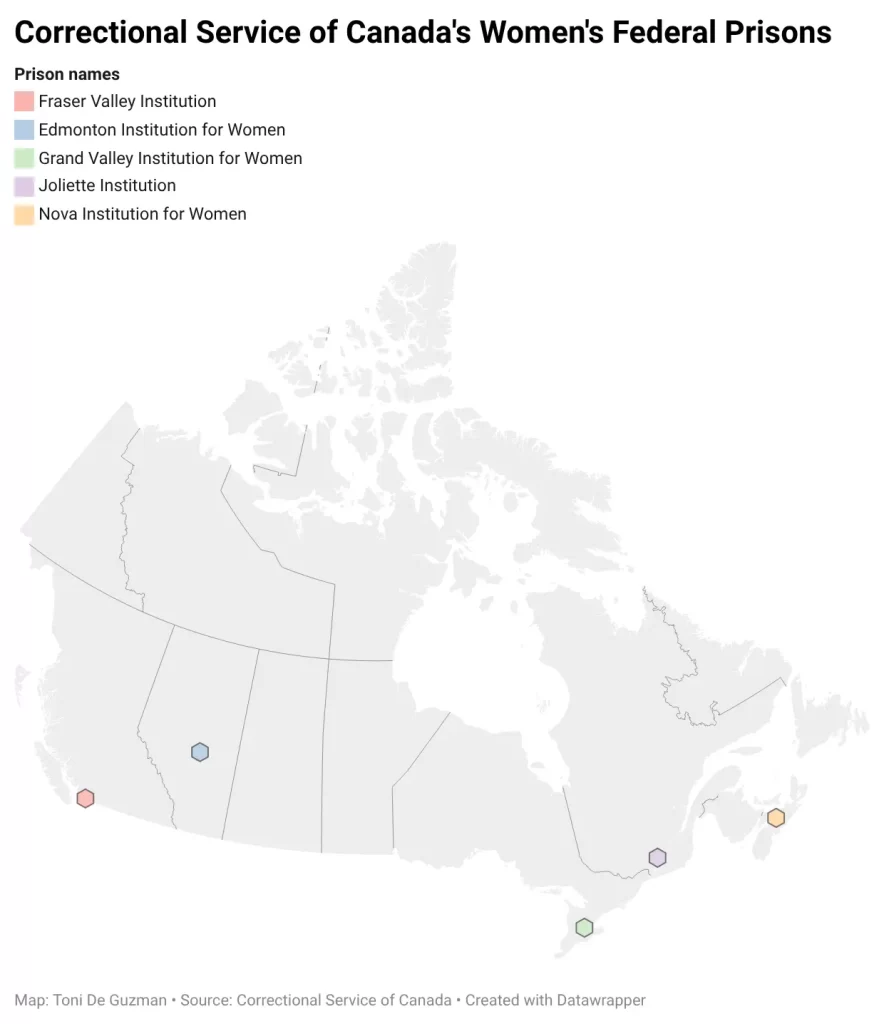
Anderson got transferred to Edmonton Institution for Women, a federal prison, in August 2024.
“I wish I could’ve done something different. I’m now in this position. I’m being taken away from my hometown, my home city, and I’m going to somewhere I don’t even know,” said Anderson, recalling the car ride.
At the same time she felt hopeful, because federal prisons have more programs, which could help her find ways to manage her mental health and addictions.
Program Promise and Reality
After she moved to the Edmonton Institution for Women, Anderson took part in a program with an Elder. She remembers them having her carry heavy bags in her hand and said it represented the baggage she’s carrying: child abuse, abandonment issues, addiction, and sexual abuse. The Elder then took one bag from her hand slowly, and Anderson started to cry as he explained to let things go.
“You learn a lot more from people that have experienced and been through things you went through,” Anderson said.
Anderson thinks if there were more resources like this there would be fewer inmates coming and going from institutions. Anderson recognizes that addiction and her tumultuous upbringing contributed to her incarceration, but knows they don’t excuse the crimes she was convicted of.
While programs can help people deal with the root causes of incarceration, getting into these programs isn’t straightforward.
“You have to be a golden child,” said Banfield.
Many incarcerated women are on waitlists for correctional programming and housing plans, which affects their eligibility for parole and their early release to reintegrate into the community, the Department of Justice’s website reports.
Cormier said the system is called “corrections” because the promise is to correct offenders, make them better people, but capacity for resources to work toward rehabilitation are not sufficient.
The slots in programs quickly fill up, so not everyone can participate, said Cormier. Because of long waitlists, inmates who can complete the program within the length of their sentences are prioritized.
The main programs are offered in group settings for up to 12 inmates, and they include topics like alcohol, anger management, healthy relationships, parenting, education about impacts of colonization, and relapse prevention. They are offered in five adult correctional centres in Manitoba, according to the Auditor General of Manitoba’s report on transitioning from custody in March 2025.
“Judges will often say to use your time in there and to take advantage of all the programming to deal with your addictions,” said Cormier, adding that people may be going to jails and prisons with hopes of getting help but find out that’s not often the reality as they may not able to take advantage of the programs.
The EFSM is one external organization that offers programs in the system. For example, its community bail supervision program offers women the chance to wait for their trial in community rather than the Winnipeg Remand Centre — but getting into the program can be difficult.
The Elizabeth Fry Society’s bail program can house up to 13 people, but the demand is beyond the program’s capacity, according to the EFSM community bail supervision report. The program receives around 20 referrals per month but only a fifth of the applicants are accepted.
The program is especially helpful for accused people who have no fixed address. The court process is even harder for them: keeping track of the date and time, showing up to court, holding a job when in custody, getting bail, and meeting those conditions are even more difficult when you are unhoused.
Ninety-eight per cent of bail violations are breaches of release conditions or a failure to attend court, according to a 2017 Justice Canada study. These breaches cost taxpayers $807 million annually, according to a 2018 Department of Justice Canada Research and Statistics report.
Anderson started her current sentence in May 2024 at the WCC, was transferred to the Edmonton Institution for Women in August 2024, and is now at the Eagle Women’s Lodge in Winnipeg.
Healing lodges are specifically for incarcerated Indigenous people. They offer programming centred around Indigenous teachings and ceremonies led by Elders, and some are Indigenous-run. The Indigenous community created healing lodges over concerns that the mainstream federal programs didn’t work for them.
There are 10 healing lodges in Canada, and the one Anderson is in can accommodate up to 30 women, according to its website. The Truth and Reconciliation Commission of Canada’s (TRC) call to action No. 35 calls for more of them. The hope being that culturally focused supports will lead to better results.
Trying to Break the Cycle
Programs only go so far when incarcerated women are released back into the same poverty, housing, and trauma that led them there.
“It’s going to remain a repetitive door in and out, because we’re not helping them in any way. They’re still going back out to struggle,” said Banfield.
It’s been more than a decade since the TRC released its calls to action. No. 30 called on all levels of government to eliminate the overrepresentation of Indigenous people in custody. It remains unfulfilled.
For Anderson, the overrepresentation is personal. It’s her. It’s her son.
When Anderson’s eldest son was also getting caught up in the system, she said it was painful seeing the cycle repeat:
“I don’t want it to go on to my other kids, my grandchildren, and my great grandchildren,” said Anderson. “[My son] didn’t have the tools, so he learned how to become street smart and how to take care of himself and his little brother. It’s just a repeating pattern.”
Sometimes at night while Anderson lies in her cell, she cries from missing her kids and four grandchildren. She wonders what’s happening out there — where her family is, how they are, and when she’s getting out.
“Now I’m 44 years old and I’m still in the system… Maybe if they would have just left me at home and not interfered with my life and just let me be at home — I always wondered what my life would have been like then.”
She hopes one day to be there for her kids. “I know I wasn’t there before, but you know, at least I could try to be there now. It’s never too late,” said Anderson.
To keep herself going, Anderson writes letters, prays, beads, and journals. Her cellmate taught her how to bead lanyards and earrings, which helps her manage overthinking and stress.
“All I know right now is I’m living one day at a time,” said Anderson. “I’m still trying to get up for myself. I won’t know until I’m truly free.”
Anderson is set to finish her sentence in 2031, but could be eligible for parole before then.