The Power of a Killer Outfit
The character of the Final Girl has been a horror staple since the classic slasher movies of the ’70s and ’80s. What does what she wear say about her and how has it changed over time?
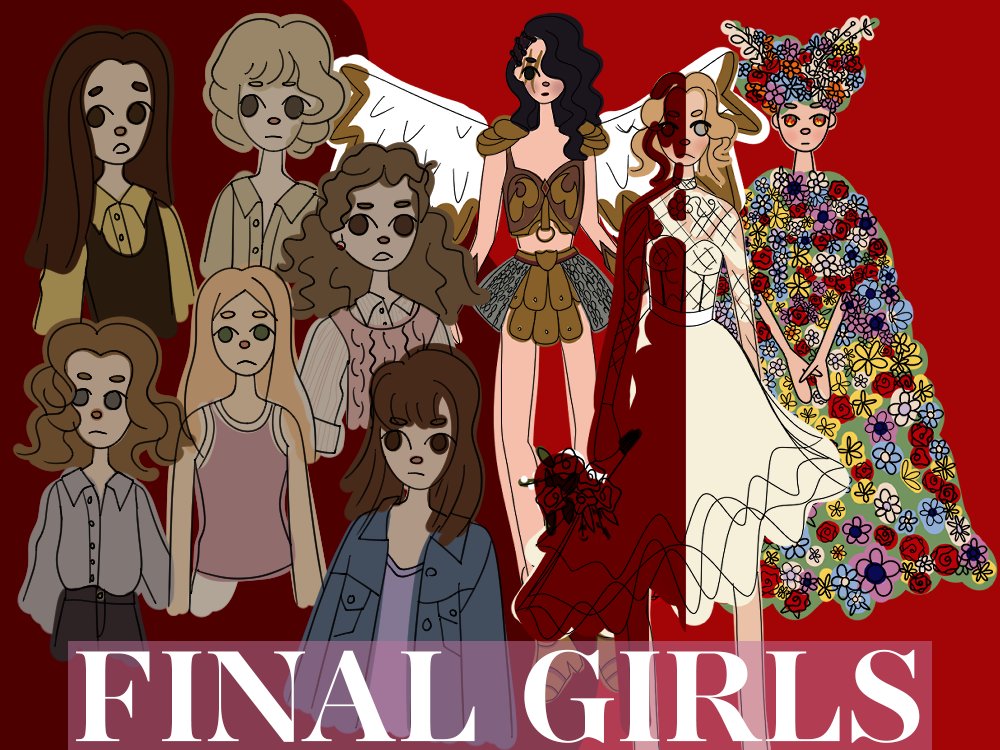
Listen to the story:
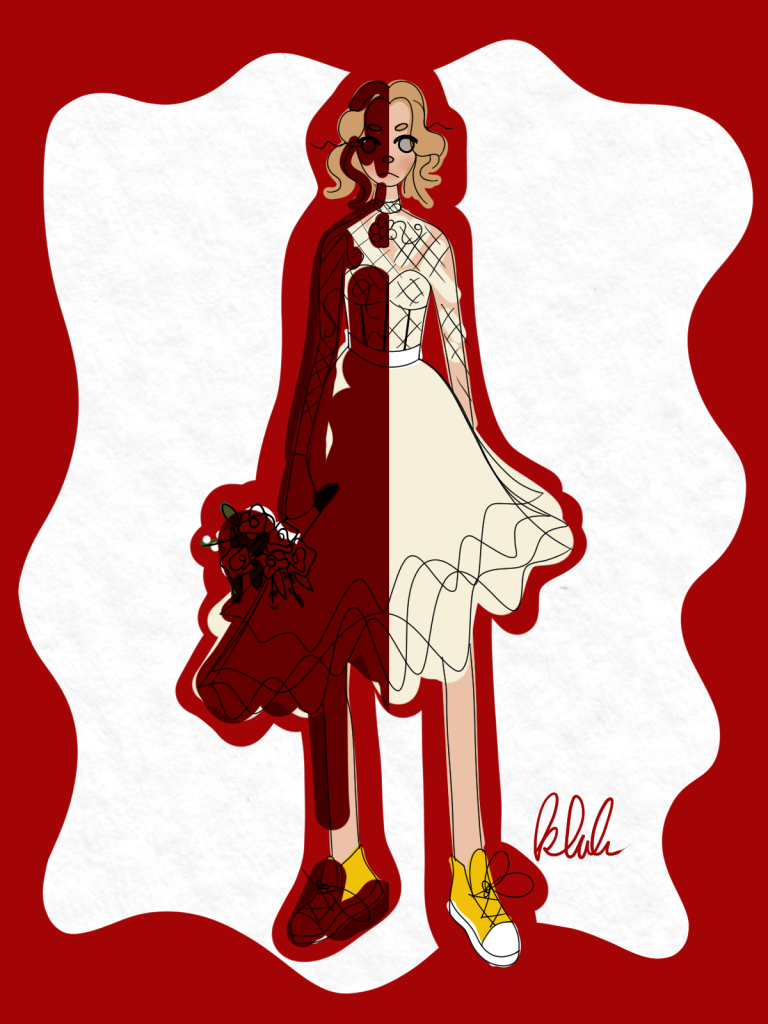
A woman sits on the steps in front of a burning mansion. Her previously-white floor-length wedding dress is torn and distressed beyond repair. The delicate lace is blood-soaked, and her high heels have been switched out for a pair of equally-bloody yellow Converse.
As the fire rages behind her, she pulls out a cigarette, smoking it nonchalantly. A policeman comes up to her and asks what happened. After a long pause, she responds with a single phrase:
“In-laws.”
I’ve always loved fashion and costume design, but it wasn’t until seeing Grace, the bride in question from Ready or Not (2019), a black horror comedy, that I started to really think about the connection between costumes and character development. Horror is a genre that relies heavily on its ability to be as visual as possible; a movie’s lasting impact usually lies in the visuals you’ll never be able to unsee, for better or for worse.
It wasn’t until high school that I watched my first horror movie. Since then, I’ve watched and rewatched dozens of horror movies in many different genres, but one sub-genre that has become my favourite is slashers: movies where a killer is literally slashing through the main cast. The kills are back-to-back and often violently creative; basically, it’s a one-hour-plus gore fest.
A good slasher is never lacking in personality. A brutally fun villain is the heart of every slasher, but the villain would be nothing without their other half: the Final Girl. The Final Girl is often the character with the most dynamic character development out of everyone, including the killer. One of the most significant ways to show this development is through what she’s wearing. From the simple to the extravagant, nothing is accidental. Sometimes all it takes to best communicate the journey these characters go on is a pile of fabric and some artfully-placed threads.
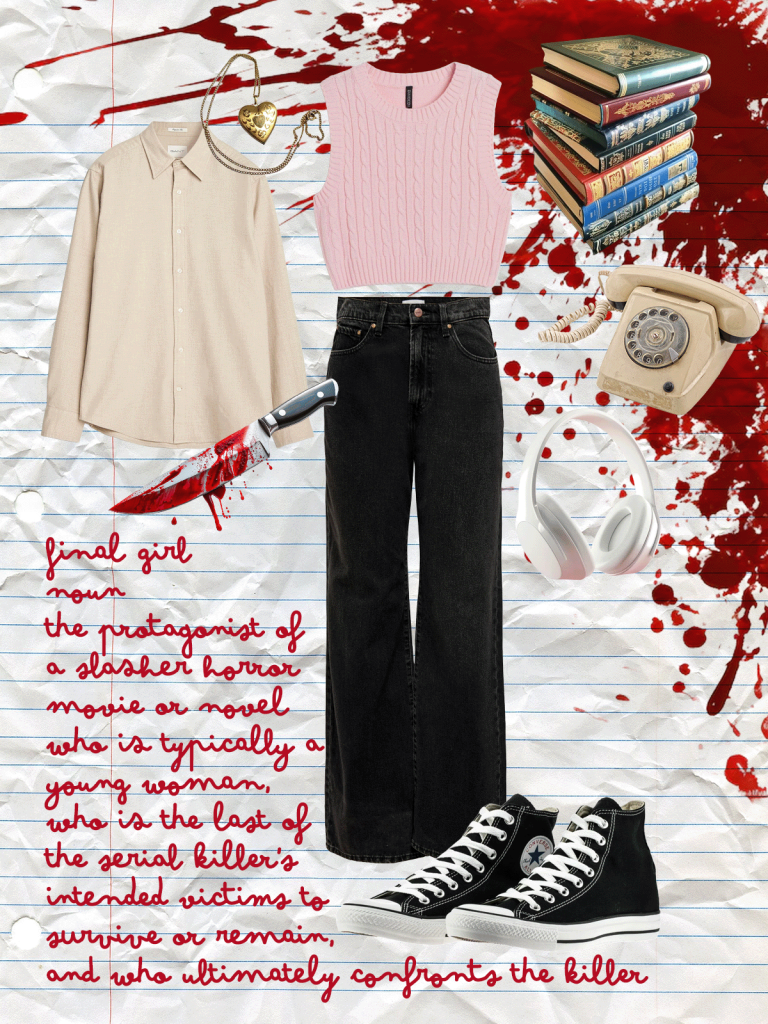
What is a Final Girl?
Outfit of the Day (OOTD): A loose sweater, jeans, and practical sneakers that could pass any high school dress code with flying colours
By the end of the movie, the rest of the cast is reduced to being nothing more than a bunch of background bodies, except for the sole survivor — the Final Girl. She is the last character alive and the one who ultimately confronts the killer. The Final Girl also gives the audience a first-person perspective on the nightmare unfolding. While we only see the other characters’ experiences from the outside, we’re with the Final Girl through every second, seeing and feeling what she does.
The term “Final Girl” was coined in 1992 by Carol J. Clover, an author and film professor, in her book, Men, Women, And Chainsaws: Gender In The Modern Horror Film. The Final Girl is the one who survives and is put through the most at the hands of the killer. As Clover describes her, “She is the one who encounters the mutilated bodies of her friends and perceives the full extent of the preceding horror and of her own peril; who is chased, cornered, wounded; whom we see scream, stagger, fall, rise, and scream again.” She is the only one of the group who eventually comes face-to-face with the killer. Using all her fresh experiences, she’s able to come out of this confrontation broken, but victorious.
The first true Final Girls are Sally from The Texas Chain Saw Massacre (1974) and Jess from Black Christmas (1974). The trope grew from there, becoming a core part of 1970s and ’80s horror, which was dominated by slashers. Laurie from Halloween (1978), Alice from Friday the 13th (1980), and Nancy from A Nightmare on Elm Street (1984) are core examples of Final Girls from this period. The last of the classic Final Girls is Sidney from Scream (1996), who is often named as people’s favourite Final Girl and is a huge influence on how the trope has developed. It’s become harder to define who and what a Final Girl is, but there are still some core criteria.
First, it has to be horror. Many movies have female main characters who survive until the end, but Final Girls are horror-exclusive.
Second, she has to survive. Some Final Girls have ambiguous endings where she may or may not have died or she canonically dies later in her franchise, but as long as she doesn’t have a confirmed death in her first movie, that’s all that matters.
Lastly, she has to have a confrontation with the killer at the end. This is the movie’s pivotal scene, and while she may or may not be the one to kill the killer, it’s the moment the power dynamic switches and she goes from victim to the one in control. Without this scene, a Final Girl is just a girl who survives.
Traditionally, Final Girls are mousey wallflowers, especially compared to everyone around them, and they look the part perfectly. Classic Final Girls typically dress in very conservative outfits, and their style often leans more unisex. Think girl-next-door: plain outfits in some combo of jeans, sweaters, and button-downs. Their clothing also often looks nearly identical to each other and remains virtually unchanged throughout the movie, besides becoming a little worse for wear. Many are also high-school or college-aged, which really doesn’t help differentiate one from the other. Despite these characters going through major character development, they’re never allowed to dress like it. While early Final Girls were progressive and powerful characters for their time, they weren’t allowed much definition or individuality.
For a long time, this plain aesthetic was a staple of the trope, but as Final Girls have become more diverse and complex as characters, their clothing style has changed too. While the average everyday girl-next-door look is still present in modern Final Girls, the way it’s shown and been allowed to develop has evolved. Whether a modern Final Girl begins her movie looking like her classic counterparts or not, the difference comes by the end of her movie, where her clothing is unrecognizably changed by what she has experienced. An outfit is worth a thousand words, and many of the most impactful Final Girls can be summed up by a final costume that symbolizes the dynamic force of nature she has become.
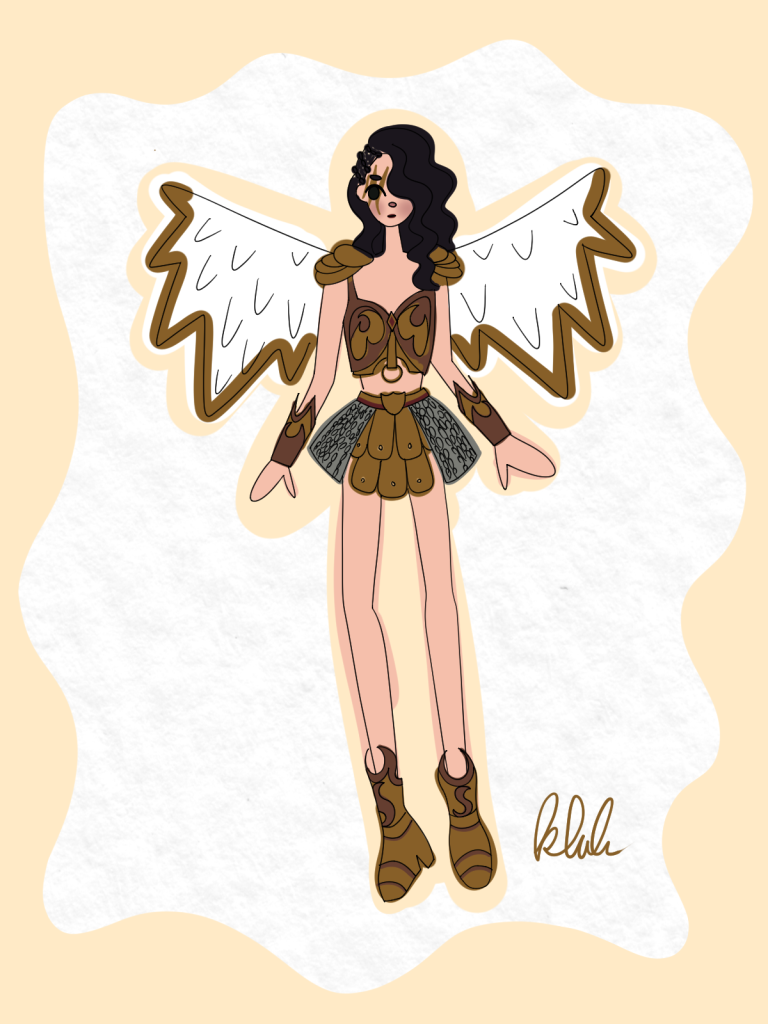
Act 1: Sienna
Outfit of the Day (OOTD): A handmade angel costume: Large white wings with golden tips and golden armour consisting of a cropped breastplate and miniskirt
While there are many Final Girls I love, Sienna Shaw from the Terrifier franchise is my favourite. She first appears in Terrifier 2 (2022) and changed my entire view on the franchise overall. For a long time I didn’t even want to try watching it because it just sounded that disgusting. I eventually tried Terrifier (2016) out of sheer curiosity and I was right. It was an over-the-top nightmare to watch, and not in the fun way. The kills were some of the goriest I’ve seen, and none of the main cast were likeable. When your villain is Art the Clown, a serial-killing supernaturally-resurrected mime with -100 morals, you need to give people someone to root for.
Enter Sienna in Terrifier 2.
In this slasher, Sienna is a teenager who is dealing with the loss of her father. She lives with her younger brother, who is obsessed with serial killers, and her mother, who has become mentally abusive since Sienna’s father died. On Halloween night, after Art kills most of her friends and family, she is forced to confront him herself. Sienna is an incredibly powerful Final Girl, even coming back from the dead to finish him off. There’s no better visual example of this power and of who she is than her Halloween costume.
Sienna is artistic, and spends most of her time working on the costume — a golden-armoured angel designed by her father. In a scene where she gets ready to go out in the finished costume, we see a montage of her braiding her hair back into Valkyrie-style braids, swiping golden makeup across her face and arms, and finally, putting on the costume. Although her armour is made out of EVA foam, we hear the harsh and definitive sound of metal as she puts on each piece. This helps to emphasize the feeling that she’s not getting ready for just another Halloween. She’s preparing for battle.
Art, the villain, is evil incarnate, so naturally it makes sense to have an angel go up against him. By traditional Final Girl standards, this costume could have been left as surface level as possible; just your standard cutesy Spirit Halloween angel costume. Adding the warrior aspect highlights Sienna’s strength as well as her pure goodness. Many Final Girls take a bit longer to get to the point where they’re strong enough to confront the killer, but Sienna’s been ready for it since the beginning. Her costume is a visual reflection of who she is as a person and the power she holds as a Final Girl.
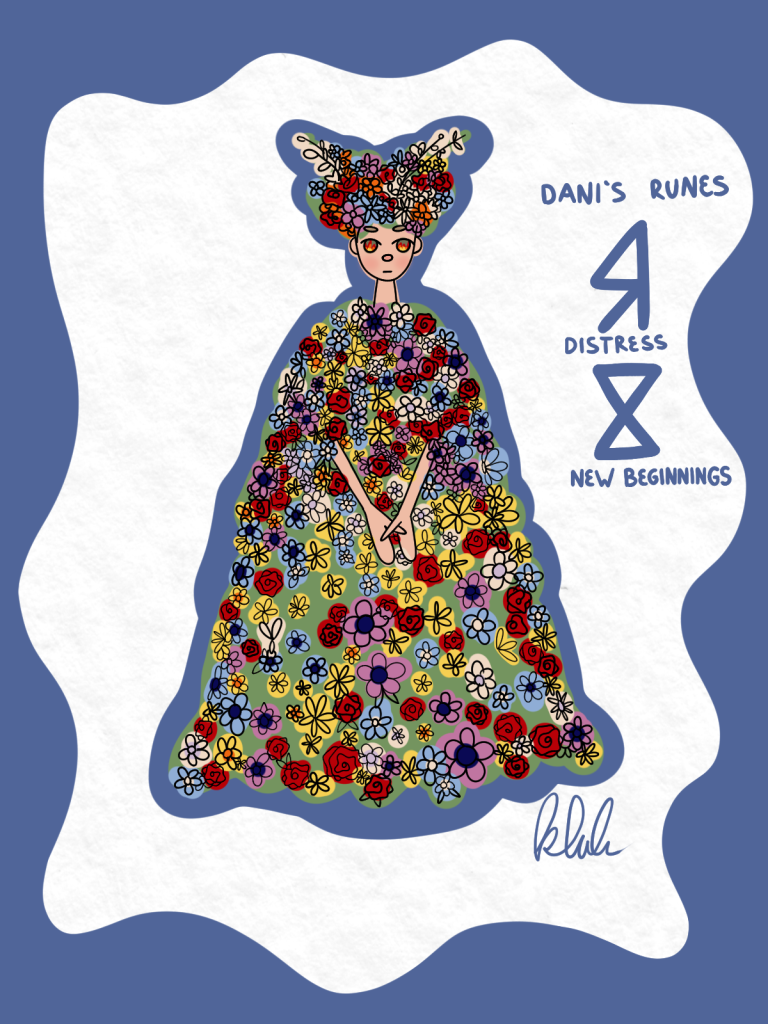
Act 2: Dani
Outfit of the Day (OOTD): A floor-length pyramid-shaped dress covered in flowers of every shape and colour, and an elaborate floral headdress
Midsommar (2019) is a folk horror film written and directed by Ari Aster. This is a movie I’m both disturbed by and in awe of. I might have only watched it once too if it wasn’t for its Final Girl, Dani. She’s one of the most complex and interesting characters I’ve seen in anything. Like Sienna, she is a perfect example of how a Final Girl can take a movie from good to great.
In it, Dani goes on a trip to Sweden with her boyfriend, Christian, and his friends. They’re visiting an isolated commune, revealed to be a cult, during the midsummer festival. Dani suffers from severe mental health issues, and Christian has been neglectful at best. He has been looking for a way to break up with her, but when Dani’s sister kills their parents and then herself, he decides to wait. By the time he’s ready to do it, Dani has found out about the trip to Sweden and instead of breaking up with her, he invites her along. While everyone else becomes sacrifices for the cult’s midsummer ritual, Dani becomes the May Queen and is given the choice of who to sacrifice: a random cult member or Christian. She chooses Christian, which leads to the final scene where she sits watching the building with him and the other sacrifices inside burn to the ground.
The key costumes that highlight Dani’s character development are both of her May Queen outfits. She begins the movie wearing casual outfits made up of plain sweaters and tops, and pants in muted neutrals. At this point, she has just lost her entire family in a matter of hours, and the one person she has left doesn’t even want her around. She’s not the only one seen wearing this style of clothing in these colours, but the specific combination of style, texture and colour, as well as the timing of when she’s wearing them, is significant. This seemingly simple wardrobe choice is purposefully designed to show us how intense her depression has become. There are times that she is able to play it off and seem okay, but that illusion can shatter at the smallest comment or incident. No matter how okay she seems, pre-cult Dani is always wearing this style of outfit; her instability is always there under the surface, ready to break through.
When she becomes more involved with the cult, she begins to wear the traditional clothing given to them by the cultists, and her wardrobe brightens up significantly. When the costume designer for Midsommar, Andrea Flesch, began to design both these and Dani’s May Queen outfits, she did extensive research into Swedish folk clothing. Two key aspects of Dani’s clothing after this shift are florals and the colour white. Compared to Dani’s previous colour palette, her new clothing is a complete 180: it’s bright and otherworldly, and helps to foreshadow her new start. She is trying to free herself from the pain she has experienced and move forward. However sinister they actually are, from her perspective the cultists are welcoming her into their family, and this new wardrobe is visually symbolic of her eventual rebirth. Once she is crowned as the May Queen, the small floral crown she had been wearing before is exchanged for a large and intricate floral headdress. Her simple white dress also becomes adorned with flowers. This is the point when we see her fully shift into her new life.
A small but crucial detail of the costumes is the runes. Using a fictional language, Affekt, and the runic alphabet that was created for the film, Flesch made sure the runes were a key part of the costumes. Every member is given their own unique set of runes and has them embroidered on their clothing. Flesch describes these runes as the character’s personal story. The runes Dani receives are both inverted, which means that they have the opposite meaning of what they normally would. Her first rune is in the shape of a R, and when inverted, represents distress or death. Her second rune is in the shape of an hourglass. This rune typically represents a new beginning, but when inverted like it is for Dani, it has a much more negative meaning — hopelessness. When combined, these runes summarize Dani’s journey. At the beginning of the movie, she is consumed by her grief at the loss of her family, but by the end the cult has given her a new beginning. But it comes with an undeniable sense of hopelessness.
Her final costume, the flower dress, is the most elaborate and dramatic of everything she wears, wrapping up her character development as a Final Girl. It is a large pyramid-shaped base covered in around 10,000 flowers with a hoop skirt underneath. Flesch says the goal of this dress was to make it “look as if she’d just put on the whole meadow.”
Dani survives her movie, but in a different way than many other Final Girls do. While others escape their nightmare, she becomes a part of hers. In ways, she has freed herself from what her life was like at the start of the movie. She has a new family and has gotten out of her toxic relationship (even if there are probably better ways to break up with someone). On the surface, there’s power in those things. However, while the combination of the colour palette and the flowers may paint a pretty picture of rebirth and purity, no amount of flowers or bright colours can hide the truth — Dani has survived one nightmare only to immediately enter another. Even if it’s just for a second, though, she has been allowed to take back her life and feel some sort of freedom. It’s a tragic ending by Final Girl standards, but after going on this journey with her, part of me still wants to celebrate and root for her, just a little bit.
Act 3: Grace
Outfit of the Day (OOTD): A once floor-length wedding dress now soaked in blood and torn beyond repair, and equally bloodied yellow Converse
I have a soft spot for dark humour and pretty dresses so there was no way Ready or Not (2019) wasn’t going to be something I loved. It’s a black horror-comedy about a former foster kid, Grace, on her wedding day. She is marrying into the Le Domas family, an uber-rich family with a fortune built off their gaming legacy. After the wedding, she is told by her new family that according to a family tradition, she needs to pick a card and play whatever game comes up on it. After picking hide-and-seek, it is revealed that the family are satanists. Grace picked the one bad card and now as part of the deal they made, they think they have to either kill and sacrifice her before dawn or die themselves.
Grace only has one outfit she wears in this movie — her wedding dress. This one dress is more dynamic than most, though. It’s also not just one dress.
Avery Plewes, the costume designer for Ready or Not, actually made 24 different dresses to create the illusion of one dress transforming and deteriorating over time. Over the design process, the dress ended up becoming its own character entirely. It was made in five parts: a lace top, corset, sash, lining and an overskirt. This allowed her to mix and match pieces as needed to fit whatever situation Grace found herself in.
In its first form at the start of the movie, it is long and elegant. Grace Kelly and Kate Middleton were both credited as inspirations. Kate Middleton’s 2011 wedding dress inspired much of the design, while both her and Grace Kelly’s beginnings as commoners who married into royalty inspired Grace as a character. Another surprising inspiration behind Grace’s dress is Bruce Willis’s tank top in Die Hard (1988), a piece of clothing that goes through a similar transformation.
While Grace didn’t become a princess, I think the jump from foster kid to married into a family of billionaires is close enough. Her yellow Converse were added in as a subtle nod to her backstory. While her heels are a representation of how she wants to present herself to her new family, her Converse are indicative of where she comes from.
Because we never actually see Grace wearing anything besides the wedding dress, details like the yellow Converse are crucial to revealing who she is. The Grace we’re introduced to is an extravagant and elegant bride, so it’s easy to forget that it’s probably not a good representation of what her style is like on an everyday basis.
Plewes designed the initial dress to have a high neckline as a bit of “armour” for the vulnerable Grace. As a former foster kid, a family is something Grace has always wanted, and whether she likes them or not, she’s going to make sure she does whatever she can to make them like her. It’s at this stage, in the very beginning of the game, that she ends up accidentally ripping her dress for the first time when climbing out of a dumbwaiter she was hiding in. This is the only case where she was genuinely upset about it, however.
For the rest of the stages, she destroys the dress to her heart’s content. It becomes ripped, soaked in blood; whatever the situation demands. This destruction can be symbolic of a couple of things. Partly it shows Grace’s resourcefulness: she takes something and adapts it to be whatever she needs at that moment. It also illustrates Grace’s mental state as what she hoped would be her dream-come-true quickly turns into her personal hell. One especially impactful image is of Grace in her second-stage wedding dress with an old-fashioned rifle over her shoulder. She has it in the movie for maybe five seconds, but it was used in nearly every bit of marketing; it’s a memorable way to show how resourceful and strong of a character Grace is. She fights back and uses her environment to her advantage, perfectly shown by her transforming wedding dress.
The look of a Final Girl
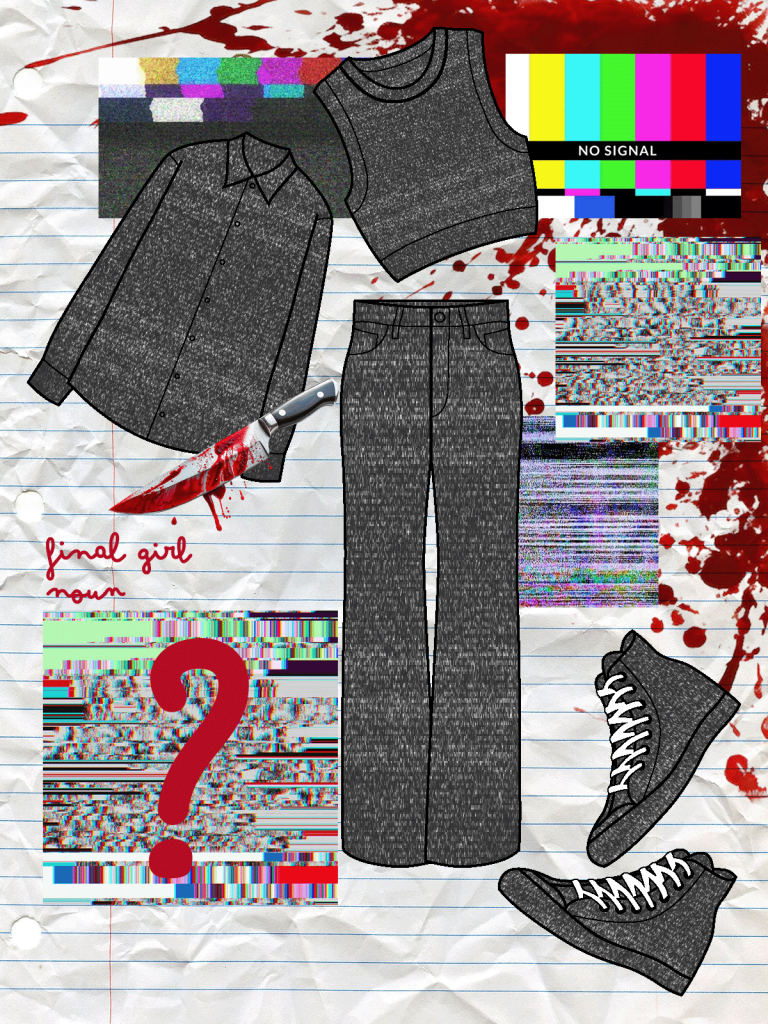
Outfit of the Day (OOTD): Whatever she wants it to be
The expectation for early Final Girls to be innocence personified stops them from being able to be the defined individuals they deserve to be. Ultimately, the only significant flaw they were allowed to have is being too sweet, too timid.
Modern Final Girls have broken out of this mold and there are now examples of the trope at every age and life situation, and with every personality imaginable. They’re also now fully formed characters, with real struggles and flaws. At the end of the day, the Final Girl is intended to be relatable, but also aspirational. Over the course of the movie, we watch her go from someone we empathize with to someone that we might hope to be one day.
It’s through clothing that the evolution of Final Girls from conservative and static to bold and dynamic is best illustrated. “Show, don’t tell” is one of the golden rules of cinema; it’s how we truly learn about and connect with the characters. Whether it’s a handmade angel costume, a traditional flower-adorned cult garment, a transforming wedding dress, or something else entirely, sometimes a cool outfit is all the “show” you need.