Once Upon a Mind
For years I believed escaping into fantasy meant I was avoiding my problems. Only later did I realize my mind wasn’t failing me, it was trying to survive the waves of borderline personality disorder.
Listen to this story:
Once upon a time, in a land surrounded by towering trees and glittering rivers, there was a castle that looked perfect from afar. Travellers would pause on the road to marvel at its shining towers and blooming gardens. They would say, “A happy young princess must live in a castle of such beauty and wealth.”
And yes, there was a princess.
She had her own chambers, fine dresses, and shelves of books that carried her mind far beyond the castle walls. But when the sun dipped and the torches burned low, something inside the princess shifted. The castle, for all its structure and order, could not quiet what moved beneath the surface of her mind.
The princess did not know where it came from. She only knew it had always been there.
As a child, she had to learn to listen closely, to read faces, and body language. She learned to reach for approval that seemed to always move out of reach just as she got close. She tried to be perfect. She tried to guess the rules before they were spoken. She tried to shape herself into something that those around her deemed right.
And as the heir to the kingdom, it was her duty to do the right thing, no matter what. She always agreed to attend gatherings she dreaded, smiled when she was tired, and thanked people who dismissed her. She quickly learned to smooth tensions before they arose, to make herself smaller when others grew loud. She never said no to those in need of aid, and because of that the kingdom praised her kindness, never noticing the cost.
But the princess had always been a sensitive soul. Someone who saw things differently than others around her. Some days that difference made everything inside her feel louder and harder to hold, and when the noise became unbearable, the princess escaped to the river.
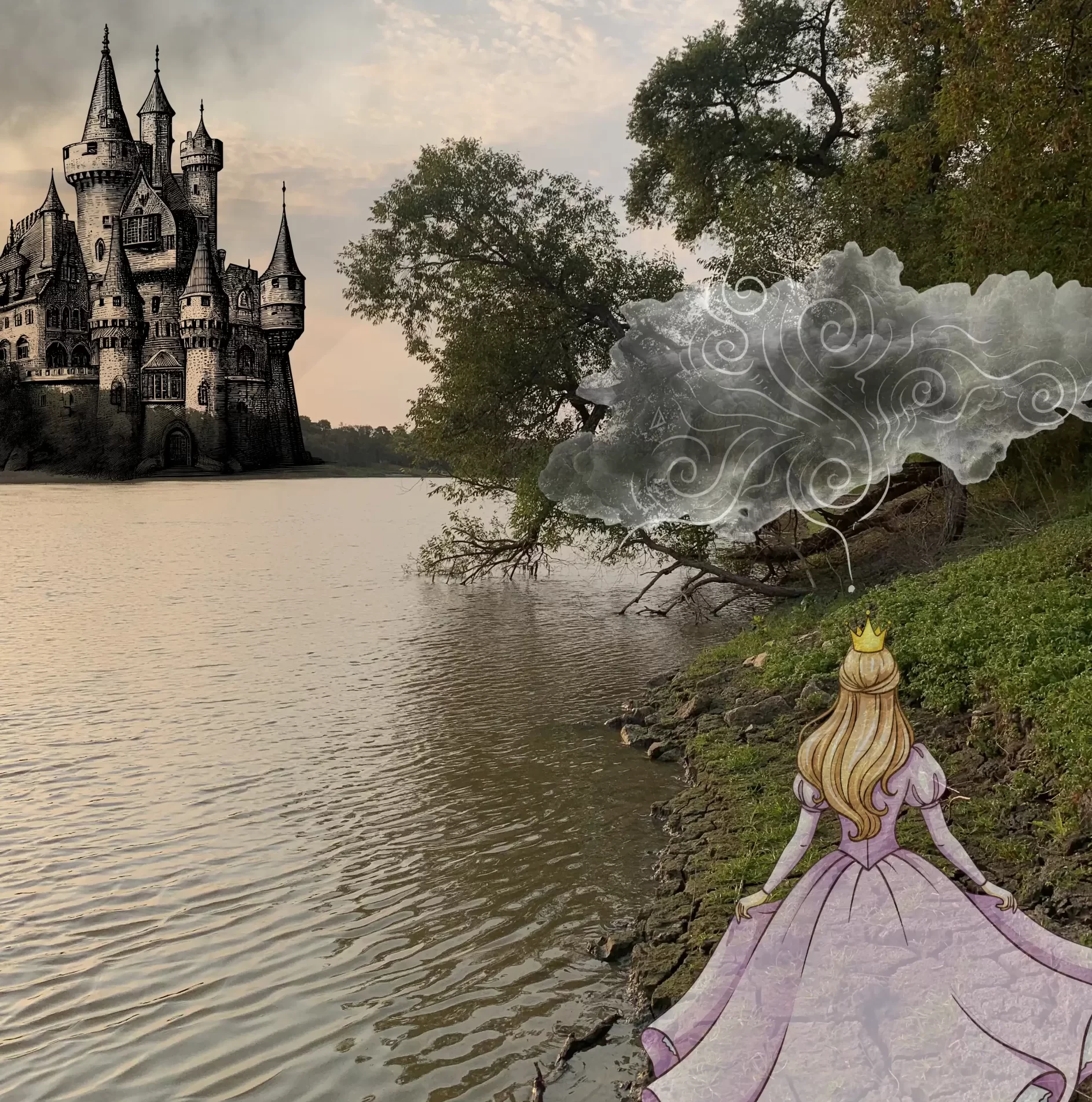
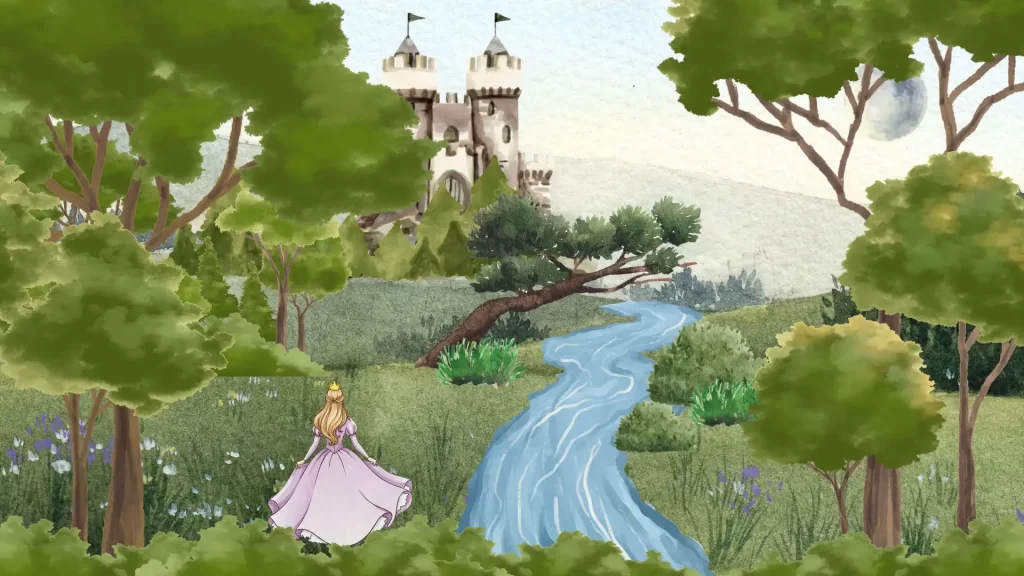
It flowed through the forest just beyond the castle grounds, a babbling ribbon of water that offered refuge without judgment. She would sit for hours on its soft green bank with her storybooks. The books made the princess feel understood. In their pages, she met girls who felt emotions deeply and survived them. Warriors who were messy but brave. Worlds where monsters could be named and understood, where pain had meaning.
Reading gave her language for feelings she didn’t yet understand. It helped her sit on the bank and breathe. And for a while, that was enough.
When she was young, she could sit still on the riverbank, content with reading her stories and watching what floated past. Leaves drifted through the crystalline waters, branches rolled along, and sometimes whole trees rushed by.
The princess paid no mind to the debris in the water, and she didn’t feel the need to chase the leaves or grab the branches. She trusted that the river would carry everything where it needed to go.
As time went on, the river did not change — but her relationship to it did. Where she once sat on the bank content to dive into her stories, she now felt the urge to move. A leaf would float past and she would think, I need to catch that, it could clog a fisherman’s net. A branch would move with the current and she would think, If I do not grab that it could hurt a small child playing in the shallows.
Even though it was just a river and just leaves, her mind wrote disasters faster than the current could carry them away.
So, one day, she stepped into the water.
For a long time, I thought escaping my mind was something I needed to change.
I thought it was proof that I couldn’t handle the real world the way other people could. I was worried that when my emotions became too much, disappearing into fantasy books meant I was avoiding my problems rather than facing them. Now I know that my mind wasn’t failing me; it was compensating.
I was diagnosed with borderline personality disorder (BPD) about five years ago at one of the lowest points in my life. Clinically, BPD is a mental health condition that affects how someone experiences and regulates their emotions. According to the Cleveland Clinic, people with BPD have intense emotional responses that build quickly and are very difficult to control, a deep fear of abandonment, and an unstable sense of self. Joy feels euphoric. Sadness feels like a bottomless pit. Fear feels like life or death. From the outside, BPD can look chaotic or dramatic, but inside, it feels like living with your emotional volume knob stuck all the way up.
BPD develops early in life when emotions are misunderstood, minimized, punished, or left unsupported. When the environment around a child feels unpredictable, the child grows up never knowing which version of the world they will wake up to, so their nervous system learns to stay on high alert all the time. Hypervigilance becomes a survival tool, and emotional sensitivity becomes a way to read perceived dangers quickly. Without the tools to navigate those tidal waves of emotion, a person can drown in them.
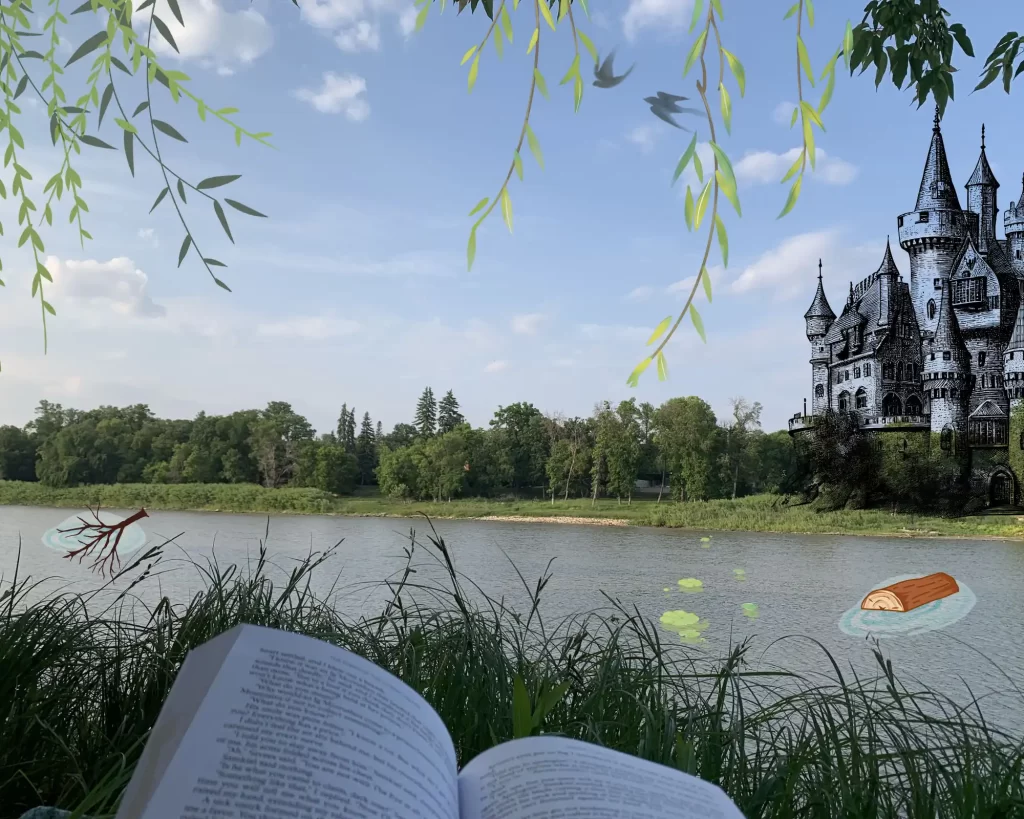
At first, the princess would only wade in up to her ankles. She could still climb back out, soaked but steady.
A few years crept past, and each day, after her lessons in the castle, after the etiquette, the history lectures, and the reminders of what was expected of her, she would sneak away to the river with a book — determined to rest and be the girl she used to be at the bank. But she couldn’t ignore the river.
The moment she would sit down, her eyes would drift to the moving water. A leaf. A twig. A log. Her thoughts would tighten around what she was seeing like a fist. That could become a problem. If I don’t fix it someone could get hurt. It would be my fault.
Soon, instead of reading, she started setting her books beside her and venturing into the chilly water chasing whatever floated past. She’d wade deeper and deeper, the current wrapping around her calves, her knees, her waist, attempting to pull her under.
And then one afternoon, she slipped.
Her foot skidded on the slick stones, her body tipped, and she went under. Cold water filled her mouth as she tried to scream, but the river swallowed the sound. Above her the surface shimmered, too far to reach. Over the roar of the current she swore she heard something whisper. Not a ghost or a spirit, but her own thoughts sharpened into certainty: You should have known better. You ruin everything. You’re too much. You’re never enough.
Panic crashed through her and she fought wildly until she burst through the surface and swam slowly to shore. She stayed there for hours, tears streaming down her face. Not delicate tears, but raw sobs dragged up from somewhere deep inside her, a place that she’d always tried to keep hidden.
Later that night, when she finally managed to drag herself back to the castle, the princess could not sleep. Every time she closed her eyes, she felt the helplessness of being pulled under the water followed by shame for being helpless in the first place. Above all else she felt fear. Fear knowing that her own mind, which could create such beautiful worlds, could just as easily turn against her.
It was that night the princess vowed she wouldn’t return to the river’s edge.
Before anyone told me about borderline personality disorder, I wore other labels: general anxiety disorder, depression — all cloaks that almost fit. They explained pieces of me, the dread and racing heartbeat some afternoons, and the heaviness that made other mornings feel impossible. But they never explained the speed of it. How quickly I could go from being okay to completely unravelling and back again. How a silence in a conversation felt like abandonment. How in seconds my brain could turn a small moment into a disaster that my body would react to as if it were real.
BPD is defined by a pattern that unfolds over time. The violent swings of emotion can seem like anxiety or depression at face value. According to this article from Psychology Today, BPD often overlaps with other mental health conditions, like anxiety disorders, trauma-related symptoms, substance abuse, and mood disorders. Therapists and psychologists tend to treat the loudest symptoms first. If someone comes to them depressed, they treat depression; if someone is anxious, they treat anxiety. That doesn’t mean the diagnosis is wrong — it means it’s incomplete. BPD isn’t always the first thing you see, but it becomes clearer after you’ve watched the pattern repeat itself again and again.
Age complicates things further. Many of the symptoms of BPD — like emotional intensity, identity confusion, unstable relationships — can look like normal adolescence. This makes mental health professionals cautious about diagnosing BPD in young people. As a result, I grew up collecting partial explanations. I was told I was anxious, depressed, sensitive, dramatic, and reactive.
When I finally heard the words “borderline personality disorder,” it felt like someone had shown me the full picture. It felt like context.
As years went by, the princess remained steadfast in her vow not to return to the river. Without the one place she had learned to breathe, she sought comfort elsewhere. When she could sneak away from the pressures of the castle, she went to the village. It was a loud, bright place full of movement. Music spilled from tavern doors; lanterns lit the streets and laughter echoed through the air. In the noise, the princess felt briefly unburdened. She met new people, but they loved her for what she could give them, not for who she truly was. They loved her attention, her counsel, and her coin. But the princess didn’t care. She just wanted the noise of the real world to be louder than what was happening inside her head. She would share wine with these new companions, and that helped soften the edges of her world. But she would wake in the morning feeling even more hollow.
By the time the princess was nineteen years of age, she had lost herself completely. She didn’t know who she was anymore. One day she was praised and felt like she could fly, the next she was criticized and she wanted to disappear. Her sense of self shifted with every gaze, every sharp judgement, every imagined disappointment.
And underneath it all, the current kept pulling.
Before I knew words like “emotional dysregulation,” “mindfulness,” or “distress tolerance,” I had my own strategies. “Escapism” often has a negative connotation, like disappearing into another world or avoiding reality is a bad thing. But for me, escapism was the first form of self-preservation I learned. When I was young and felt emotions so intensely, I found a metaphorical door wherever I could. For me, fantasy worlds were that door.
Therapist and writer Lindsay Braman has written about how imagination and fantasy can act as a form of emotional relief, a way to regulate stress and anxiety by giving the mind some distance from what feels unbearable. That doesn’t mean that fantasy fixes mental health conditions, but it can create breathing room, a pause, when your internal world is too loud.
But for me, escaping is a double-edged sword. Escapism becomes unhealthy when it turns into the only way I can cope; when the goal isn’t rest or creating a safe space, but rather total disappearance. When I stopped reading regularly as a teen, I didn’t stop needing an escape. I just ended up trading one form for another. That’s when alcohol and social media took over. I wasn’t partying for fun; I was doing it because it turned the volume down in my head. Social media became a sort of trance: Scroll until your brain goes quiet. Drink until the feeling blurs. Anything to avoid being alone with my own thoughts.
The thing about unhealthy coping mechanisms is they’re temporary — then they make everything worse. A systematic review published in the journal Cureus found links between certain patterns of social media use and negative mental health outcomes in adolescents and young adults. When people turn to social media simply to distract themselves, the constant stream of information and comparison can sometimes intensify anxiety rather than relieve it. The argument is not as simple as “screens are bad,” but the coping mechanism is part of a larger picture: what we are reaching for when we’re distressed, and what happens when those habits become compulsive? I didn’t scroll endlessly because I was bored. I scrolled because I was overwhelmed and the feed of information gave my mind something to focus on, something easier than my own thoughts.
Even imagination can get complicated with certain mental health conditions. Psych Central notes that an overactive imagination can sometimes make intrusive thoughts feel more real and intense. My brain doesn’t just imagine the worst-case scenario; it renders it in high definition. For someone with BPD, this can feel like your mind is telling stories so vivid they feel like facts.
They hate you. They are leaving. You ruined everything. My brain believed those thoughts, and my body would react as if it were true. So yes, I escaped. But what I was really trying to do was regulate something I didn’t yet understand.
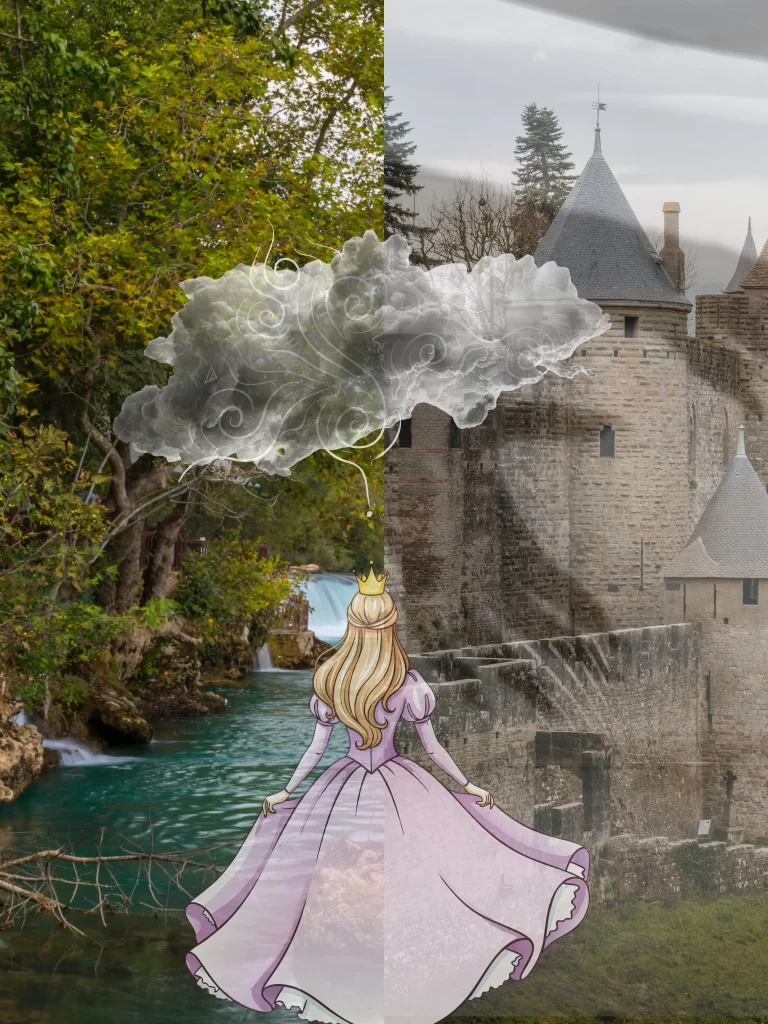
One night after hours of particularly horrible lessons in the castle, the princess felt a sadness unlike anything she had felt before. Without thinking, she left her chambers and ran through the castle and out into the night towards the river.
The moonlight touched the water’s surface like silver paint and the air was cool enough to sting. The princess stood on the bank that had once been a safe place for her and stared at the rushing water.
She was too tired to resist, so she stepped into the river. The water rose quickly around her legs, pulling at her dress, her hands, her hair. Her limbs moved slowly in the cold as panic flared then quickly faded into a heavy surrender. The water closed over her head. Then the whispers returned. You will always be too much. You disappoint everyone. You should be ashamed of who you are.
In its murky depths she suddenly felt a hand wrap around her arm. She felt her body jolt upwards toward the surface. Water exploded around her as she was dragged onto a grassy bank. Coughing, spluttering, and gasping for air, the princess blinked through tears and saw a woman standing over her.
The woman didn’t scold her or demand an explanation. She didn’t look afraid as the princess sobbed and trembled like a wounded animal. She simply said, “Come with me,” and wrapped a warm dry cloak around the shoulders of the princess. She led her through the trees, away from the castle and village to a small warm cabin tucked away in the forest. The woman gave the princess food and new clothes; she set a cup of tea in her hands and waited until the princess stopped shaking.
Only then did she ask gently, “What troubles you so deeply that you would walk into such dangerous water?”
The princess stared at the steam rising from her cup. She tried to answer like a princess was supposed to, composed and articulate, but the truth was not so neat and tidy. “There’s… something in me that feels too loud,” she said in a small voice. She swallowed, and her throat hurt from the river water, the crying, and the years of holding things in. “I feel everything too much,” she whispered. “I try to be what people want. But no matter what I do I feel like I’m failing and drowning in every emotion. I don’t even recognize myself anymore.”
The woman nodded slowly, as if the princess had said something familiar. “You are not the first I have talked to with this affliction,” she said.
The princess flinched at the word affliction as if it were confirmation she was broken. Her eyes filled with tears again. “Is there something wrong with me?”
The woman leaned forward, her voice steady. “There is something hurting in you,” she said. “And you have been trying to survive it without tools.”
The princess didn’t know of any tools that existed for something like this, for a mind that turned on itself, for pain that felt bigger than her body. But the wise woman began to teach her anyway. Not with spells or potions, but with practice. She taught the princess to talk about her childhood growing up in a castle with so many expectations, to talk about her trips to the river when she would chase things in the water in fear of the dangers they could pose. She talked about the people she had surrounded herself with after she ran from the river.
The wise woman listened. She told the princess to sit by the fire and breathe in patterns when panic surged. She taught her to press her feet into the ground and notice what was real and name what she felt without turning it into a prophecy.
“This is fear,” she said. “Not truth.”
“This is shame,” she said. “Not a verdict.”
“This is sadness,” she said. “Not an ending.”
The princess fought it at first. She wanted something written in stone that would erase the feeling forever. But the wise woman only sat there and repeated patiently, “Try again. I know you can do it.”
If you have never done Dialectical Behaviour Therapy (DBT), it’s hard to explain how strangely un-magical it looks from the outside. There are no dramatic breakthroughs, no grand moments of revelation. Mostly it’s just sitting in a room, learning skills that sound too simple to matter — until you realize no one ever taught them to you.
DBT was originally developed to help people who experience their emotions intensely and it’s widely used for borderline personality disorder treatment. It’s structured, skill-based, and built around a balance of two things that sound like complete opposites: you can accept that your pain is real and work on new ways to cope.
Research from Cleveland Clinic says DBT is usually taught through four core skill areas: mindfulness, distress tolerance, emotion regulation, interpersonal effectiveness.
DBT didn’t take my imagination away; it gave it a job. Before DBT, fantasy was one of my emergency exits. Now it’s more like a tool I use with intention. Reading becomes something I reach for after I’ve done the basics. After I’ve eaten, I’ve slept, I’ve checked in with myself, I’ve named what I’m feeling instead of becoming it. DBT helped me understand the difference between resting in a story and disappearing into one.
That distinction mattered because my unhealthy escapes were never really about the stories, or the social media likes, or the partying; they were about not wanting to be in my own head. Alcohol and endless scrolling weren’t just bad habits; they were my attempt at emotional anesthesia. DBT gave me options and ways to ride the feeling without drowning in it. And when fantasy is used with balance, when it comes after DBT techniques, it can become something gentle and sustaining. Fantasy can be a way to feel understood, to borrow courage from knights who survive impossible things, to learn from characters who doubt themselves, fight battles no one else sees, and keep going.
In my life now, the work is quiet. Some days, it’s pausing long enough to name what I’m feeling before reacting. Some days, it’s recognizing the moment my mind starts chasing a “leaf in the river” and letting the thought pass instead of grabbing it. It’s not that the current in the water disappeared. It’s that I learned how to live alongside it, without letting it pull me under.
After months of work, the princess sometimes still slammed the cabin door and fled into the trees, furious at the unfairness of having to work this hard to simply feel okay. Sometimes she cried until her body ached. Sometimes she felt hopeful only to crash into despair the next day. Each time she returned, the wise woman opened the door, no punishment, no disappointment, only, “Come in, it’s good to see you.”
Slowly, the princess began to learn the difference between standing on the bank and chasing things in the river. She began to notice the first urge, the moment her mind latched onto a leaf or branch and demanded that she chase it. She began to practice letting it float past.
One morning after many days that were hard and slow and ordinary, the wise woman handed the princess a book. It was a book the princess loved very much as a child.
“I haven’t read in years,” she admitted.
“I know,” the wise woman said.
The princess’s hands trembled as she opened it. She felt something like mourning maybe, for the girl who once sat by the river and found comfort in stories. She read by the cabin window as sunlight spilled across the floor. And as she turned the pages, she felt something inside her shift. Not because the feelings had disappeared, but because they finally had somewhere to rest.
A few days later, she returned to the riverbank for the first time in years. It was a sunny day, the air was warm, and the bank was lush and green. Wildflowers bobbed in the breeze like tiny nodding heads and a new cedar tree had grown where she used to sit, now offering shade.
The princess sat down with a book in her lap. The river carried leaves and branches as it always had, and she quickly felt the urge to stand, to chase, to grab the debris. But instead, she watched it and let it pass.
She opened her book, and for the first time in a long time, she read. The river kept moving beside her, and the pull was still there. Some days, it would batter her. Some days, it would whisper cruel things. But now she had learned something important: She was not the river. She was not the feelings that tried to pull her under.
She was just a woman learning to sit on the bank. As the sun warmed her shoulders and the story in her hands unfolded, the princess realized that survival would be quiet.
It could be practiced.
It could be hers.