Evolving Classrooms
Schools have been working to be more inclusive towards 2SLGBTQIA+ students, but many queer students have had to bear the weight of finding themselves on their own. Where do we go from here?
Listen to this article:
Kaiden Peters remembers sitting in the back corner of the practice room just outside his high school’s band class, clutching his guitar, not playing a single note. The dimly lit room was small and crammed with the noise of classmates talking and practicing their instruments. It was chaotic, yet Peters sat by himself lost in thought. A friend came to ask if he was ok. Peters burst into tears and the room fell silent.
“I didn’t even know how to explain myself, because I was just so depressed at the time I couldn’t manage anything,” said Peters.
His friend comforted him. After collecting himself, Peters opened up, explaining his gender dysphoria had led to severe depression and made school life extremely difficult. Gender dysphoria is when someone experiences extreme emotional distress because their gender identity doesn’t align with their sex assigned at birth. Peters, who has now transitioned from female to male, describes the feeling as always being uncomfortable in your own skin.
After consoling him, Peters’s friend suggested he’d feel better if he went to his school’s office and asked to have his name changed in the system. He rejected the idea at first but finally went after some encouragement from his friends.
“I was just finally in a dark enough place where I had a hard enough time going to school as it is. I was just so uncomfortable and overwhelmed,” said Peters.
Peters went to Miles Macdonell Collegiate and started transitioning in Grade 12. Once he had his name changed, a staff member asked if he’d also like to speak to a counsellor, who gave him the resources he needed.
“I was like, ‘finally an actual source.’ But that tells me that there are people and teachers in this school who are actually aware of those resources and trained, and yet it’s not taught,” said Peters. “[The information] is only given to the students brave enough to drag themselves down to a student counsellor office — which I wasn’t. Thank God a friend dragged me there.”
He said his bad mental health made it difficult to seek help, and Peters was uncomfortable asking about transitioning because his teachers barely brought it up in class. He said if discussions around gender identity and sexual orientation were more normalized, he’d have gotten help sooner.
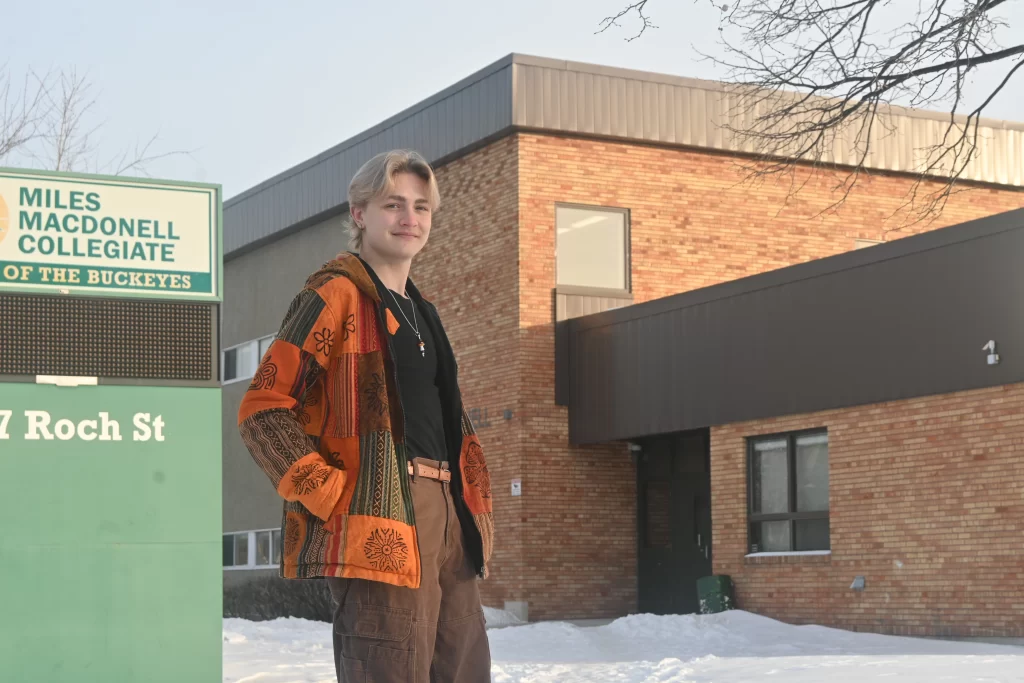
Kaiden Peters, 20, says more 2SLGBTQIA+ education in school would have made his transition much easier, Mar. 4, 2026.(Tiago Resko)
How inclusive are schools?
In Canada 1.3 million people ages 15 and above reported being 2SLGBTQIA+ and 1 in 10 of those people are youth, according to a 2024 report by Statistics Canada. Most schools have adopted Diversity Equity and Inclusion policies to promote safe environments for queer youth and have Gay Straight Alliance (GSA) clubs. Organizations like SOGI 123, the Rainbow Resource Centre, and the Sexuality Education Resource Centre (SERC) provide training and resources to teachers on how to be inclusive and teach 2SLGBTQIA+ content well. Great progress has been made in recent years addressing the lack of queer education, but there’s still work to be done. The Manitoba health curriculum hasn’t been updated in over 20 years according to an article by CBC. While the current curriculum includes gender identity in Grade 5 health, it’s limited.
There’s been controversy around 2SLGBTQIA+ inclusivity in schools the last few years in Manitoba. In 2023 there were protests in Manitoba, Dauphin, and Brandon organized by the organization 1MillionMarch4Children to push back against 2SLGBTQIA+ inclusive education in schools. But many students like Peters, who graduated high school only a few years ago, say they left the public school system without learning crucial information. Information on risks of STIs during same-sex intercourse, differences between gender identity and sexual orientation, and aspects of transitioning and gender dysphoria is often left out of health classes. Not teaching this information can leave queer students struggling to find it on their own. Peters said this was the case for him, and the resources he got from his counsellor was the start of a long and complicated journey.
Vulnerable to misinformation
After getting resources from school, Peters talked to his family doctor. She said she couldn’t prescribe him hormones and referred him to Klinic Community Health. Peters says the environment at the health centre is vibrant and welcoming, and the walls of the office are filled with posters and queer art. At his first appointment, Peters sat one-on-one across from his doctor discussing why he was there and how the health centre could help him. Peters had been on the waitlist for Klinic for over a year and was excitedly anticipating the appointment. He had hoped to start testosterone as soon as possible. When the doctor asked who referred him, Peters said it was his family doctor. That’s when he found out hormones can be prescribed by family doctors and they can be covered under Manitoba Health, according to the Rainbow Resource Centre. His family physician could’ve prescribed him testosterone and saved him from waiting for a year to get it prescribed through Klinic.
“I was really angry in that moment and just kind of shocked,” said Peters. “If we were taught in school about the process, everyone would be aware that yes, your family doctor is qualified to [prescribe hormones] whether or not they tell you they are.”
In addition, he said he was completely unaware of the different types of gender-affirming surgeries, wait times, or even how to get on a wait list. Peters said learning about these things in school would’ve made the process much easier.
Awkward discussions
Peters recalls sitting in a classroom with harsh fluorescent lighting while his Grade 11 gym teacher skirted around queer sex saying things like protection should be used “under all circumstances.”
“I’m getting the hint awkwardly, but other people aren’t going to get that,” said Peters.
He said his teachers seemed to dance around queer issues making it feel like they didn’t know what they were talking about. While 85 per cent of Canadian teachers believed 2SLGBTQIA+ education was important, only 73 per cent were comfortable teaching it, according to a 2016 report by Egale Canada, the country’s leading organization for queer issues. While this number is high, it suggests that a percentage of teachers who believe in inclusive education didn’t feel confident teaching students about it. Teachers often know the medical terminology but don’t know how to distill it into casual information for students, said Robyn Sugden, who runs an independent sexual education consulting business. She said that overall, there’s a gap when it comes to education on the queer community, even among adults.
“I have lots of adults that ask me ‘what does it mean if someone’s trans?’” said Sugden.
She’s worked in harm reduction for the last decade and started her own sexual education consulting business last year. She gets questions about if trans women can ejaculate, if trans men can get pregnant and what various surgeries entail. Sugden said she’s taken many sexual education courses and workshops, and this information was never included. She had to seek it out on her own, similar to Peters’s experience. He said while his school had counsellor resources, clubs, and books to educate students, the onus was on them to seek out that information. Peters said after finally getting the resources he needed, he was left to sort through the complicated process of transitioning without school support.
Where do parents fit in?
Peters said having supportive parents was “life changing.”
“I don’t think I’d be even half as transitioned without them,” he said.
He said transitioning involves a lot of paperwork and doctors’ appointments, making it overwhelming to do without family support.
“It’s hard not to have your family there supporting you while you’re trying to go through these changes,” said Peters.
He knows people who haven’t been able to start hormone therapy because their parents aren’t accepting.
Many queer students still don’t have support at home, and parental rights groups protesting inclusive books, imagery, content, and policies has made many schools nervous about introducing more queer content, said Sugden.
“I feel personally that we’ve gone a little backwards where people now are more scared to talk about things because of this whole parental rights movement,” said Sugden. “I would say almost every administrator I’ve talked to or even school staff said like, ‘you know, we need this, and teachers especially know we need this, but we don’t know how it would ever get passed.’”
Teachers typically approach her independently, seeking more information, and have asked her to give presentations to classes about emotions and neurodiversity, but it hasn’t happened yet with sex education.
“That to me shows that there’s still hesitancy,” said Sugden.
Inclusion in early education
Peters said in elementary school he learned nothing about different types of relationships or gender identities. In his early years he doesn’t remember being exposed to any kind of queer media and didn’t learn what being gay was until the end of middle school. Peters thinks having access to queer content as a child would have helped him figure himself out much sooner. He didn’t know being trans was even an option, and said he mistook his gender dysphoria as insecurity. He said he’d try to be more feminine by wearing more revealing clothing to embrace his body — but it never worked.
“It’s like if you didn’t know that period cramps were a thing, you’d just think that you got really bad stomach aches, but you wouldn’t understand why,” said Peters.
Sony Duong, a support teacher at Shaughnessy Park School who also teaches Grade 5 and 6 health, said he educates kids by simply answering questions and teaching them about all types of families.
“Some people have two moms, some people have two dads. That’s fine, you just pull out different examples,” said Duong.
Duong has been teaching at Shaughnessy Park School for seven years. He said he includes lessons on queer figures in history and believes it’s important to keep classrooms stocked with queer reading material.
Duong has done training through the Sexuality Education Resource Centre, and other teachers at Shaughnessy Park School have done inclusivity workshops with the Rainbow Resource Centre. “It’s important that teachers do bring up and teach to what different identities are, because they’re present,” said Duong.
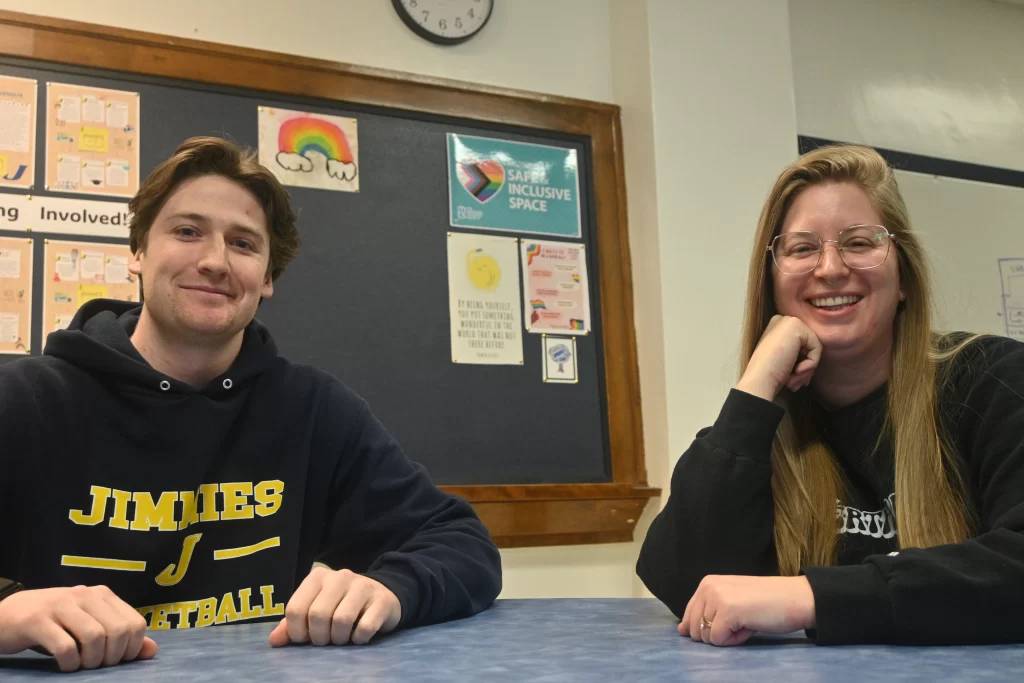
Danny McCullough (left) and Kassey Templeton (right) say their training from Sexual Education Resource Centre (SERC) has made them more confident teaching 2SLGBTQIA+ content in health classes, Mar. 5, 2026. (Tiago Resko)
Teaching for a new generation
Peters said he feels like his gym teachers lacked the training to teach sexual education outside of straight relationship dynamics. He never felt comfortable fully coming out in gym class because of this. He said it often felt like they were just checking a box and didn’t know how to effectively teach a 2SLGBTQIA+ curriculum. The St. James Assiniboine School Division now requires all gym teachers to take yearly professional development courses with the Sexuality Education Resource Centre, said Danny McCullough, a physical education teacher at St. James Collegiate.
“We all have training in it. It’s awesome,” said McCullough.
McCullough teaches physical education with Kassey Templeton, who also serves as the school’s guidance counsellor and resource teacher at St. James Collegiate. Templeton has been teaching for nine years and said the Sexuality Education Resource Centre is the school’s main resource. She said 2SLGBTQIA+ staff also give feedback on the curriculum to better reach students.
“We do it together,” adds McCullough. “I find that we fill in the gaps that the other person leaves.”
McCullough said while he learned a bit about teaching gender identity in university, most of what he’s learned has come from the programs built up at St. James Collegiate. Templeton said a one-hour class within the week-long health course is dedicated to gender identity. The content looks at the difference between gender assigned at birth, gender identity, gender expression, sexuality, and pronouns. She said the training from the Sexuality Education Resource Centre and health courses physical education teachers are required to take in university made her feel comfortable teaching this content and willing to say things that might otherwise be considered taboo.
“Sometimes there’s other schools like elementary schools where it’s like a classroom teacher and they’re like ‘oh, you’re teaching health this year, you know nothing about it. Here you go, good luck,’” said Templeton. “That’s where that nervousness comes from.”
Templeton feels having all teachers committed to training is important. She said the workshops have made a big difference since she started teaching, when she couldn’t expand on content outside of the lesson plans she was given. Templeton said she feels teachers who have graduated recently tend to be more open-minded. McCullough adds that education reflects our society.
“As people are coming in, we’re much more open to talking about these things in regular life or learning these things outside of school, then that kind of like seeps into what we teach,” he said.
According to him, being more open as a society results in younger teachers being more knowledgeable, compared to older teachers who were brought up in a time when queer issues were considered taboo.
“I had sex-ed in high school in a basement [with] some old man. I hated that,” added Templeton.
She said there’s always a line between what is and isn’t appropriate, but ultimately 2SLGBTQIA+ education is simply teaching the facts.
“Being a person that teaches those factual things and just providing knowledge that’s going to help reduce harm and help reduce risky situations — I think that’s the role of a teacher,” she said.
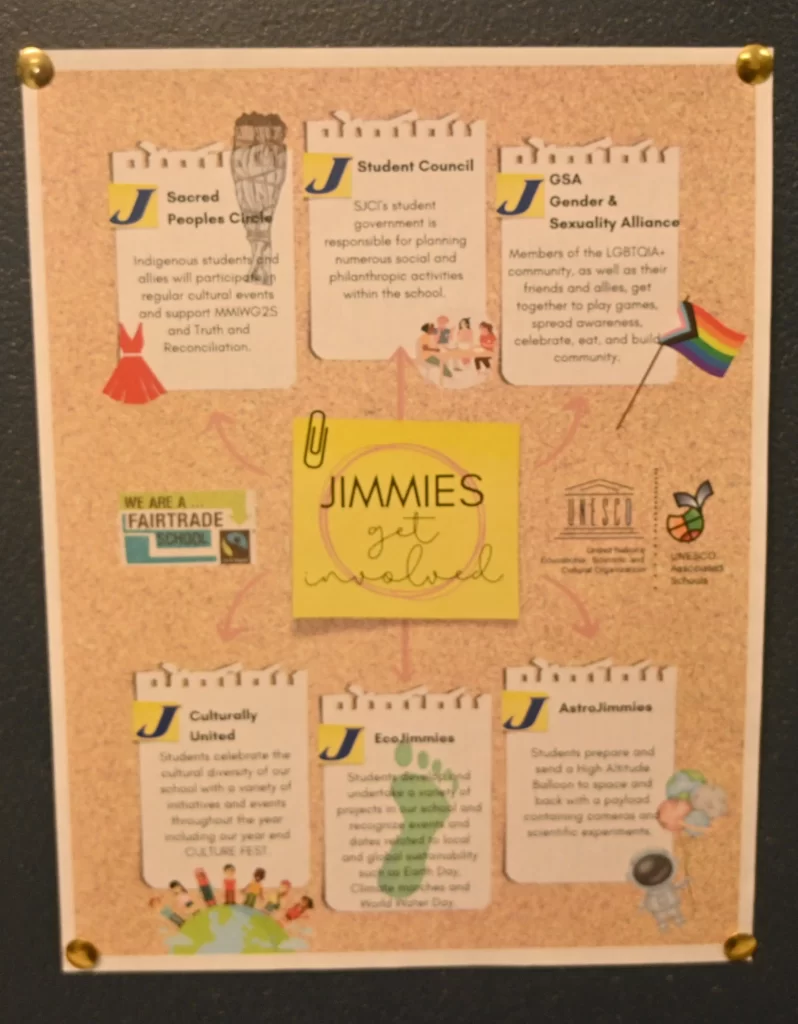
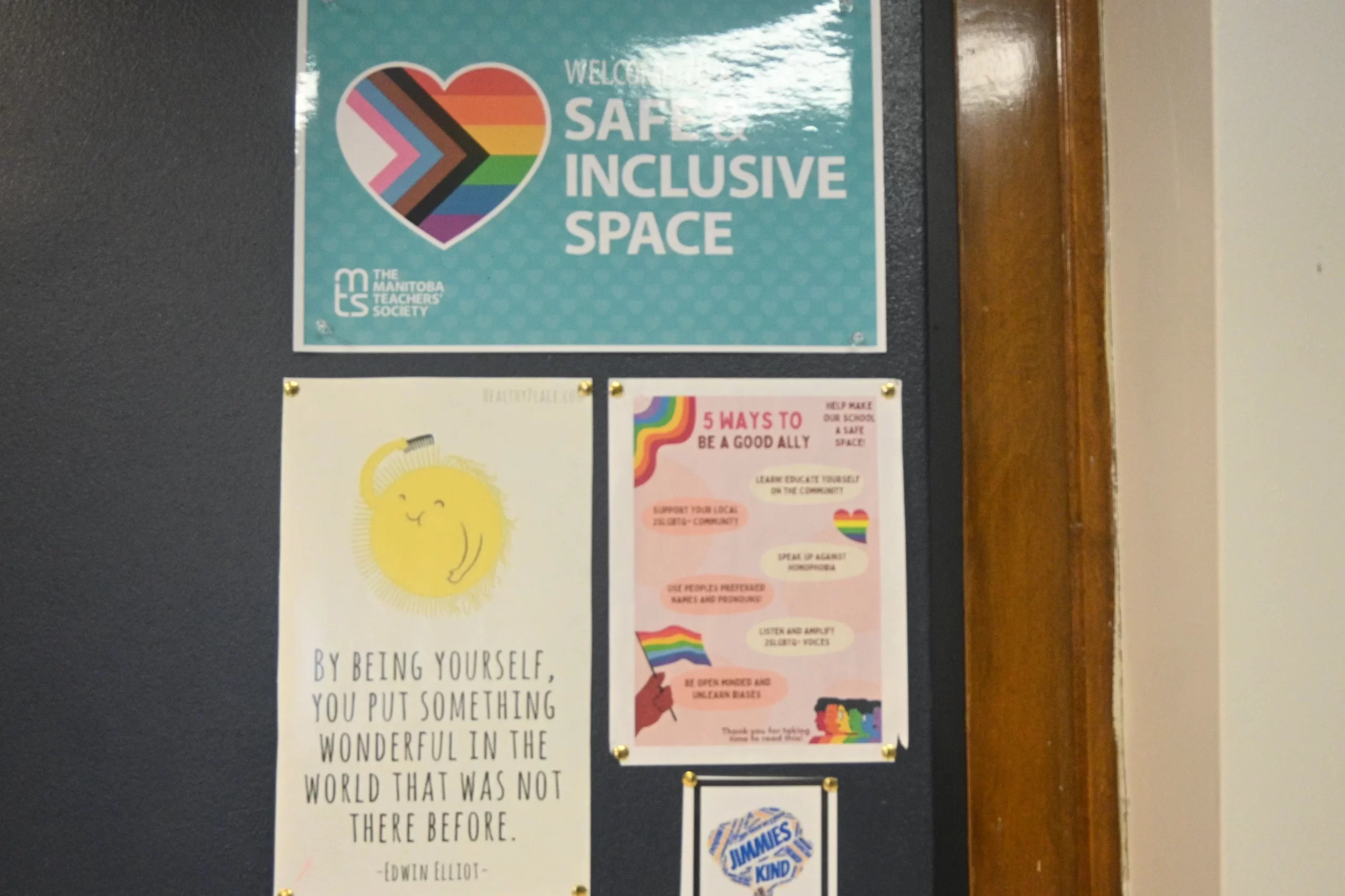
Inclusive imagery can be found in the student support centre at St. James Collegiate Mar. 5, 2026. (Tiago Resko)
A holistic approach
Peters said queer history was touched on in English class towards the end of high school, but only through optional projects. Elective classes like music and theatre were very inclusive, but other students would miss out if they weren’t in those classes. He thinks having more representation in other subjects would have helped him a lot with his transition.
“I would’ve had something to go off of in terms of, oh that is what I’m relating to, instead of just not knowing it was an option at all,” said Peters. “Just having that representation being there alone would have made me feel more comfortable and safer.”
There’s still a lack of 2SLGBTQIA+ representation in classes like science or history said Dene Guillas, who works with queer students and schools on inclusivity through his business Braiding Colours Consulting. Guillas is Two-Spirit Métis and worked at the Rainbow Resource Centre for five years before leaving to start his consulting business. While queer education is mostly included in subjects like family studies or health, Guillas said there’s room to include it in areas like science, English, and history.
“We forget there’s amazing queer people in history as well that we can talk about and do projects on, same with English class with books that are inclusive,” said Guillas. “Looking at those barriers to how do we show rainbow kids that this is a safe place for them, that they are welcome here, not just saying the words, but actually following up with it.”
Inclusive spaces
Peters joined his school’s theatre program during the COVID-19 pandemic. He said theatre was his first time being in an inclusive space and hearing people share pronouns. He remembers sitting with his class in a circle doing introductions in Grade 11. As each person went, he grew increasingly nervous as his turn approached to say his name and pronouns. As the moment came and passed he felt a sense of relief.
“I was just so not used to it,” said Peters. “The first couple weeks I was nervous and eventually I was like ‘it’s stupid that I’m nervous.’”
Starting in his Grade 11 year, Peters slowly started switching his pronouns until he finally introduced himself as he/they in Grade 12. Peters said he was nervous each time he’d change his pronouns and felt a deep sense of relief when no one cared. From theatre he joined his school’s GSA club. Once he joined, he met more queer people making him feel less alone.
“[It] felt safe knowing other people like that,” he said.
Guillas said schools are sometimes the only safe place for queer kids, which is why GSA clubs are so important. He said more teachers need to make it known they’re safe to talk to so queer students feel safe everywhere, not just within a club.
“They may know that their GSA teachers are safe, but out of their GSA teachers they’ve had bad experiences in the classroom, whether it’s peers or whether it’s the teacher saying something inappropriate. So, their concern comes with, well, you know the teachers are saying these things or these students are saying these things, but like, no one’s doing anything about it,” said Guillas.
Guillas acknowledges the pushback to the wider implementation of DEI policies, but said inclusion is a natural progression of our society.
“Whenever we’re going towards growth or change there’s always going to be pushback,” said Guillas.
Change is happening
Peters said he’s seen a lot of progress in how 2SLGBTQIA+ education is addressed in schools. He noticed the shift near the end of his Grade 12 year, in particular when he got to speak to middle school kids about his high school’s GSA club. He said he was able to answer students’ questions about the club, while sharing his experience and letting them know these kinds of safe spaces exist.
“It was nice because that wasn’t something we had when I was in middle school,” said Peters.
Guillas said progress has been made but there’s still lots of work to be done. He said many schools still only reach out to him about making their spaces more inclusive due to an issue or situation that made them realize it was needed, being “reactive instead of proactive.”
“There are so many schools I know in Manitoba that really need this type of education, really need this type of support, really need to do a better job of creating safety for the rainbow kids, but they just aren’t,” said Guillas.
Guillas said more people who are queer themselves or have 2SLGBTQIA+ children are now getting into positions of power and driving change.
“I feel that’s [where we’re] starting to see where the shift is happening,” said Guillas.
Peters said he’s glad more schools are getting clubs and having more safe spaces for kids to learn. He said schools still need more 2SLGBTQIA+ representation that everyone sees — not just students who seek it out.
“If other people have to listen, it makes the people who relate feel like other people are going to understand them,” said Peters.