Bracing Against the Undertow
As the gap between community need and government support widens, Winnipeg’s non-profit staff are caught in a violent undertow that is felt in every shift.

Listen to this story:
I. The Undertow
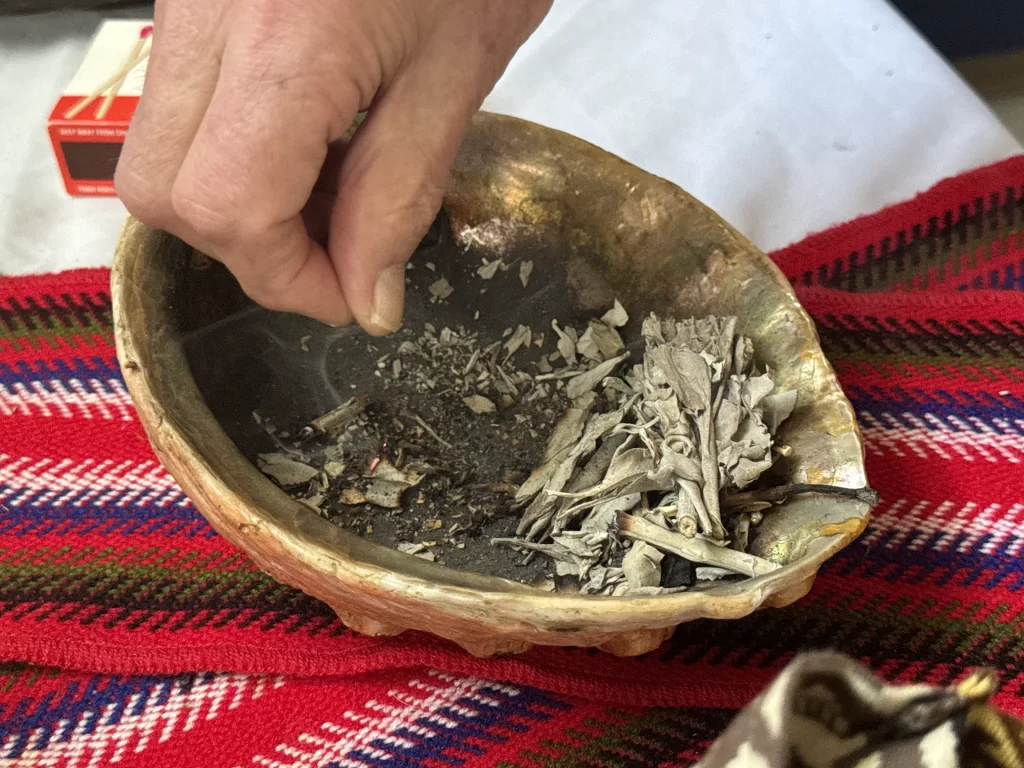
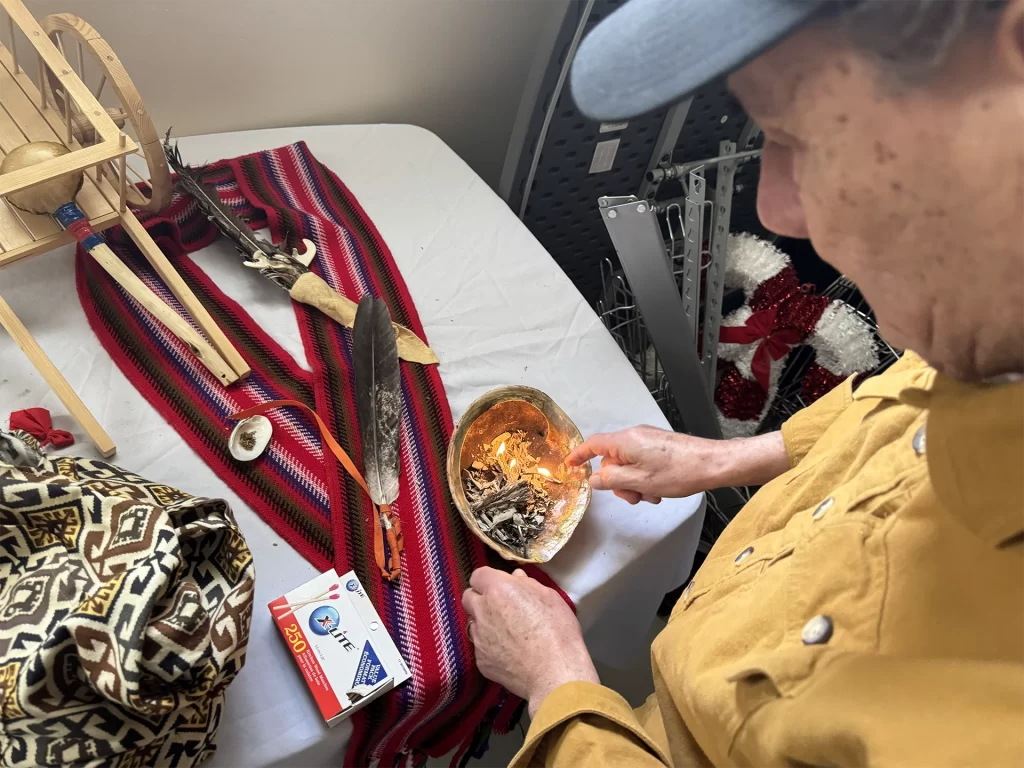
The rising summer sun beams onto the metallic front door of 1JustCity’s Oak Table site. John McKay, who leads Indigenous cultural programming, hums to himself as he enters the centre. He says “good morning” to the kitchen staff and volunteers preparing meals for Oak Table’s lunch service. To begin the day, McKay prepares a smudge. He lights a match and draws it to the sage. It smoulders on the abalone shell, releasing an earthy smoke that invites the Creator into the space to replace negative energy with positive, caring energy. For the staff, the ceremony is an opportunity to spiritually wash themselves. They draw the smoke over their eyes to see good things, their ears to hear good things, and their mouths to say good things. They smudge their hearts to keep them open, and their minds to clear away the heavy energy of the day. As the smoke drifts through the halls, the smudge washes the site in a protective smoke. It clears the room so that everyone can simply be present with each other. “So, we can all be together in a good place,” McKay says.
A line swells outside the centre’s entrance. Tara Zajac, Oak Table’s site lead, passes a cigarette to an older woman in a mobility scooter. The ember reflects off her pink sunglasses. At noon, the doors finally open. As the line streams in, Zajac greets each guest by name. “There are moments when the line doesn’t just feel like a line; it feels like a physical weight of everyone’s needs pressing into the room at once,” Zajac says. “But in that same line, you see the beauty of people sharing their last cigarette or holding a spot for a friend. It is the underbelly of the exhaustion, yes, but it’s also the place where you see the most incredible acts of kindness you’ll ever witness in this city.”
Inside, unlikely people sit together at tables, eating and talking. Stan, an ex-wrestler, sits with Kyle, who can provide an accurate measurement of any object simply by observing it. Staff and volunteers rush, greeting guests and providing hot meals, coffee, and support services. These moments of connection with the community are what keep the team going, but there is an underlying strain. The pressure is mounting. Currently, individual resilience is keeping the team from being pulled under by a system that is slowly collapsing. Staff are tired and at risk of burnout. While they serve the line of guests on the surface, they are also bracing against an undertow that puts their well-being at risk.
II. The Swell
1JustCity is one of the many community-based organizations in Winnipeg straining to support an expanding community of people experiencing poverty and housing instability. The organization provides essential services, nutritional support, and Indigenous-led wellness programming to a community that is outgrowing the sector’s capacity.
The 2024 Winnipeg Street Census confirms the scale, recording 2,469 people experiencing homelessness in Winnipeg — nearly double the 1,256 people recorded just two years earlier in 2022. The City of Winnipeg touted a 17 per cent increase in funding for community-based organizations in Feb. 2026, but the total $750,000 investment was split between 13 organizations. Running these programs takes resources; it costs about $68,250 to cover an average salary for a single social worker.
This imbalance between the cost of running programs and the availability of funds functions like an undertow for staff. The number of people requiring services through these organizations are like a surface current pushing the staff of community-based organizations forward, but insufficient funding pulls at their feet in the opposite direction, threatening to drag them below the surface. The reasons for this backwards pull is complicated, but funding is a significant part of the problem.
Statistics Canada shows the cost of living has risen 32 per cent since 2014, yet funding has remained stagnant for some community-based organizations. Christina Maes Nino of the Manitoba Non-Profit Housing Association noted in 2024 that many sector agreements have missed over a decade of inflationary adjustments. A dollar from 2014 is now worth 68 cents. Staff are caught at a point of friction between the two currents, attempting to survive a 2026 crisis on a 2014 budget.
The Canadian Centre for Policy Alternatives describes this systemic withdrawal of support as “organized abandonment.” By refusing to increase grants while demand rises, the government is funding a status quo that no longer exists.
This financial disparity affects community-based organizations like 1JustCity. The organization provides vital support during the day, but funding constraints for its Just a Warm Sleep program restrict the number of people they can shelter overnight. This forces staff to face the heartbreaking reality of reaching maximum capacity every night, knowing the system hasn’t grown with the need.
III. The Submersion
To help staff manage the emotional toll of a system beyond maximum capacity, organizations are adopting wellness and retention strategies that prioritize collective support. Grace Bashir, 1JustCity’s housing and shelter lead, highlights the camaraderie of staff who refuse to give up, even as community needs rise above sector resources. “You try to help get someone inside, but sometimes we are at max capacity, and you go home knowing they are still out there. But then there are the days when a [housing] lead finally comes through, and the whole team celebrates like it’s their own family member getting a key. We hold that weight together so that none of us has to carry the ‘max capacity’ feeling alone.”
Staff also risk letting camaraderie override their own well-being. Journalist and culture critic Anne Helen Petersen, known for her work on the labour of burnout, explains that professions framed as a “calling” often expect workers to absorb systemic failures as a personal sacrifice. Staff fall into a cycle where the invisible pull of the ongoing crisis makes leaving on time or taking a lunch break feel like betrayal. They often end up sacrificing their own mental health to prevent the system from going under. Burnt out staff are at risk of losing the drive that brought them to the sector in the first place.
IV. The Drag
Organizations like Main Street Project operate at high intensity, running 24-7. Main Street Project’s director of development Cindy Titus explains, “Our staff are effectively serving as emergency responders, navigating the drug poisoning crisis every hour, often serving as the first emergency response in overdose situations, sometimes multiple times in a shift. We’re the last place for people to go because they can’t access services anywhere else.”
Frontline work has grown more intense as the substances on Winnipeg’s streets have become more volatile. In a Jan. 2026 report, data from The Winnipeg Fire Paramedic Service revealed that opioid calls have risen from 231 in 2016 to 2,927 in 2025 — nearly 13 times higher. The flood of high-potency synthetic opioids like fentanyl and carfentanil has altered the pace of the work. The frequency of life-threatening toxicity events has surged, turning support spaces into emergency zones. Marion McKenzie, program support manager of Ma Mawi Wi Chi Itata Centre (Ma Mawi), notes that the organization has shifted its language to reflect this reality, moving towards the term “toxic chemical crisis.” McKenzie explains, “It’s not just a ‘drug problem’; it’s an environmental hazard. Our staff are facing this every single day.”
Now staff are on high alert, scanning for any subtle, silent signs that someone has stopped breathing. This constant need to be on high alert creates a fatigue that standard self-care just can’t fix. It’s a level of exhaustion that goes beyond what a yoga class or a day off can restore. Staff fight to stay grounded, but the drag of constant vigilance is relentless. That invisible pull follows them out the door, forcing them to stay braced even in their quiet moments.
V. The Crosscurrent
Beyond internal pressures, staff also face pressure from people who question their methods. In Aug. 2025, PC Leader Obby Khan commented on Sunshine House’s Mobile Overdose Prevention Site, labelling it as a failure, citing a 25 per cent reduction in overdose calls and a 29 per cent reduction in naloxone administrations by first responders while the van was out of service. Khan used this as evidence that the site’s presence was fueling the crisis. However, the organization argues that the correlation is misleading. While ambulance calls dropped, internal records showed staff responded to 27 overdoses in July, when the van was inactive, compared to 11 in June. Levi Foy, Sunshine House’s executive director, says the previous month’s higher naloxone distribution meant more kits were available to the community, allowing people to treat emergencies on-site and reduce the need to call 911. After Khan’s comments, Sunshine House faced calls to have their resources stripped. This took a toll on the team, forcing them to defend the essential work that they do.
This narrative that the organization is somehow to blame for the drug crisis shifts the blame from the glaring structural cracks in the system onto the people working to patch them. As a result, Petersen argues that individual wellness strategies are insufficient when staff face structural failure. Winnipeg’s crisis is the result of years of under-funding, creating a problem that demands wider structural repair.
VI. The Drift
At West Central Women’s Resource Centre, Christie Paul, director of communications, says the conversation needs to shift away from blaming workers. As community needs continue to climb, funding and resources also need to increase. Without this support, staff find themselves in impossible positions where they are trying to bridge a gap that can’t be closed without more resources. Titus notes that the reality is that staff are often trying to do “three people’s jobs” to keep the doors open. “We are losing talent because we refuse to fund the capacity required for the job,” she says.
Underfunding creates a dangerous wall between paperwork and the people in need and puts staff in the middle. McKenzie stresses that without people’s basic needs being met, they can’t focus on anything else. She asks, “What makes these systems think that somebody that’s fighting many more hurdles… is going to be able to do that [without food]? People cannot focus on healing if they are hungry.”
The struggle to get essential items like food covered while managing grants is what The Bridgespan Group calls the “Nonprofit Starvation Cycle.” It’s a loop driven by a flawed perception of success. Some funders judge a non-profit’s efficiency by how little they spend on overhead costs, which pressures organizations to under-report their real operating costs to secure the funding they need to survive. To keep getting grants, non-profits often feel forced to lower operating costs, which reinforces donors’ unrealistic expectations and feeds into competition within the sector. Eventually, this cycle whittles away an organization’s foundation, leaving them without enough money for fair wages and staff retention. It is a cycle that exhausts an organization’s budget and its people.
VII. The Depths
Beyond the constant state of high alert, frontline staff also carry the weight of communal grief. While many industries rely on professional distance to function, frontline work is built on being close to the community. Staff act as neighbours, mentors, and family. “Losing people that we have actively been working with has had a real impact on the mental health of staff,” Christie Paul explains. “We mourn them because they aren’t just names — they were our friends.”
Mourning requires time, and in a sector defined by scarcity, time is often a luxury that staff can’t afford. For a frontline worker paid hourly, taking a day off to process loss means losing income. To prevent staff from making the difficult decision between their mental health and financial needs, Titus says that Main Street Project has turned empathy into policy. They introduced a policy that supports the strains of the job. “If a staff member experiences a critical incident, their shift is paid out so they do not lose money while processing trauma,” Titus explains. This structural shift emphasizes that wellness should be treated as a priority and not an inconvenience. “We have to make sure that we’re taking care of our staff,” she says, noting that leadership must model the fact that it is “okay to take a step back and take a break.”
VIII. The Breath
Policy is only the beginning. Paid leave supports a staff member’s livelihood, but organizations recognize that they must also protect their staff’s spirits. Some organizations are integrating Indigenous cultural practices, such as ceremony, into their organizations to combat the sector’s systemic exhaustion by providing staff with an outlet to ground themselves. Grounding is the act of finding physical and/or spiritual stability.
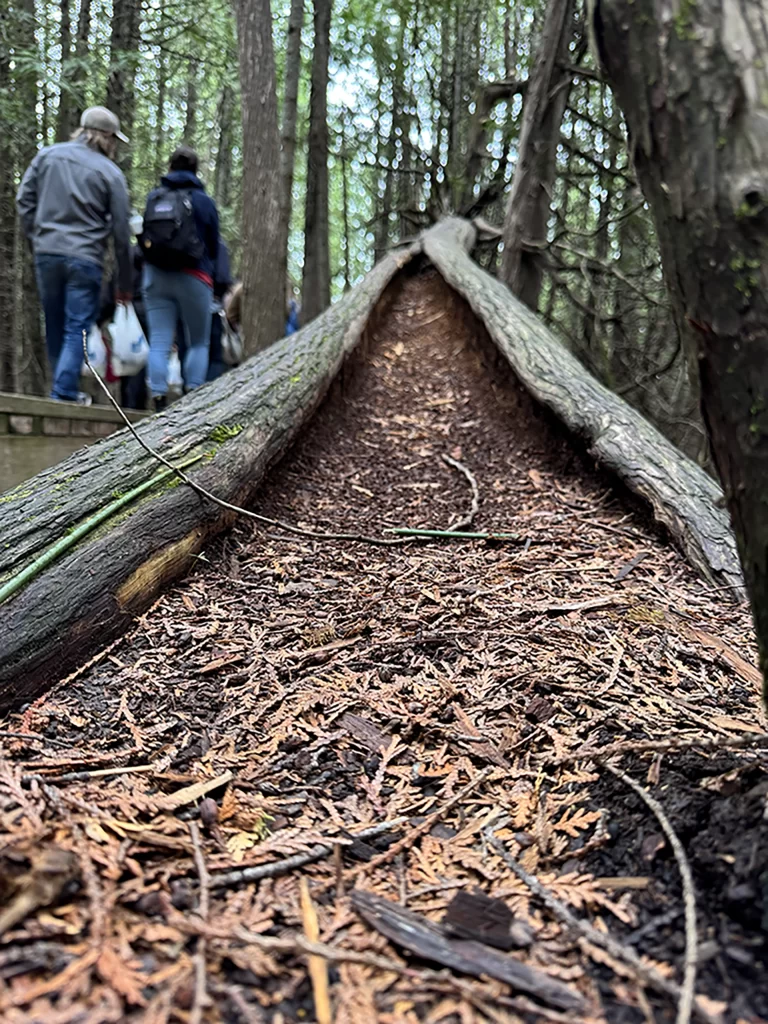
At 1JustCity, John McKay occasionally brings staff and guests beyond the centre’s walls for land-based learning, with recent outings ranging from ice fishing to visiting the Brokenhead Wetland Interpretive Trail. “It’s a real good time for our staff to reconnect and re-energize. And it’s also a good time for us to appreciate each other,” he says.
At Ma Mawi, the day often begins with a smudge to create a moment of pause and a necessary breath for staff. “We can’t be there for our community if our team is not doing well,” McKenzie says.
This practice of grounding is the core of the First Nations Mental Wellness Continuum Framework. The model acts as a foundational chart for health, using a holistic Indigenous perspective of supporting life. It states that wellness requires fulfilling the physical, emotional, mental and spiritual aspects of an individual within the context of their community and family. The Framework defines wellness through four outcomes: hope, belonging, meaning, and purpose. By reconnecting with the natural environment, staff find a space to decompress from the sector’s pressures. Taking the time to listen and see what the land offers allows them to return to the city refreshed, ready to be present for the community.
IX. The Tether
To combat the pressure frontline staff experience, more organizations are building holistic frameworks to sustain staff wellness. West Central Women’s Resource Centre operates under a model Paul calls “Holistic Relations.” It treats staff performance issues as a capacity problem. The idea is if you miss a deadline, examine what happened in your work that made meeting it difficult. “We look for opportunities for connection rather than management, rather than discipline,” Paul explains. “We ask ‘what do you need?’ Instead of ‘what did you do wrong?’” In the holistic model, admitting a struggle is an invitation for the team to provide support.
Ma Mawi’s safety philosophy is grounded by Mino Bimaadiziwin, an Ojibway concept that translates to “the good life” or “living life in a good way,” McKenzie explains. At Ma Mawi, accountability is communal. It’s driven by a Code of Honour; a shared social agreement rooted in traditional values. “Calling someone out in a good way, to say, hey, you know that’s not our Code of Honour,” she continues. “It’s about holding each other up, not tearing each other down.” The approach distributes power across the organization. Staff feel empowered, creating an environment where there is a collective desire to protect each other — a shared tether against the undertow.
Then there’s the weight of funding. The process of acquiring essential financial support comes with an administrative price tag. The Charity Insights Canada Project confirms that only 8 per cent of charities can easily manage reporting requirements, while 65 per cent describe the burden as moderate to overwhelming. Funders have a legitimate responsibility to track their investments, but the administrative load needs to be scaled to fit a community-based organization’s actual capacity, to ensure funders aren’t draining the organizations they are trying to support. This raises the question, who is an organization accountable to?
At Ma Mawi Wi Chi Itata Centre, the organization approaches accountability under a kinship model. In this environment, the organization is accountable for the well-being of its staff, the staff are accountable for the care they provide to the community, and the community is accountable to the organization for ensuring it stays true to its mission. Accountability is circular instead of lateral. “Ma Mawi Wi Chi Itata translates to ‘we all work together to help one another,’” McKenzie says. She uses the metaphor of a grandmother to define the structure.
A grandmother protects the entire home. She realizes that you can’t care for the grandchildren if the parents are starving. When the grandmother makes sure that staff are grounded and rested, they can stand against the currents without being pulled under. This holistic view proves that staff well-being is the foundation of an organization’s mission. The path forward requires funders to be the life jacket for this kinship, providing the buoyancy that keeps community-based organizations afloat while they continue to save others. At West Central Women’s Resource Centre, staff are encouraged to invest in their own self-care through an annual $100 Individual Wellness Fund. While a small token, the policy recognizes that wellness is personal; while one person may find stability in a new pair of walking shoes, another may use the funds for art or gardening supplies to decompress.
X. The Shore
Back at Oak Table, the clock strikes 2 p.m. and the noon rush has ended. Remaining guests finish up their desserts and coffee. The scent of sage still lingers faintly in the hallway. Kitchen staff scrub the counters. Staff and guests work together to clean up tables, move chairs, and reset the room for tomorrow. The crisis hasn’t vanished, but inside, the simple act of eating and cleaning up together is a small, stubborn victory. The current in the room has slowed. In this moment, the team isn’t bracing against the undertow. They are standing on the shore they’ve built for each other.