
Shifting the Eldest Daughter Perspective
Eldest daughters wear a lot of hats: the role model, the parentified child, the mediator, the responsible one. Online communities like #eldestdaughter are building a narrative of support that finally recognizes the backbone of the family.
Listen to the story:
I was twenty-two when I attended my first therapy session.
Up until this point, I wasn’t a particularly introspective person. Growing up, I didn’t have anything to complain about. I had a roof over my head, clothes I grew out of, and a family where we laughed and argued.
Andrea, my therapist at the time, swivelled her chair to face me again, the notepad on her lap already full. My eyes were already puffy, and I was only halfway through the session. I was talking about the strong bond I have with my younger sisters — Alaiza and Charlie, four and twelve years younger than me — and how they now called me their “safe space” to vent and rely on.
“And for you? Do you think you deserve the same amount of care and love you give to your sisters?” Andrea looked at me intently, waiting for an answer. “Do you not consider yourself worthy to be loved?”
This question rendered me speechless. I lived my life quietly bearing the burden of being the eldest daughter, with no regard for my own well-being, because it was the first identity I attached myself to.
It wasn’t until I started going to therapy and seeing Instagram posts about “Eldest Daughter Syndrome” that I found the language to describe what I’ve felt throughout my life.
I saw a reflection of myself in every post and video that I consumed.
Eldest Daughter Syndrome
Eldest daughter syndrome, while not a clinical diagnosis, is a term widely used to describe qualities many first-born daughters develop and exhibit into adulthood. This concept is resonating with audiences, as more women are telling their stories through TiktTok posts that have gone viral with the “eldestdaughter” hashtag.
An article by Ragini Jha in Therapy Today describes how this trend particularly resonated with women from immigrant families. Growing up in a Filipino immigrant household, both my parents worked two jobs to be able to provide for our family. I was the one preparing dinner or helping my sisters with their homework. I was the one who my parents never had to worry about. I was headstrong enough to figure out things on my own, but obedient enough to never say no even if I was overextending myself.
I wore the mask of the perfect, self-sufficient, diligent child enough times — it was all I’d ever known. Becoming anything else felt like a transgression.
In her 2024 article “Understading ‘Eldest Daughter Syndrome’,” Deshna Chatterjee, a student from the University of Calcutta, put together a list of qualities that define eldest daughter syndrome: perfectionism, caregiving, conflict mediation, self-sacrifice, and independence.
Upon reading this research, I realized that the varying eldest daughter stories that I’ve seen and heard relate to one or more of these qualities.
Perfectionism and High Achievement
When I was named the top student at my grade nine graduation, an elated feeling spread across my body.
I did it. The phrase rang in my head as I stepped up to claim the award. My eyes darted to where my family was sitting. Their claps and cheers brought warmth to my chest.
When I was growing up, my parents never voiced their expectation that I should be at the top of my class. It was just my inherent thought.
They never told me directly, but it’s what I understood whenever they beamed as they bragged about me to their friends.
“I never had to worry about her, she’s a smart girl,” I heard my mother say to her friend once. I wore her words as a badge of honour.
My achievements and successes mirrored my parents’ pride. I was the proof that their move to Canada from the Philippines had paid off.
I didn’t consider myself a perfectionist then, but I was a high achiever. I was the type of student who would contest my scores if I didn’t receive 100 per cent and wouldn’t sleep until my homework was completed.
I was considered a smart and sensible girl, mature beyond my age, and a good role model for my siblings.
I didn’t know it then, but this perfectionism and high-achieving tendency would leave me burnt out part way through high school, where I was in a pond with much bigger fish.
Maintaining my status as a successful child started to feel like being swallowed by a vast sea.
In her article, Jha writes that cultural guilt is common, particularly for children of immigrants, who are aware of the sacrifices made by their parents. I clung to the identity of the perfect eldest daughter so desperately that it contradicted the person I was becoming.
I stopped sharing the results of my test scores and doing homework at the kitchen table where my parents would see me before they went to bed. I didn’t want them to ask how my classes were going.
I feared asking for help. I feared becoming a disappointment. I feared becoming useless.
The article “Perfectionism in context: Authoritatrian influence of parenting, birth order, cultural values and their associations with psychological distress,” published in Personality and Individual Differences, found that perfectionists often rely on achieving or exceeding their own high expectations to boost their self-worth. Eldest daughters in particular are more prone to develop driven behaviours and conscientiousness that can push them to the extreme.
This can result in people-pleasing behaviour that Meg Josephson, a licensed clinical social worker, details in her book Are You Mad at Me?: How to Stop Focusing on What Others Think and Start Living for You. Once Josephson moved out of her parents’ home, she no longer felt the need to be “perfect” or “good,” but realized that the thought of being seen anything else was terrifying. She did not know herself outside of these perceived values. She was trapped in a role she held onto as a way of surviving.
Caregiving and Nurturing
Another characteristic often associated with being the eldest daughter is caregiving and nurturing, with certain family dynamics characterized by parentification of children.
The article “Parentification Vulnerability, Reactivity, Resilience, and Thriving: A Mixed Methods Systematic Literature Review” from the International Journal of Environmental Research and Public Health defined parentification as a process when a child assumes the roles and responsibilities of a parent before they are cognitively and physiologically ready to do so.
Many eldest daughters in immigrant families come to bear the responsibility of caring for their younger siblings when their parents are unable to do so because of work or other commitments.
As new Filipino immigrants in Winnipeg, my friend Gavie Marasigan’s family had no relatives or connections to find a last-minute babysitter when her parents needed to attend a medical appointment. The responsibility fell on Gavie, who was only ten years old at the time. As the oldest of the children, she was tasked with caring for her baby brother while her two other sisters — who were only eight and five years old then — stayed in school.
Gavie fell asleep while babysitting.
She remembers being woken up by her dad. It was already dark outside and she jumped in panic, scanning the room for her brother. To this day, she remembers her baby brother’s red and blotchy face as he cried in their mom’s arms.
A sinking feeling enveloped her as she imagined what could’ve happened while he was unsupervised. In her mind, the task was so simple. She only had to play with him and feed him at the right time.
“How could I let my little brother be hungry, crying, and confused all while I was asleep?” she thought to herself. Gavie recalled that moment as the day she became more attentive and more vigilant.
Her responsibilities as an Ate, a Filipino term to indicate an older sister, only grew after that day, and she carried the guilt of failing to meet her brother’s needs when her parents were counting on her.
But as a ten-year-old girl, she was only a kid herself.
“Poor little Gavie, thinking like this is really all on her,” she said, reflecting on the experience.
A 2023 UCLA study showed first-born daughters mature and experience puberty earlier, perhaps so that the mother could rely on them to help in raising their younger siblings.
This early maturity comes with a cost.
Because Gavie was the one that her parents relied on to enforce the rules with her younger siblings, the line between parenting them and being their sister blurred. She didn’t realize how damaging her behaviour was until she grew emotionally distant from her siblings, often policing and judging their actions.
Her sisters stopped going to her for advice because they knew she would only scold them. Her younger brother often treated Gavie more as a parental figure and withheld his playful attitude.
Gavie only wanted what was best for her siblings and a cold shoulder was what she got in return.
Conflict Mediation
Another emotional burden familiar to the eldest daughter is being the family mediator.
Josephson dubs this quality as “The Peacekeeper” in her book Are You Mad at Me?, as the one who straddles the opinion of both sides and maintains a semblance of peace within the household. This often means developing an eye for a change in body language or an ear for a shift in tone of voice.
My friend Maia Gonzales carried this burden in their family whenever there were conflicts.
For Maia, it meant treating their parents as if they were the kindergarteners they taught at summer school. When their parents fought, it was emotionally taxing. Even though their sister was only a year younger, Maia didn’t want her to get involved. Who else would step in if they didn’t?
The Gonzales living room was usually neat and tidy. The couch cushions were fluffed up, the remotes were placed in their holders, the plants were thriving — one String of Hearts was more than two metres long.
One morning, Maia’s mom’s voice cut through the usual silence, raised with intensity.
“My mom and dad often had differing opinions on the smallest of topics, and they [would] argue about two completely different things while both thinking it’s just one argument,” Maia said as they recall a disagreement that took place when their parents were trying to build a new TV shelf.
Maia listened to their parents’ conversation with an exasperated and unsurprised look on their face. When Maia got tired of the yelling, they stepped in.
“I was using my gentle voice. I distracted them first with something visual, and I noticed my parents followed suit,” said Maia.
They handled the conversation like a moderator in a debate.
Maia described standing between their parents, holding their palm up to their dad to let their mom speak for one minute about her exact needs. They could tell their dad wanted to chime in, but they stopped him.
“I’ll give you your turn, but I just need to hear from Mama first,” Maia said. Their dad reluctantly obeyed.
After their mom was done speaking, they turned and did the same thing with their dad.
Their sister, after hearing all the commotion, stepped out of her room and watched the scene unfold. Later, she commended Maia for how they got their parents to calm down.
Maia was proud of themself for being able to get through to their parents, but at the same time, the thought that they shouldn’t have to deal with these kinds of childish arguments at home also crossed their mind.
Self-sacrifice and Suppression of Needs
To me, my Tita Aizel — Tita is the Filipino term for aunt — wholly embodied the quality of self-sacrifice. Chatterjee describes this term as someone who puts the requirements of their family before their own.
Not long ago, my Tita Aizel was on a video call with her younger sister, my Tita Lhen, who was the caretaker of their parents in the Philippines. Aizel is the eldest among her five siblings and the first one to leave the nest, getting married at 18 years old. Ten years later, she immigrated to Canada with her family, and eventually helped mine move here.
While Tita Aizel held the phone out in front of her, I overheard them discussing how my grandma was doing after a hospital stay from a bad fall. The conversation eventually came to a lull, and in the silence, Tita Lhen took a breath before asking a question.
“The grocery prices are up again, and our electricity’s about to be cut off… Are you able to send money this month?”
Tita Aizel didn’t say anything for a couple of seconds, but then she sighed, nodding as she replied in Tagalog: “Sige, gagawan ko ng paraan.”
Alright, I’ll make it work.
It was a conversation that I’ve heard many of times between my aunts, and I’d never heard Tita Aizel say no.
“It was the only thing I could do,” she tells me. “It’s not like I can physically go back to the Philippines just to take care of our mom and dad, so I try to include sending them money when I budget.”
Filial piety is a deep-rooted Filipino value, and one aspect of it is the concept of utang na loob, which directly translate to a sense of debt or gratitude. Right now, my auntie is the only person her family back home will look to for help. If that means working 16-hour shifts, then so be it. And she asks for nothing in return. To her, family is family and you help whenever someone is in need.
I remember having to stay at their house for a couple of months, and giving her money as I was leaving. In my head I thought she deserved it for all the help she’d given me, and she later told me that she cried after receiving it because she never expected it.
My aunt continues to show me that love comes in many different forms, and I wanted to show her that I see her efforts and how hard she works for those she loves.
Independence and Self-reliance
I recently had a candid conversation with my Tita Aizel. This conversation stands out because Filipino families seem to be allergic to open communication, often scolding the younger generation for “talking back” when all we wanted was to explain our emotions.
When the topic of my upbringing came about, my auntie noted how independent I’d become.
“You had to raise yourself, didn’t you?” she said. “Yeah, there was someone to bathe and feed you, but when it comes to your thoughts, values, and understanding, you formed that all by yourself.”
I was shocked by this realization and didn’t know what to say, so I just let her continue.
“Your mom and dad had to get up and leave at 5 a.m. to get to work and come home around 9 p.m. when you were already asleep. Of course you felt you only had yourself to rely on.”
I always had a sense that I taught myself everything I knew and that’s why I never asked questions. There were a lot of things I thought of as just common sense and would get irritated whenever my sisters asked what I thought were obvious questions.
There was a sense of I figured everything out, so why can’t you?
I had rage simmering in the pit of my stomach for all the times I had to figure things out for myself and got annoyed when my sisters tried to rely on me. Yet I still turned around and helped them with things they could eventually figure out themselves because I wanted it to be easier for them than it was for me.
They didn’t have to develop the same sense of independence I have. I had no older sister figure to look up to, and I wanted to make sure my sisters did have someone looking out for them.
My independence stemmed from necessity, and it has been a lonely path.
I thought I had to keep all my worries inside and couldn’t show any sign of weakness whenever facing family conflict. I see now that Tita Aizel was also familiar with this double bind, hence why she was the only one who noticed it as I was growing up.
The Resilience of the Eldest Daughter
Even as I am writing this piece, I have an underlying sense of shame that maybe I am only expressing my inner thoughts so others will sing my praises.
I saw these eldest daughter qualities as a burden I never wanted to take on, yet I turn around and say being an eldest daughter is a part of my identity.
This feeling was extremely paradoxical in my eyes.
But I now realize both things can be true at the same time. Using the language gained through therapy and online discourse, I am able to have vulnerable conversations with fellow eldest daughters in my life. But talking about these characteristics also made me see how much resentment and guilt I have pent up inside.
Only now am I owning up to it.
I thought these qualities were things I needed to fix about myself. Perfectionism deteriorated my self-worth but it taught me to aim higher; caregiving challenged my boundaries but it taught me empathy; mediation emotionally exhausted me but it taught me to communicate with an open mind; my independence was isolating but it strengthened my sense of self, and self-sacrifice made me give love until there was none for myself, but it also taught me kindness.
My friends — many of whom are also eldest daughters — and I all continue to grapple with what to do with the language we’ve learned to characterize our identities as eldest daughters.
Gavie, who graduated in psychiatric nursing, says being an eldest daughter taught her what it means to be truly present. She knows the value of taking a moment before reacting and learning to wait and let her siblings come to her for help. Her younger brother, now old enough to see her as more than a parental figure, often jokes and plays pranks on her and she mostly enjoys it.
Maia learned helpful communication strategies from their colleagues at the summer learning program they worked at, some of which they now used at home. This has resulted in their parents being more considerate of each other’s emotions.
As a reprieve, my Tita Aizel buys herself handbags as gifts from time to time. She told me that even though the money could be put elsewhere, it is her way of rewarding herself.
I still don’t do a ton of self-reflections. I shy away from it as if hiding from a mirror, afraid of what I’ll see, afraid of what I’ve become. But I do regularly talk to my therapist now, and each session helps me learn to celebrate my small achievements, even if they’re not perfect. While my sisters still ask me obvious questions, I now encourage them to try things in their own way so then we can make mistakes and learn from them together.
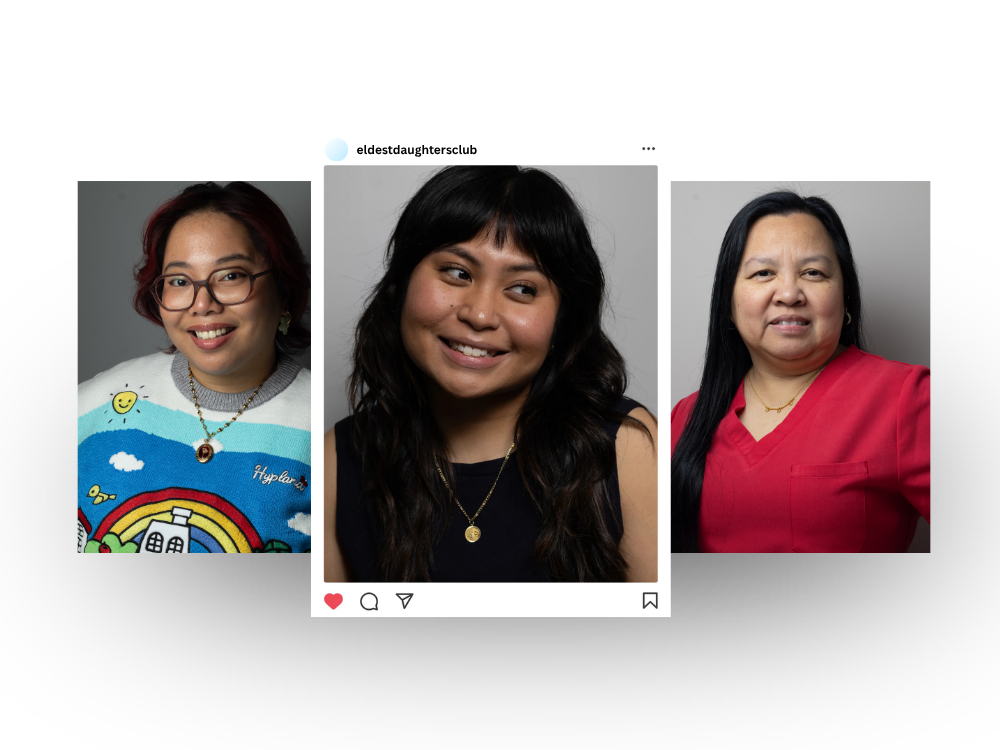
After finding a community of fellow eldest daughters, through @eldestdaughterclub on Instagram and other online groups like it, I’ve learned that there are other people who understand the complexities of this role. The recognition of this shared experience only needed a shift in perspective for me to embrace the upsides and downsides of being an eldest daughter.


