
What are we Worshipping?
I spend my Sunday mornings watching an eight-person band perform for a crowd of 400 — this is the reality in many contemporary Evangelical churches. As a musician and a Christian, I’m questioning why worship is done this way.
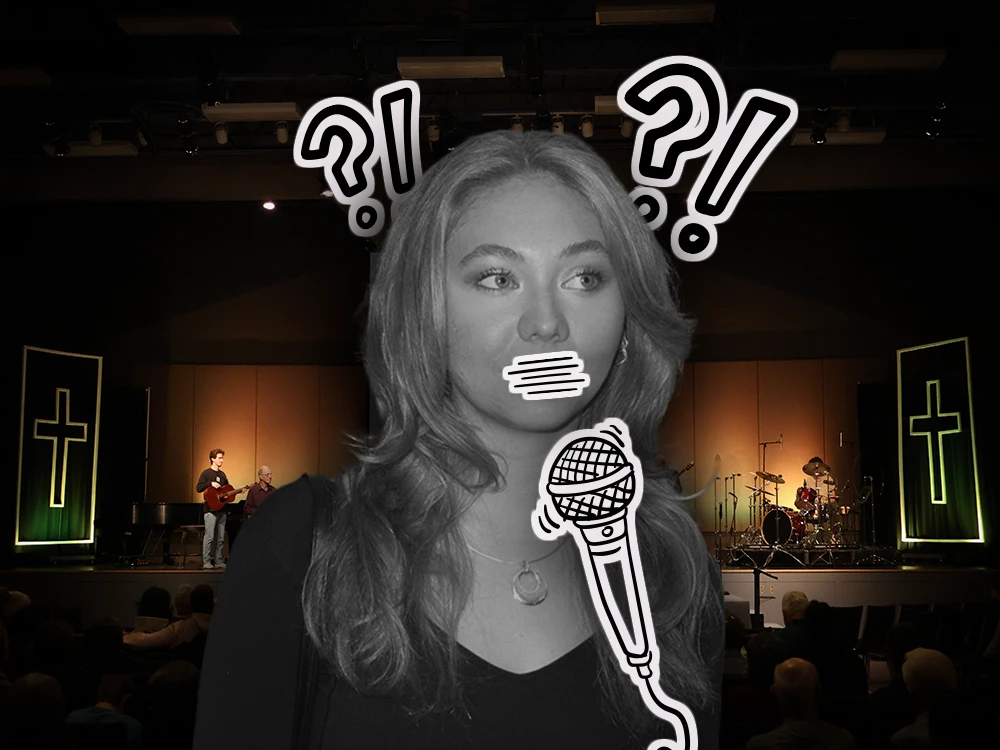
The small band and I hammered out the upbeat melody of our last song on Saturday night, and the teenagers cheered and clapped. We had spent the last three weeks practicing our setlists for the annual September Youth Retreat; the weekend where my church brings 100 teenagers to a Bible camp. To keep the youth engaged, we chose some of the most popular and recent songs in Christian Contemporary Music (CCM).
When I sing and play worship music in front of a crowd, I hope the crowd’s praise and excitement is for God, not those of us on stage — but some days, that line feels blurry. At the end of the song, the voice of a 17-year-old boy rang out over the crowd, asking for an encore.
“Doxology!” he chanted.
I lit up. That’s the title of a classic hymn, and I know the words by heart. I hovered over my microphone and sang out the starting note before backing away so I could hear everyone’s voices. Inside the small chapel, 100 teens sang out a song from 1674. They didn’t need instruments; they didn’t even need the lyrics.
It was the least practiced, least complicated — and in my opinion, most beautiful — song we sang that entire weekend.
My experience with music is indelibly intertwined with church. It’s where I learned to sing, it’s where I was given the opportunity to play for large audiences, and it’s where I first felt the surge of energy that comes from a group singing in unison. Since entering adulthood and joining a large evangelical church, I have begun thinking more about the way worship music is done. As I watch many contemporary churches increase the production value of Sunday mornings by adding eight-person bands and fog machines, I am filled with questions: Why is worship music like this? What’s the purpose of worship music, anyway — and what’s my role in it?
What are we feeling?
When a church song comes to its end and the instruments quiet down to reveal a chorus of acapella voices singing, I feel chills.
This physiological reaction is not exclusive to worship music. “I’m not religious, and I never was, despite going to churches a lot and listening to a lot of church music,” said Dr. Robert Zatorre, a neuroscientist at McGill University.
He’s dedicated his career to music science, publishing a book on the topic in 2023: From Perception To Pleasure: The Neuroscience Of Music.
As a teenager living in Boston who was inspired by bands like The Doors and The Moody Blues, Zatorre felt compelled to learn the organ. But his organ instructor insisted that Zatorre meet him at a church and learn to play Bach, not 60s rock.
“Though my love for mass or oratorios hasn’t converted me to any particular religion, I can appreciate and understand the way it fits in,” says Zatorre. “You can’t play Bach without understanding religion, because he was very religious. Bach wrote his works ‘for the glory of God’ — he put that at the bottom of any of his manuscripts.” On Sunday, Zatorre went, sat, and listened to his instructor play. Zatorre’s mouth opened in awe. “Ah, okay, I thought — he’s right.”
Zatorre clearly remembers getting goosebumps in this moment — a phenomenon he’s studied closely. He explains that music lights up the brain’s reward centre and releases dopamine. This same system is also lit up by food, money, and sex. While these are essential for survival, music is not. This chemical reward helps explain why humans have valued music throughout history. In his TEDTalk, Zatorre points to artifacts of musical instruments from over 35,000 years ago. In an era marked by the goal of mere survival, humans still felt the need for music.
The chills are a result of arousal in your brain, signalling the nervous system to increase your heart rate and cause piloerection, or goosebumps. Goosebumps are typically a reaction to the cold or a significant life event, but the emotional experience of hearing good music mimics these situations.
“When people experience particularly strong emotional reactions, this tends to be associated with something surprising happening in the music,” says Zatorre. This may look like a key change, a beat drop, or introducing a new voice or instrument.
Chills are also more likely to be triggered by music that is sad and thoughtful, rather than happy, according to the 1995 journal article “The Emotional Sources of ‘Chills’ Induced by Music” by Jaak Panksepp. This same study also emphasized unfamiliarity; if a song is new, it’s more likely to elicit goosebumps. These findings are significant when considering the style of Contemporary Christian Music (CCM) that is now being played in many churches. These songs often have slow introductions with long builds, layering in new voices or instruments until the peak of the song is reached.
There’s also an emerging trend in the turnover rate of music in churches. Hymns used to sit in dusty books for decades. Today, modern churches pay an annual subscription to CCLI (Christian Copyright Licensing International), which allows them to stream the lyrics and music of hundreds of thousands of worship songs.

CCLI publishes stats about top used songs. These numbers show songs are sung for fewer years than they used to be before being replaced by new music. I worry about what’s behind this need for innovation. Does eliciting an emotional and physical response support the purpose of worship music? Music has power, and while the exciting sensation of goosebumps could be a divine gift, what happens if I become consistently focused on how the music makes me feel?
Who are we fooling?
For some of my friends who didn’t grow up in church, their experience with Christian music comes from summers spent at Bible camp. There’s a common issue with these Christian retreats: they often play upon human emotion and vulnerability, whether they mean to or not. By the end of the week, you’ve spent several hours bonding with other campers and counsellors over your struggles in life; you’re sleep deprived and homesick, and though you’ve never done it before, you may feel compelled to raise your hands while singing the chorus of the last song because you’ve never felt the love of Jesus like this and you’re ready to change your life! By Monday, everything feels horribly normal and spiritually dry again.
Some call this final day of camp “cry night,” and those highly emotional moments “mountain top” experiences. It’s like the resolve you have on January 1 to stick to your New Year’s resolutions, but it comes with much more elation, and the goal isn’t to eat healthier — it’s to get right with God. While kids are most vulnerable to this phenomenon, I still see it creep into Christian adult life.
In spring of 2023, I attended a Christian women’s conference at a large church in Winnipeg. We were halfway through the worship set. There was a full band plus six singers on the large stage. The synth backing track for “What a Beautiful Name” by Hillsong Worship began, and I felt the hair on my arms and neck stand up. I’m sure dozens of people in the crowd of 400 attendees felt it too.
“I can feel the Holy Spirit moving here in this room tonight,” the lead singer said into her microphone.
I jolted up my head. I dropped my open hands. I stopped swaying. I looked around the room, wondering how many people were attributing the work of the synth to the work of the Holy Spirit.
I believe there was truth in her statement: the Holy Spirit, or God, was in that room. But I believe God is always in the room — whether I feel Him or not. Could pursuing those “mountain top” experiences train me to think that tingles down my spine or tears or the compulsion to throw up my hands is the only way to know my worship is working?
A TikTok from April 2025 shows the Vancouver singer Beach Bown walking down a street with the caption, “I believed in god as a kid because I always felt so moved during worship songs at my mega church and then I went to a One Direction concert and felt the same thing and realized I just like live music.” It has 1.5 million views and over 600 comments, many echoing the sentiment. This got me wondering — how many Christians are basing the quality of their relationship with God with how “moved” they felt while singing?
I brought up this concern to Christine Longhurst, a professor of music and worship at Canadian Mennonite University. “Music is not this emotional wheel we get on to feel connected to God, and that’s how we know we’ve worshipped,” she said. “That’s such a slippery slope.”
Longhurst has spent decades leading worship bands and choirs. “I know that I can make you feel anything if I choose the right songs with the right drum kick at the right time, followed by repeating the tag four times to create a build. It’s so manipulative.”
Manipulative. I shiver at the word, though I’ve thought of it before. As a worship leader, how do I ensure I am not rigging people’s experiences? Longhurst posed a question to me, “You have to start with ‘why are we doing this?’” I’m back to my original questions: Why is worship done like this? What is the purpose of worship music in church?
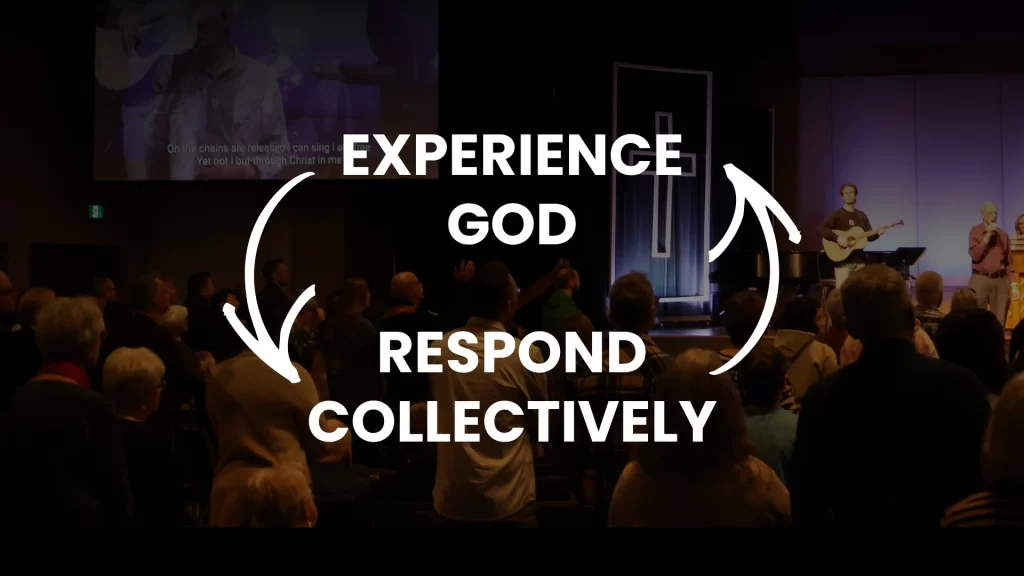
I asked Longhurst for more help. “The purpose of the music is to enable [Christians] to respond collectively to God,” she said, “because at its root, worship is a meeting between God and the gathered community.”
When Longhurst says “respond,” she’s picturing a typical Sunday church service: For me this looks like reflecting on my week, praying, reading the Bible, and hearing a sermon. These are ways God connects with me, and singing worship music is one way I can respond back to Him. What makes this response special is the “collectively” part. On Sunday mornings — as long as we can keep pace with the singers on stage — I’m in sync with others, responding to God through song.
What are we singing?
My older brother has a wide smile and deep convictions; he jokes about everything except his faith. One night during dinner, he brings up the erosion of traditional worship. I play devil’s advocate. The rest of our family chimes in when they feel brave enough.
“I have to agree with Kyle about that one song,” our mom says. “The one about having a ‘shy soul’ and a ‘lion inside our lungs?’ Now where can you find that in the Bible?”
She’s referring to Brandon Lake’s “Gratitude.”
I stiffen. I also don’t care for the lyrics, but I have played this song as a worship leader before. The intro has a beautiful and apparently easy guitar riff that my bandmate David memorized. In my conversation with Longhurst, she addressed this, saying, “One of the weaknesses I see in worship leaders is how they choose songs. It often is more a musical basis than it is an intellectual basis.”
This describes how worship leaders find themselves sorting songs first by tempo, mood, and then meaning. I think this approach prioritizes mood curation over the glorification of God. And yet, I get it. David and I have this conversation every time: “We can’t do that song, we already have two slow ones. We need a faster one.” And when we can’t decide what to play? We default to crowd pleasers, like “Gratitude.”
But then just a few weeks later, on a Sunday evening in October, my friend Ava invites me to her apartment for a housewarming party. A group of young women, most of whom I haven’t met before, share some food before two of them pull out guitars and begin to play worship songs.
I suppress a grin when I hear the opening riff to “Gratitude.” My mother’s words fill my mind. I stop and think: it’s fine, I am content to unenthusiastically sing for one song.
Halfway through, my skin is thick with goosebumps. This is one of the most beautiful sounds I have ever heard. I secretly pull out my phone to record our impromptu harmonies.
The moment is surreal. While being fully immersed in the music, I find myself in a state of wonder: if this is what 10 girls who just met can accomplish in a tiny apartment, how much more beautiful will it sound in heaven? And with the creation of this new memory, I find myself in love with the song. While I regularly listen to my unprofessional recording of it, Brandon Lake’s original version has yet to end up in my playlist.
Brandon Lake is one of the top artists in Christian Contemporary Music (CCM). At the 2025 GMA Dove Awards, a large annual Christian music awards show, Lake took home five trophies — more than any other artist at the event. Among these awards was Song of the Year for “Hard Fought Hallelujah.” The song speaks from a first-person perspective, and includes slang like “I’ma” and a bridge that is the word “whoa” repeated 10 times.
In a 2025 interview with Christian influencer Bryce Crawford, Lake shared that he has a goal with his songs: He wants to reduce the “Christianese language” found in CCM. He’s targeting a persona he’s dubbed “Bubba,” who is “the guy at the back of the room who got dragged there by his wife.” Lake says that Bubba hears “‘Holy, Holy, Holy is the Lord God Almighty,’ and I think he’s going like, ‘What does holy mean? Holy crap? What?’” With this goal in mind, Lake and his team produce multiple tracks a year from their professional recording studios, which you can see on Instagram.
One of my favourite hymns is from 1873. It was written by Horatio Spafford after he lost his house and children to scarlet fever, a fire, and a sunken ship. I don’t think worship music is valid only if it is born out of suffering, but hearing Spafford’s story, I am moved by his faith. While sailing over the spot in the Atlantic where his children had drowned, Spafford returned to his cabin to write “It Is Well With My Soul.” With no team, no soundboard, and certainly no paycheque, Spafford wrote:
When peace like a river, attendeth my way
When sorrows like sea billows roll
Whatever my lot, thou hast taught me to say
It is well, it is well, with my soul
I grew up in a Reformed church that sang out of a hymn book, including “It is Well With My Soul” regularly. My nostalgia for tradition recently led me back to the denomination, and I visited Grace Reformed Church in Transcona.
I was shocked at how foreign it felt, and how different my new evangelical church feels in comparison. The room was bright from the large windows; they had no stage lights, no projector screens, no band — just an organ.
Every song came from a hymnal with titles going back to the 1500s. I didn’t recognize a single tune. There was no person leading us on a microphone, and surely not everyone knew how to read music, yet the room was full of voices.
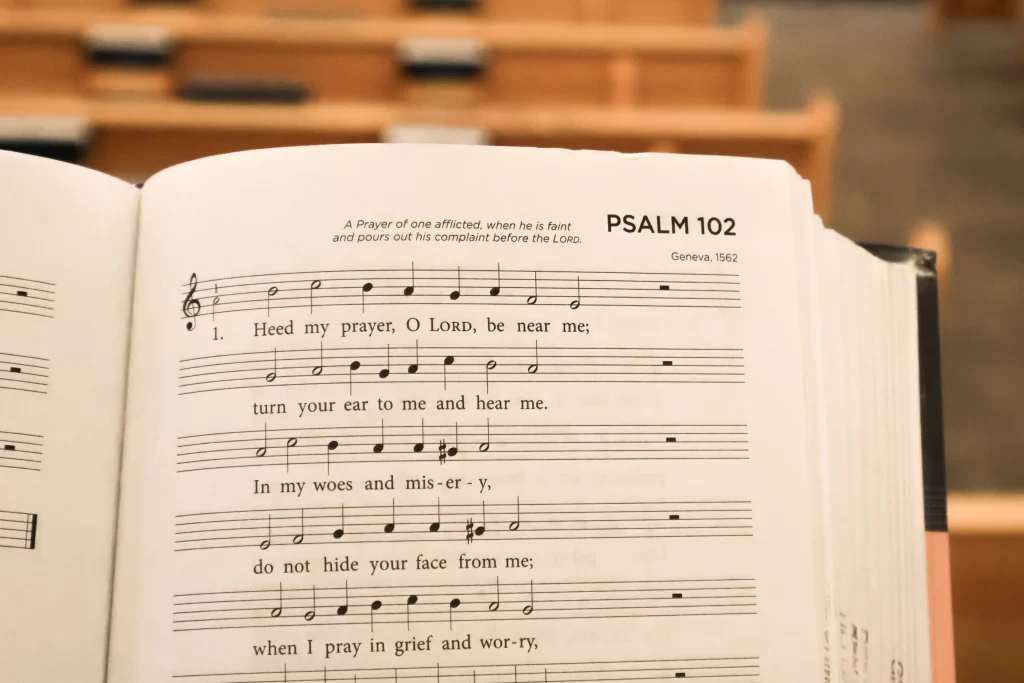
“How does everyone know what and how to sing?” I asked James Teitsma, an organist at the church. He explained how this music is taught in school and carried down through the generations. Teitsma admitted that this may make the music less accessible to newcomers — less “seeker sensitive,” as he put it. This church is not thinking about Brandon Lake’s “Bubba.”
I asked Teitsma how they pick their music. “We ask, ‘will this addition promote congregational singing?’” he said. They use an organ and piano because these instruments are known to be good for accompaniment; their large sound fills a room and supports human voices and pitch. “So, we ask, ‘does the addition of a drum kit assist in the congregation’s singing?’” Teitsma’s church concluded that no, a drum kit does not help. I think what Teitsma asked about the drum kit reflects my core question: how do we support the purpose of worship music? How do I help the collective group respond to God?
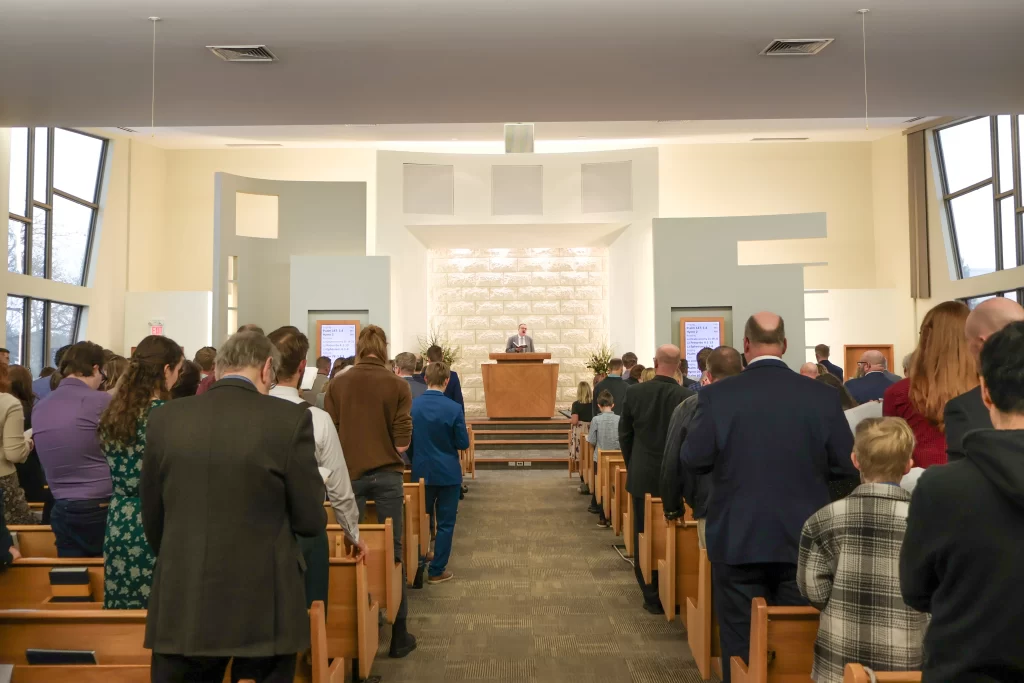
While I appreciated my visit, I can’t really imagine returning to this way of worship. I’ve watched my current church, Winnipeg Evangelical Free, evolve far beyond a drum kit since I started attending a few years ago. Most Sundays, there are up to eight musicians on stage, with a sound team in the mezzanine.
Sometimes I pause during our worship services, and I wonder: if aliens who didn’t know our language and had never heard of Earth crashed into my church’s parking lot on a Sunday morning, who would they assume we’re worshipping? There are people elevated on a stage; their voices are amplified by microphones. The crowd stands facing them, raising our hands and singing along.
Only recently did my church put crosses on the stage. They’re white plastic outlines of the cross shape, suspended in the air against the black backdrop of the stage — one on each side, framing the singers who stand in the middle. Would the aliens notice them over the music and lights? And if shown a historically accurate cross — wooden, jagged, and heavy — would they compare it to our minimalist plastic frame?
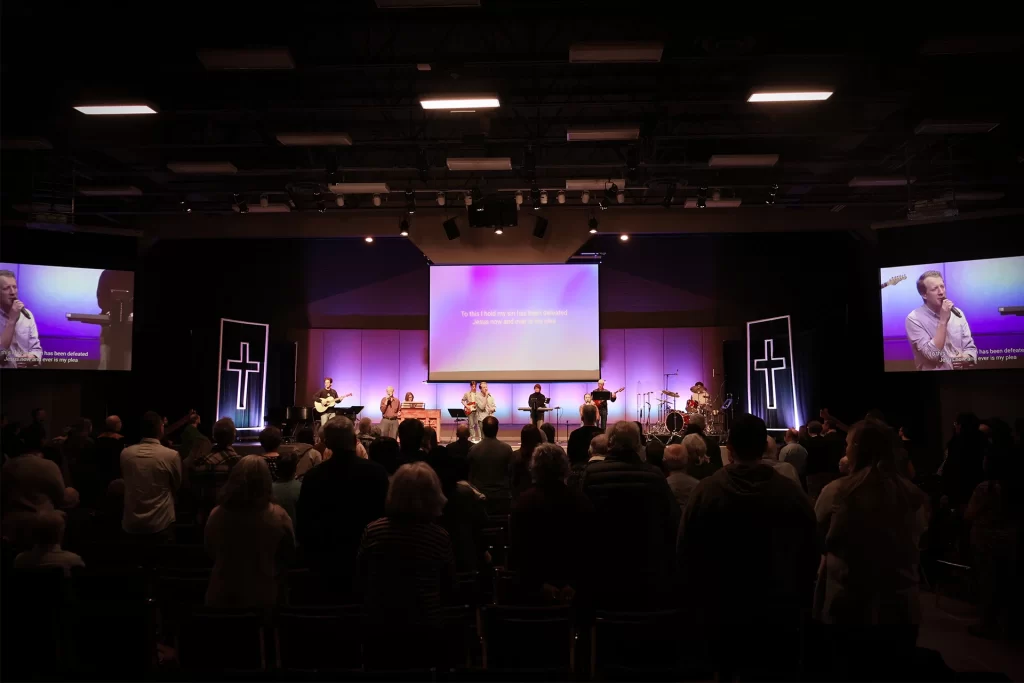
The lights, the stage, the screen projections, the microphones — these are the reasons why I haven’t yet volunteered to sing in the Sunday morning worship band. I’m comfortable working with David to sing for smaller groups when we can minimize the production elements. But I stare at the Sunday morning stage and ask, if pride is the deadliest sin, then why are modern churches placing a person on stage, armed with a microphone, and illuminated by spotlights? If the goal is simply to lead the congregation so that they can sing together and meet with God, why has it become a highly produced performance? Does this performative element support the purpose?
Who are we supporting?
In the mid 2000s, Christians in Australia were rocked by the news of beloved preacher and CCM artist Michael Guglielmucci’s cancer diagnosis. They watched his health deteriorate as he continued to preach and sing for crowds. In 2007, he wrote the song “Healer.” It was an anthem for people enduring illnesses, with the lyrics calling on Christians to put their faith in God for miraculous restoration.
A giant CCM producer picked up the song and included it in a worship album in July 2008. Video clips from that time show Guglielmucci delivering an emotional performance, singing to a mournful crowd while wearing his oxygen tube.
But it was all a lie.
A month after the album release, Guglielmucci admitted to having a 16-year porn addiction that he claimed was so spiritually debilitating, it manifested as physical symptoms, including his hair falling out. He passed off these symptoms as being caused by cancer, using doctored medical documents and props to fool his audiences, parents, and even his wife.
Knowing this backstory, should we sing this song in church? That’s the question Silas Friesen posed to me and other young adults at Winnipeg Evangelical Free. He took the debate idea from Dr. Geoff Dresser, who taught Friesen while in his fourth year studying worship at Briercrest College.
“My hope was for the group to engage with the tensions around worship music as a way to glorify God, but also as a performance done by flawed people,” said Friesen. The debate was heated on both sides. Reading over the lyrics, I couldn’t see any theological points I disagreed with — but the origins of the song were disgraceful.
“Healer” was made famous by Hillsong Music, a CCM collective that produced the song on their album, This Is Our God. Hillsong is a megachurch originally from Australia that has locations throughout the west. Hillsong Music, Bethel Music, Elevation Worship, and Passion Music have been nicknamed the “Big 4”; they’re each megachurches based in Australia and the United States that also produce CCM.
From 2010 to 2020, the same 38 songs appeared across the top 25 lists put out each year by CCLI; 37 of them were co-written or made popular by one of these megachurches. So, when stories like Guglielmucci’s emerge from within these churches, worship leaders like me are left wondering how these scandals should impact our repertoires.
Controversies and coverups are not new for the church, and have emerged from every denomination. The latest scandal of the Big 4 happened on January 17, 2026, when American pastor and Christian apologist Mike Winger released a six-hour video exposing Bethel pastor Shawn Bolz. Winger accused Bolz of sexual abuse and fake prophesying, claiming that for over a decade, leadership at Bethel knew what was happening and hid it, contributing to what Winger calls “cover-up culture.”
Bolz gained traction in 2013 for his prophecies, where he would seemingly miraculously come up with the names, addresses, and relationship statuses of audience members, without ever having met them. Victims have stepped forward to say that Bolz was collecting people’s personal information from Facebook ahead of events and then pretending it was prophetically provided by God.
When these scandals arise, my heart sinks, and I see a push to boycott anything produced by the Big 4. The concept of boycotting controversial musicians, such as Kanye West after his antisemitic behaviour, is familiar to both religious and secular society. The challenge for churches looking to filter their music comes when trying to decipher what is considered tainted by the ideologies of Big 4 churches like Bethel, and if singing Bethel songs hinders the purpose of worship. I sought answers from Kurt Willems, the worship director at Winnipeg Evangelical Free Church, where I attend. This is a large church, seeing upwards of 450 attendees across two Sunday services each week. In some churches, worship directors are volunteers, but because of the church’s size, Willem’s position is a full time, paid job.
“When Bethel is brought up, I ask, what’s considered a Bethel song?” Willems says. “Is a Bethel song any song that is on their Apple Music? Is it any song they make famous? Is it any song that features an artist who has sung for Bethel? Is it any song related to any staff, songwriter, or member associated with the church who plays any role in the production process?”
Worship artists don’t have to be a part of the megachurch to collaborate. Guglielmucci was leading his own worship collective when Hillsong scooped his song, and Brandon Lake has produced with both Bethel and Elevation while still pastoring at a different church. For emerging CCM artists, being picked up by the Big 4 is a chance at a big break.
“I think trying to eliminate every possible association with people or churches that you disagree with is a bit of a lost cause,” says Willems. “You’d pretty much have to be willing to write all your own songs, so I try to limit associations, not eliminate them.”
Willems’s approach is to choose as many songs as possible from churches or labels that are in good standing in the community, but his top priority is “judging songs based on their content.” Song lyrics are just one of the many areas of concern for a worship leader. Willems created a wheel of concepts to be held in tension. This wheel is designed to provoke thought in worship leaders and participants alike.
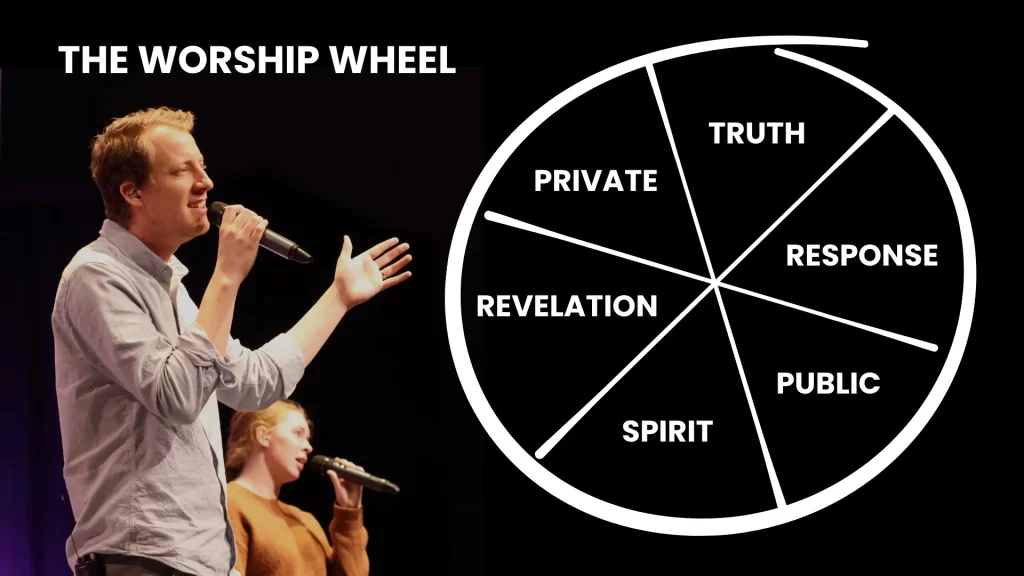
Willems says that when one side of the wheel is overemphasized during worship, there’s a problem. For example, focusing on spirit is to pursue an emotional high, prioritizing musicality and feelings above lyrics and theology. But if you lean too much into rigid truth, worship may become an intellectual exercise, lacking heart or authenticity.
This kind of visual helps me identify the delicate threads holding worship together, both for me personally and the wider church. But the wheel doesn’t solve other issues: ego, production costs, risk of manipulation, or the sins of musicians and producers. Maybe we should go back to classic hymns of the 18th century. At least those sinners are dead and public domain laws say we don’t owe them a penny.
I don’t know what exactly needs to change within church music. What matters to me is that we talk about it. When left unchallenged, seemingly small ideas in churches become powerfully hegemonic. Not everyone will agree with the purpose of worship being to “respond collectively” to God. My question is, then: what is your definition of its purpose, and how do you uphold that?
I want to be part of a church and worship team that looks inward, carefully considering our intentions. In the meantime, I’ll continue playing music for smaller groups. But something has to change before you’ll find me on the mainstage on a Sunday morning — whether it’s my heart or the production value is to be determined.


