
A Beginner’s Guide to Ranked Play
In 2019, my high school esports club had fewer than 10 students showing up each week. Today, 72 schools are registered with the Manitoba School Esports Association. So what changed? As it turns out, a lot more than I ever expected.
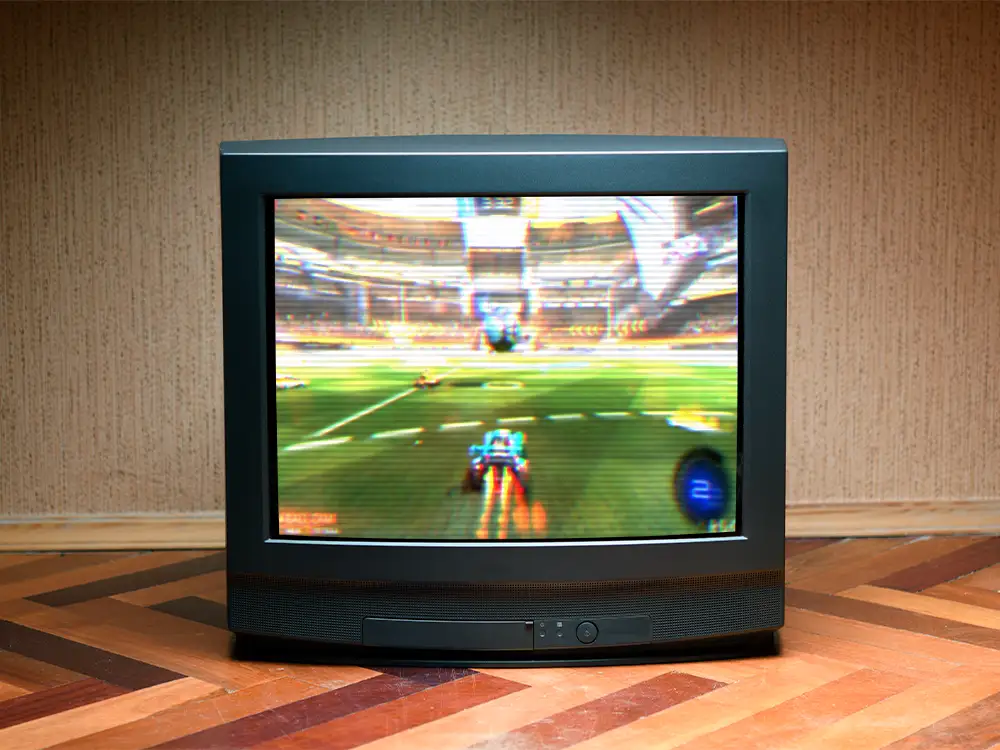
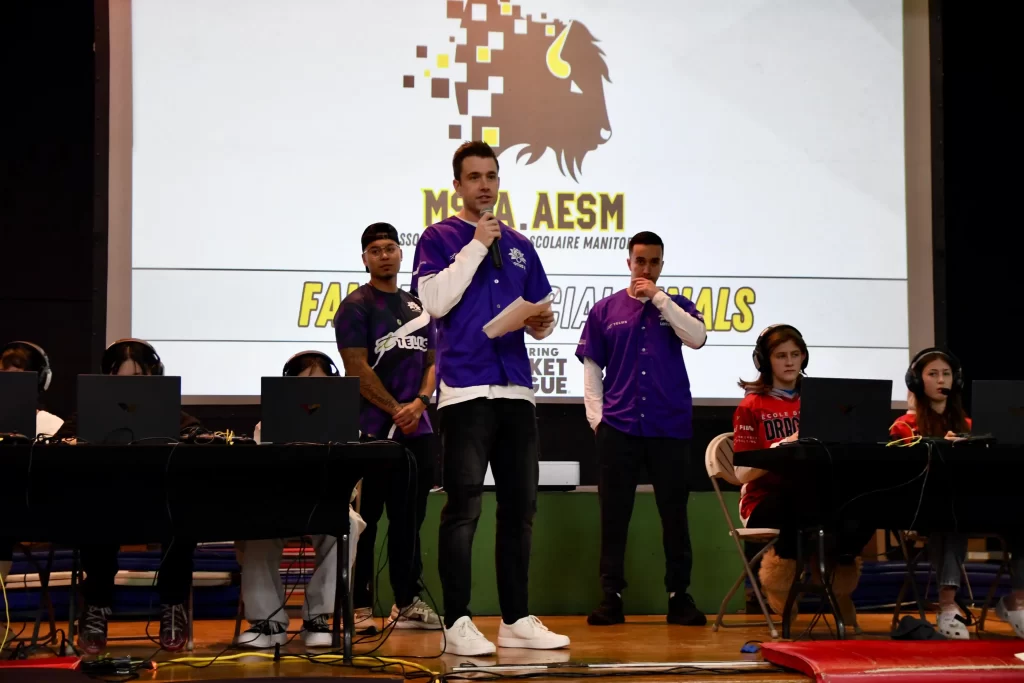
Cheers ring out from the Kelvin High School gymnasium as Allison Harder from the École Dugald Dragons scores the tying goal in the provincial championship game. As the replay shows the Dragons’ goal, their coach tells the team to focus and stick to their game plan. They high-five, praising Allison for her amazing play. Their opponents, the Gordon Bell Panthers, hang their heads — then reach down and grip their controllers.
It’s the 3rd annual Manitoba School Esports Association (MSEA) Provincial Championships for Rocket League, a physics-based video game that combines soccer with rocket-powered cars. The championship saw more than 20 schools from across Manitoba compete in the playoffs, with separate leagues for middle school and high school students.
The winners of the provincial championship are eligible to compete in the national championship, hosted virtually by Esports Canada. While this scene and structure looks and feel a lot like other school sporting events, a few things are different.
For one, esports are not part of the Manitoba High Schools Athletic Association, so the leagues and tournaments are organized by the MSEA, a non-profit organization run by teachers and educators around Manitoba.
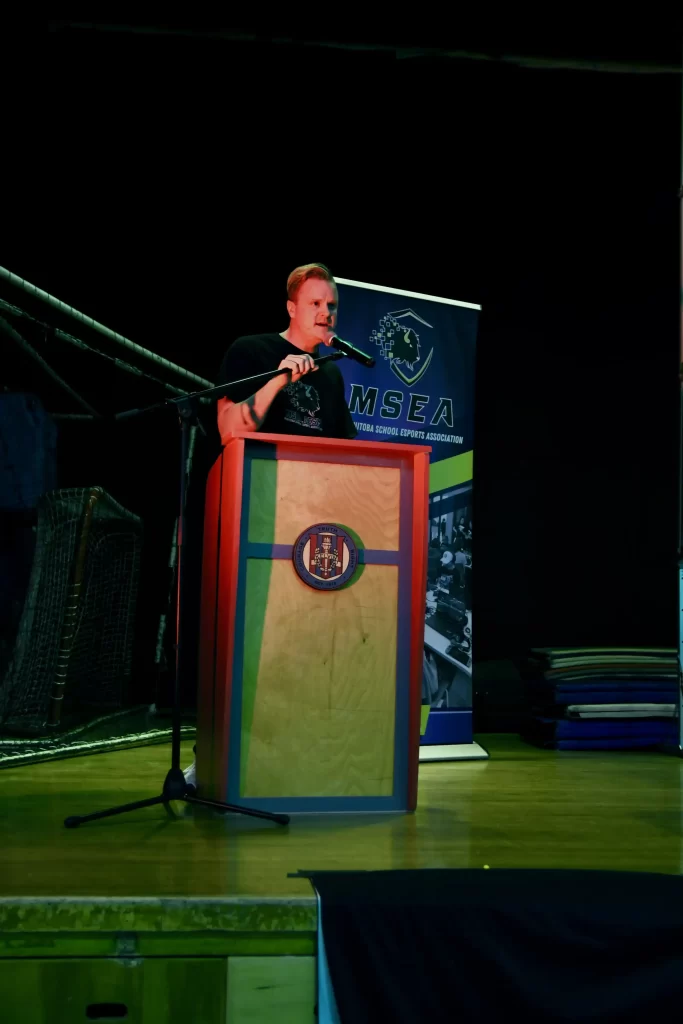
James Young, the co-founder of the MSEA and director of the senior year leagues, has been working with the MSEA to change the perception of esports and video games.
He is highlighting the positives that come along with structured leagues for gaming. Esports clubs host weekly practices and provide a variety of consoles such as gaming laptops, Nintendo Switches, and Xboxes. They open their doors at lunch for students to drop in and play, even weaving gaming into spirit weeks and colour days.
I was part of the esports club at my high school, Dakota Collegiate, from 2016 to 2020. Our club only had a handful of people, and even fewer showed up. We would meet once a week to play one game because it’s all our club could afford: Super Smash Bros. Competitions with other schools were few and far between. We played with Glenlawn Collegiate once a year because our teachers knew each other outside school and would plan the event together.
The esports club I was in six years ago pales in comparison to what the MSEA has created today. It makes me wonder how esports became such a popular and organized extracurricular in Manitoba? How did they get students, teachers, parents, and administrators to buy in?
The answer is more nuanced than I thought. While the stigma around gaming hasn’t disappeared, research, student testimonies, and a network of organizations working to improve gaming are finally putting esports in a different light. Manitoba schools are starting to embrace what gaming can offer: community, belonging, teamwork, and fun — things that are making a big difference for students like Allison Harder.

A Different Game
When I was in high school, my friends would jab at me about being in the esports club. They said the people were weird and cringey. I felt embarrassed — and that embarrassment is exactly the problem the MSEA is trying to fix. Gaming carried a stigma from my classmates, and at home, my parents would tell me to stop playing video games and do something better with my time. They thought the games I played were too violent and bad for me.
Allison’s experinece is different. She found out about her school’s esports club through a friend and was later encouraged by her teacher to try out for their Rocket League team. “[My teacher] told me about it before he put up the sign-ups and asked me if I wanted to join,” said Harder.
Nobody recruited me. Nobody pulled me aside before the sign-ups went up. Hell, we didn’t even have sign-ups.
Karl Hildebrandt, the CEO of the Manitoba School Esports Association, is one of the people responsible for that difference. He has been a part of the esports scene since he started his own club 12 years ago. He said it was challenging, as the idea that video games make children more violent and unproductive was difficult to shake. Educators largely saw gaming as a frivolous pastime, rather than a tool.
“It’s been difficult to change that mindset,” said Hildebrandt.
Studies conducted throughout the ’90s and early 2000s focused on the harms of gaming, making it difficult for him to expand what he had at his school. It was especially difficult to convince older decision makers that gaming had a place at school.
“The media coverage 20 years ago is still entrenched in the older generation, and that’s kind of who are in those positions of power that decide whether these things happen,” said Hildebrandt.
I didn’t know about this media coverage before I began trying to understand why esports had changed so much. But after learning more, I connected the dots on why everyone was telling me video games were a waste of time — even bad for my mental health.
A book published in 2007, “Violent Video Game Effects on Children and Adolescents: Theory, Research, and Public Policy” said that violent video games make students have more hostile personalities, believe violence to be more typical, and behave more aggressively in their everyday lives.
Another article published by The Guardian in 2000 links the video game Doom — a first-person shooter where the player has to kill demons — as a possible influence for the Columbine High School massacre.
Extreme, but I’d bet you’d believe it if it was all you read about video games.
The real problem isn’t the research itself. It’s the selection. When headlines consistently frame video games as dangerous, readers buy into the narrative.
A more recent study from the University of Oxford in 2019 shows that a person’s behaviour isn’t linked to the video games they play whatsoever. It explains that past studies cherry-picked results that added to the moral panic surrounding video games, and concludes that “Our research has not demonstrated that there is cause for concern.”
So yes, it’s disproven today, but this narrative was still something the MSEA is pushing through. Learning all this made me curious about how they changed minds about having video games in schools. The answer is simple: their positioning and values.

Better Together
Young and Hildebrandt promote esports as a way for students to connect. Both encourage healthy gaming by educating and setting ground rules for students to ensure they get their video game fix in an educational and team-building environment with peers, rather than at home by themselves.
“We know kids would play in the dark in their basement, but at school, they’re playing together as a team,” said Hildebrandt. “We want to bring esports into a positive light, and that’s what we’re trying to achieve with the MSEA.”
And in Allison’s case, the team aspect is a major reason she joined.
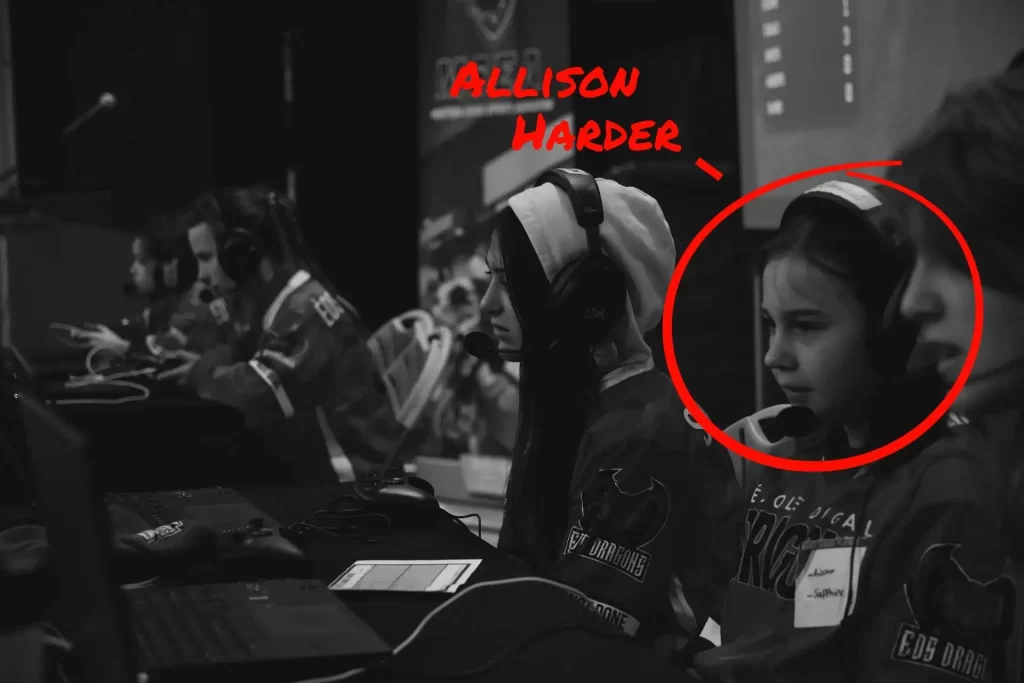
“I became closer with my classmates, which was nice,” said Harder. “We got to know each other really well by spending a lot of time together.”
And for me, playing doubles with my club was the best part of it all. We would play one-on-one with each other, but when you had a teammate there with you, everything was just so much more exciting. We would hype each other up if we did something cool, and when I won, we could celebrate together.
Research further iterates this fact. In a study comparing 67 esports gamers to 107 casual gamers, the Université du Québec à Montréal found that “esports have positive consequences on their physical and mental health, social and family relations, and on their motivation.”
For Allison, the benefits of esports stretch beyond her club. She says competing has helped her develop communication and leadership skills that show up in her everyday life at school.
“When I’m doing work [in class], I’m able to help my friends out with the mistakes that they made,” said Harder.
She’s not alone in that experience.
A World Economic Forum article found that gaming naturally builds communication and teamwork skills in students. Esports are a vehicle to train these skills, and while the spirit of competition is still very much a driving factor in these clubs, the why of it all includes students to meet new friends, talk to each other about a common interest, and discover a community that makes showing up to school feel worthwhile.
“For some students, it’s the only thing that gets them out of the house,” said Young. “So, this is the first step toward getting comfortable being in a building in a social setting around people the same age.”
The approach is deliberate. The MSEA builds its clubs around the idea that gaming is better together, and that these spaces are a place to make friends or meet people you wouldn’t normally talk to.
I know gaming helped me find friends I wouldn’t have met if it weren’t for our gaming club. I was a shy kid going into Grade 9, and having common ground with my peers helped me find my voice — I still talk to some of them today.

Creating an Inclusive Space
I tried out for my Grade 9 basketball team when I was in high school, and long story short, I did not make the team. Who knew a 5-foot-3, 110-pound kid would not be a generational basketball player?
But esports were a great fit for me. I was still on a team and competing for my school. Some players were definitely better than others, but everybody had a place. None of my fellow club members played any of the “traditional” sports at my school, but still got the experience of being on a team that represented our school.
Allison found the same thing. Where some competitive environments can push people away, esports kept that door open.
“For esports, there’s no negativity. We all get along,” said Harder. “We are all sweaty students sitting in a chair playing the same game.”
There’s one detail I left out, though.
Harder didn’t make the regular esports team when she tried out for Rocket League — she didn’t even try out.
She tried out for the MSEA’s Game Changers Division team. The Game Changers league started in 2025 and consists of only women and gender-diverse students. While the championship had its regular teams, it had the first-ever Game Changers division championships as well.
It’s an ongoing effort from the MSEA to make gaming more inclusive, and Young said that the regular teams had made it difficult for women and gender diverse students to “fit in” with the regular clubs.
“[The boys] can be loud, super competitive, and it can just be an unappealing environment for students who aren’t boys,” said Young. “So having a separate Game Changers division gives those students a comfortable place to play.”
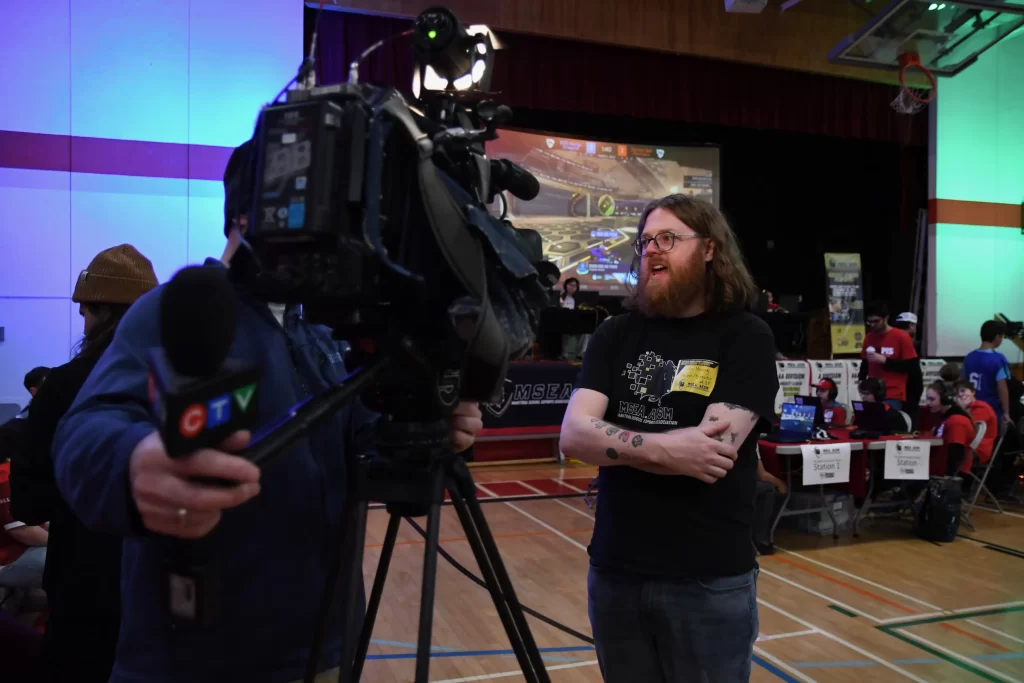
Currently, the MSEA only has a Game Changers division for middle years Rocket League and Minecraft. However, the league is growing and is planning on expanding it to different games and age groups.
“This is the first year we actually have a division for middle Years Rocket League,” said Young. “We want to do it for seniors as well because it’s had such a big effect for middle years — our plan is for the spring Rocket League season to do a Game Changers division as well.”
The MSEA is built on the foundation of inclusivity, and for James Young, that foundation is personal.
Young grew up in a small, rural town in northern Manitoba. He’s loved video games since he was young, but felt left out at his high school of 25 students. He was relentlessly bullied by peers who didn’t take kindly to someone different from them. He started the MSEA because it was something he needed growing up, and never had.
“I had a very challenging time in school, and I know that if I’d had something like this in high school, my life would have been much better,” said Young. “That’s 75 per cent why I do it.”
That mission shows up in the students the MSEA reaches.
“There was a team that was playing Rocket League in high school, and one of the students had a wheelchair, but he could still hold a [controller], and he could still talk,” said Hildebrandt. “He fit into that place, and you could see it: this is where he belonged.”
Belonging doesn’t require you to be good. For Allison and everyone else, it just requires showing up. In the future, Allison wants to make sure others have the same opportunities too.

Next Steps
“In my future, I’m planning to be as involved as I can in esports,” said Harder. “I want to go to events and help out — hopefully be a coach at some point.”
She’s not the only person who’s thinking about the future.
Steven Mao is the founder of Lotus 8 Esports, a Manitoba-based esports organization recognized at the highest level of competitive play worldwide.
Mao started Lotus 8 in 2024, and in just over a year, has grown to include teams from around the world — most recently, their Call of Duty: Warzone team competed at DreamHack Birmingham, finishing in the top 16 globally.
Steven started Lotus 8 for the same reason Young started the MSEA — he didn’t have anything like it growing up and needed it.
“I use what I struggled with, and I built [it into] what Lotus 8 is now,” said Mao. “I’m able to create these opportunities for students that I never had when I was in school.”
But Mao isn’t just building a competitive roster. Lotus 8 actively sponsors and supports students and educators, promoting healthy gaming habits and creating opportunities for students who want to take esports further than competing in high school.
Firstly, Mao is an NCCP-certified mental health professional and a meditation and mindfulness coach. He uses both of these certifications in tandem to teach educators and students about healthy gaming, and partners with the MSEA as a platform to spread that message.
“They would have a time slot for us, we would talk about who we are, and tell them our mission — helping youth with their development and mental health,” said Mao. “We educate about the importance of fitness and mental health in esports. We then switch off by teaching everybody in that room live sessions in mobility, and I guide everybody in meditation.”
That focus on physical and mental health isn’t just a talking point for Mao and his presentation — it tells a truth about esports and what it actually takes to perform at a high level.
A study done by McGill University, “Exercise Improves Video Game Performance: A Win-Win Situation,” found that exercise directly correlates to improved performance in gaming, making physical fitness not just good for your health, but good for your game as well.
Mao takes that seriously. And while his teams practice, it’s nothing like what you’d find in a traditional sports team. There are no laps around the gym or push-ups for missed layups. Instead, Lotus 8 is focused on the mental well-being of players, because according to Mao, that’s what affects their performance the most.
Mao holds his players to the same standard, and says this visibility matters.
“Our pro players don’t compete without doing these preparations now, and if students are seeing pro players do this, the students will be more insightful to follow that kind of pathway,” said Mao. “Students might say, ‘Lotus 8 is doing this, they’re succeeding because they’re taking care of themselves.’ That already alone inspires students to work on themselves.”
And this work needs to be done as well. Research from McGill University states that “young gamers may be at a higher risk of mental health problems,” when they struggle to manage their own gaming time.
That’s where Lotus 8 helps. When an established esports organization tells students to take care of themselves, it lands differently than hearing it from a teacher or parent. Lotus 8 has the resume to make students listen. And has created a pathway to show them where healthy habits can actually take them.
“Before Lotus 8, Central Canada never had a pro team,” said Mao. “We created a pathway from grassroots to pro, and are the Central Canada pro team.”
Lotus 8 is the first Central Canadian professional esports organization, and just existing, it brings esports opportunities to Manitoba.
Opportunities in gaming are increasing across Canada. Universities are starting to take notice of skilled esports players just as they would a talented athlete in traditional sports.
The University of Waterloo in Ontario offers students scholarships ranging from $2,500 to $5,000 to students enrolled in eligible programs that might lead to a career in videogaming or esports. Other universities such as St. Clair College and the University of Ottawa are offering bursaries for students who are skilled esports athletes.
Even if these scholarships don’t mean becoming a professional player, they could help make college more affordable for some players.
For Allison Harder, that future isn’t far away. She’s in middle school, competing at provincials, and already thinking about coaching. The pathway Mao built, the spaces the MSEA created, they exist so that students like her have somewhere to go and a passion to pursue.
She just has to keep playing, even when it sucks.

Defeat
Allison and the Dragons ended up losing the grand finals to the Panthers in a close series of five games.
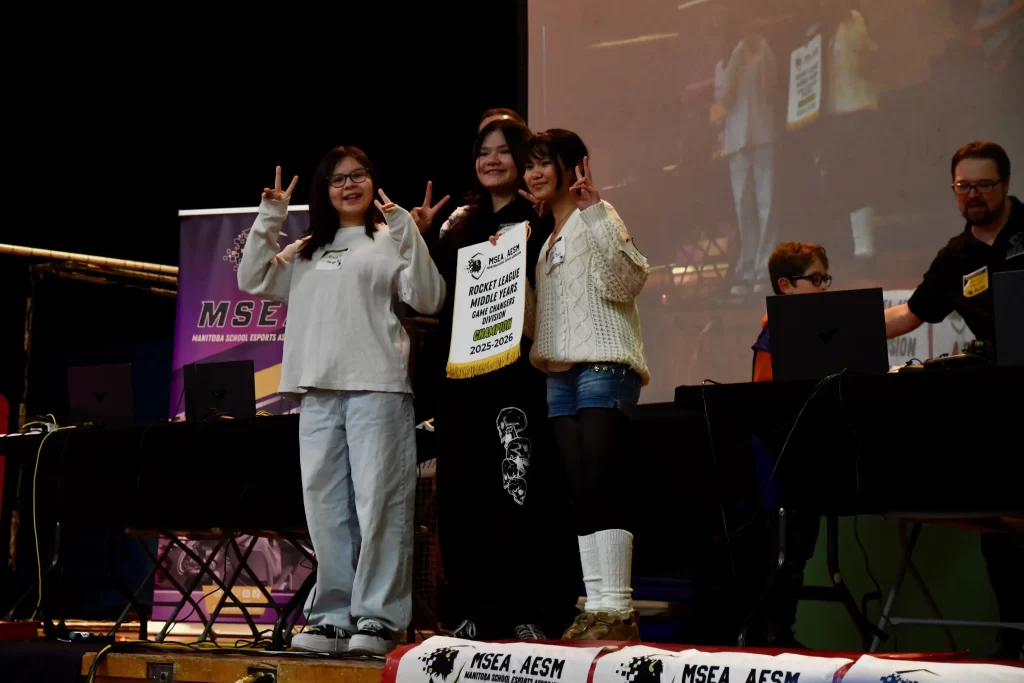
They collected their finalist banner and walked off the stage, looking back as their opponents got their picture taken with the championship banner.
This moment reminded me of my own esports loss from years ago. It was the 2019 annual Super Smash Bros. tournament, and after a long day of matches, I was sitting on a long couch. My clammy palms were white-knuckling my controller, staring up at Glenlawn’s projector screen, the grand finals were about to start.
To put it bluntly, I got destroyed. Glenlawn’s star player, who went by his gamertag “Sleepyhead,” proceeded to dismantle me in all three games.
After losing, I sat on the couch, staring at the ground while he popped off in front of the crowd of 30-odd students there.
My esports career ended there. COVID-19 hit before I got the chance to redeem myself in Grade 12 and just like that, it was over.
Some might call that a sad ending. I don’t.
I was surrounded by friends, in the most exciting moment of my high school career. I lost — but at least I got the chance to compete.
And for Allison, there’s always next year.


