The Tiny Game
Come for the miniature orcs and goblins playing football. Stay for the camaraderie.
Listen to this story:
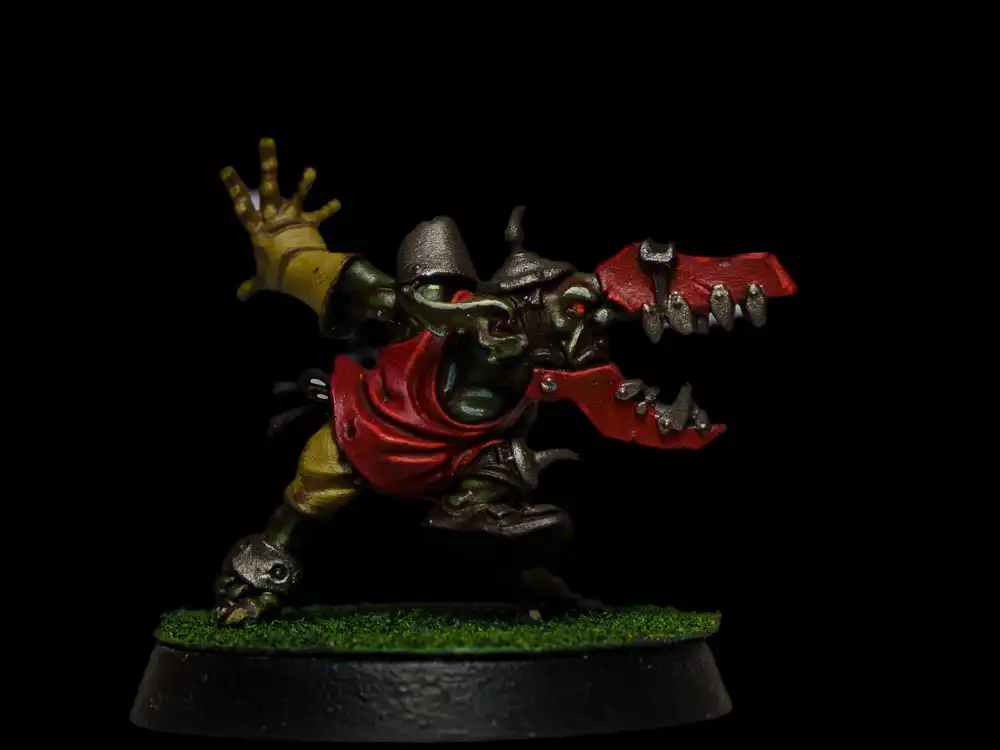
Welcome one and all to another gloriously brutal day on the pitch. The sun is red, the sky is blue, the grass is green (as long as you ignore the bloodstains). We have another exciting matchup for you today. The Rats are sharpening their tails for what looks to be a grueling match against the returning champion Orcs. That leathery green skin ought to blend right in with the pitch, not that the Orcs will be trying to hide.
Alright folks, settle into your seats and buckle in, today’s game will be a doozy. Can the Rats outrun their brutish opponents, or will the Orcs catch up to them and lay down a bruising? Enough talking, let’s find out.
Blood Bowl is a tabletop board game that parodies American football. It’s best described as literal fantasy football. Instead of the Seattle Seahawks, it’s the Athelorn Avengers. Instead of human players, it’s miniature plastic elves.
Like many tabletop games, it’s played with miniatures about the size of an adult thumb. They come unpainted in grey plastic on a flat sprue. They must be built, primed, and painted in order to play, turning every new team into a personal art project.
While many people play Blood Bowl casually, there are some people, like Eric Blaich and Sven Drakenspear, who play at a competitive level.
Earlier this year, Eric was looking for a spot on the National Open team that would represent Canada in one of the biggest annual Blood Bowl tournaments, Eurobowl. Sven, the team captain, interviewed him after they played a game to test Eric’s mettle and see if he had what it takes to compete at that level.
He does.
Sven has been playing for over three decades and is the most skilled player on the National Open team. He makes the final decision on new members like Eric.
Like football, the game starts out with a kick-off, but in Blood Bowl, the kickoff opens the possibility of up to a dozen random events, things like trapdoors opening or a sudden blizzard blowing onto the pitch. Then the coaches (the humans playing the game) take turns moving their players (the figurines) across the pitch via squares, like a game of violent chess. The goal is to score touchdowns like a traditional football game. Nearly everything is determined by chance, which keeps the game light.
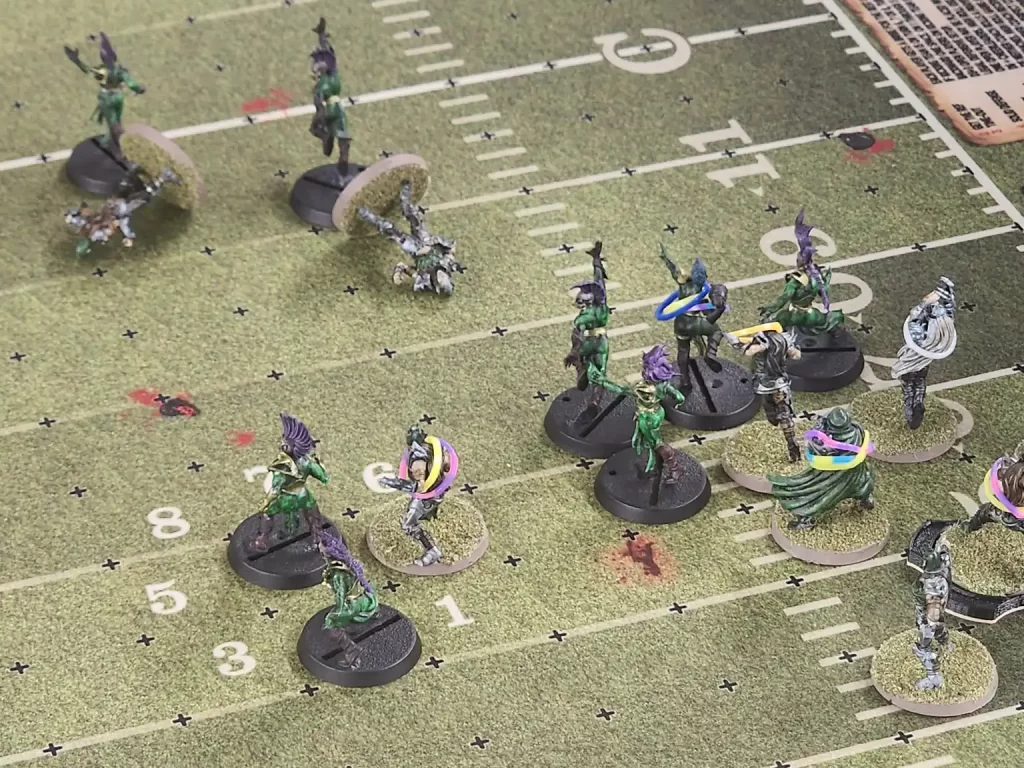
No matter how hard you try to win, your plans can always be ruined. Your Goblin blitzer can be one space away from carrying the ball into the endzone but fall victim to an unlucky roll. I’ve seen it happen many times at tournaments. Situations like this lead to loud uproars from spectators. Anything can happen — like seeing your opponent’s eyes widen as your lumbering Ogre somehow manages to catch the Hail Mary pass you sent down the field.
Coaches choose their team from over twenty sets that can be purchased at local game stores. Themes vary from Goblins, Knights, and, in Eric’s case for most of his Blood Bowl career, Lizards.
“I played my Lizards for a long time, but I think my favourite is Vampires now,” said Eric, a 32-year-old who’s been playing since 2022. “I like how much skill it takes to play them well.”
Eric plays in the Manitoba Blood Bowl League, a group made up of 30 coaches that each choose a team, paint it, build a roster, and organize games against each other for a season, usually lasting four months. Coaches record and track everything that happens in a game, which takes about an hour to play, including things like the score, injuries, and deaths. Yes, sometimes players pass away on the pitch.
Eric won last year’s league with his Vampire team, giving him the confidence to try out for the National team.
“I played against Drakenspear himself, which made me have a f****** heart attack,” said Eric about his practice match against Sven.
The Eurobowl tournament is set to start in October in Warsaw, Poland. The caliber of competitors in Europe for tabletop games is much higher than in Canada.
“We can play a tournament here every month at best, over there they can play two every weekend. The level of practice isn’t even close,” said Eric.
Blood Bowl was made by a company from Nottingham, England in 1986, which explains its European popularity. The rules haven’t changed much over the years, and the community has played a large role in keeping the game alive. It has a relatively large following in North America, but North American matches only makes up about 10 per cent of recorded matches globally.
To prepare for Eurobowl, Eric is trying to play as many games as he can. He played in a charity tournament in February 2026 called the Dallas Cup. The tournament is named after a community member that often wins the sportsmanship prize events. All proceeds went to Manitoba Mutts Dog Rescue, a cause dear to Dallas’s heart.
At the charity tournament, you could even buy a re-roll for your dice if you didn’t like the result. It was always clear when that happened because you’d heard a “damn it” followed by the clink of a loonie hitting the table.
Tournaments like these are often held at GameKnight Games, a game store painted to look like a castle from the outside in Winnipeg’s Osborne Village.
New faces are always welcome at tournaments like the Dallas Cup. What keeps many coaches coming back is not the pretty painted miniatures or the thrill of rolling well, it’s the camaraderie around the table.
“Everyone is super nice and it’s fun even if you’re losing, which I think is the entire point,” said Eric.
The age range of people who show up to play varies. The youngest member of the league is 12 years old, the oldest 54.
Since this game has been around since the 80s, it has kept a loyal fan base that has aged alongside it.
According to medical science journal Cureus, board games are shown to prevent cognitive decline and help those who are already experiencing impairment. In a test comparing people who played board games regularly over the last twenty years and those that did not, the ones who played had a 15 per cent lower risk of dementia. These results are useful for older adults, but board games have been proven to help younger children with Attention Deficit Hyperactive Disorder (ADHD) as well.
The same paper states that games aid in improving executive function, a term that describes the brain’s ability to regulate impulse control. According to the Attention Deficit Disorder Association, those with ADHD are often heavily impaired when it comes to executive function and therefore struggle with completing tasks involving delayed gratification. They report children playing the Chinese board game Go were seen to experience hyperarousal in the parts of the brain responsible for executive function attention.
Playing board games early in life can provide even more benefit. Another paper published by the Scandinavian Journal of Psychology found that preschoolers that played board games together, both competitive and cooperative, showed better social behaviours.
Rolling dice on the pitch at an early age has made a huge impact on some of the young coaches playing in Winnipeg, including Baz’s children.
Another beautiful day for some carnage! We’ve got a special feature for you all today, three coaches all hailing from the same family. Each at the helm of a different team, but all here seeking the same glory. Who will emerge victorious, and who will be left strewn across the field? There’s only one way to find out folks. Let’s play ball!
Michael “Baz” Bazylewski manages the Manitoba Blood Bowl League, working out the administrative side of things and setting up matches. He started playing tabletop games about 15 years ago. He still plays a few different games, but Blood Bowl is his pride and joy.
“It has definitely been rewarding, but definitely taxing to be honest,” says Baz. “My number one goal with how I run it is, it’s run by me — but it’s what all the community wants.”
He not only runs the league himself but also plays in it. He enjoys playing the Snotlings, a team made up of tons of little goblins, each the size of a fingernail.
They’re a goofier team, not meant to be competitive. This is where Eric and Baz differ in their play styles.
“I make people laugh and I laugh too. I can win, but it’s absolutely not what I’m looking for. It’s just the game itself,” said Baz.
The social aspect is what he loved most about the game. It’s helped him come out of his shell and meet new people.
“I’d like to say every one of the members are my friend,” said Baz. “I just absolutely love it.”
The theme of the game itself helps grease the social wheels; things like an Ogre eating one of his own teammates during the game, or a wizard in the crowd casting a fireball and knocking down your players add to the tongue-in-cheek nature of it.
Baz rarely comes to any Blood Bowl game alone though. His two children, Lucius and Mason, ages 18 and 15, are usually by his side rolling dice and talking strategy.
Baz homeschooled the boys during the pandemic, so it was difficult for them to grow their social skills and make new friends.
“I would have anxiety around people and never open up,” said Lucius. “But with this game, it brings me more confidence to talk to people and get to know them.”
Lucius played his first match when he was 12, so he has grown up with the game and its community. Mason found he’s developed an interesting skill playing against older league members for so long.
“Being around older players made me feel more mature, and I realized who was immature at school,” said Mason. “I could tell who were not the greatest people to be hanging around with.”
The family had a chance to experience the community on a much larger scale when they visited Pow Town, the largest annual Blood Bowl tournament in Canada, hosted in Calgary.
Many league members make the trek out to Pow Town together, including Eric, who won best defensive team in 2025 clad in a custom jersey with a walleye to represent Winnipeg.
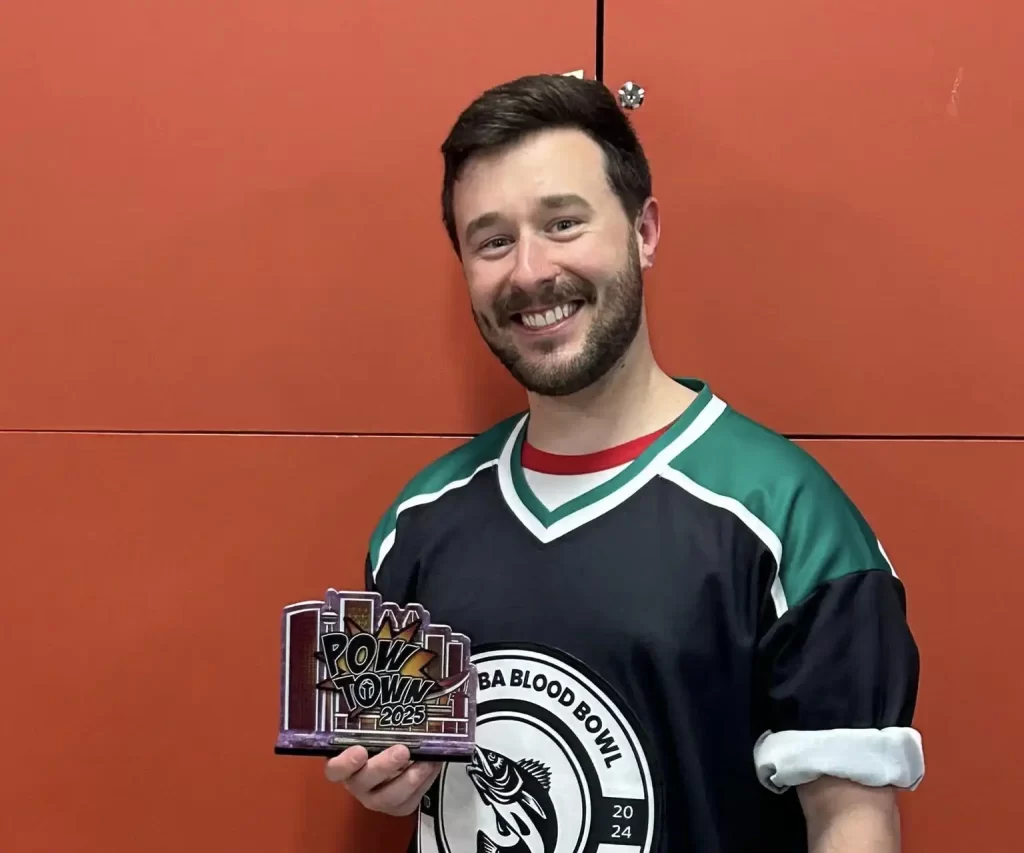
Pow Town sees hundreds of participants each year who come to compete, laugh, and roll dice together.
“It’s super cool just being able to see the community in a different way,” said Baz. “It’s different faces, but, like, all generally the same great personalities.”
Baz and his Snotlings come to mess around and have fun, while Eric brings his Vampire team to win. It’s two sides of the same game that are equally accepted and embraced.
All games at Pow Town are recorded using the NAF (Nuffle Amorical Football), a themed, player-run association that acts as a resource for keeping track of your statistics and running tournaments.
Coaches have the option to record every game they play to their NAF profile, a feature Eric loves.
“There’s a feature where you can see your biggest rival, the person you’ve played the most games against,” said Eric. “It was me and Mason. Now it’s an ongoing joke we have together, and I think we’re like a fifty-fifty win rate.”
Eric is looking to improve his win rate to have a chance at competing in the Eurobowl. He likens elite players to card counters in Blackjack. They make sure every move and every dice roll is optimal.
“There’s never a guarantee in a dice game, but they are always making bets and taking chances that are in their favour,” said Eric.
Mason’s favourite team is the Dwarves. Made up of short, stout, bearded players, they are far from nimble. He is known by league members for doing what he calls “Dwarf dodges,” a tactic where the dwarf tries to evade an opponent. This almost always ends in failure. When it works though, anyone watching the game goes wild.
“I like the randomness because players who expect everything to work always get screwed over, even though they’re really good players,” said Mason.
There is a digital version of Blood Bowl that players like Eric use to practice and improve. Like most computer adaptations, it lacks the social aspect at the core of the game.
“There are advantages in it being so much quicker. It rolls the dice for you, and I feel less stressed because of that,” said Eric. “But being able to sit here and be like ‘bro what the hell just happened’, that is probably my apex of this hobby.”
Anne Helen Petersen, a writer and cultural critic, describes adult hobbies in her Substack article as “something you feel like you’re choosing, or scheduling — not a hassle, or something you resent or feel bad about when you don’t do it.”
She’s written extensively on the topic of adult hobbies, and Baz is a great example of someone finding his hobby later in life.
“I made friends playing and painting with these guys, but I just wanted to have some fun,” said Baz. “We’d meet up and catch up with each other. It’s a great excuse when we’re all so busy with work and whatever else.”
When he’s not playing Blood Bowl, Baz works as an electrician. Eric works in the Costco tire shop.
Gather round as we take a gander at the new team brandings while it’s still unstained. So many colours and patterns, all soon to be covered in dirt, grass, and the blood of their opponents. Isn’t it glorious?
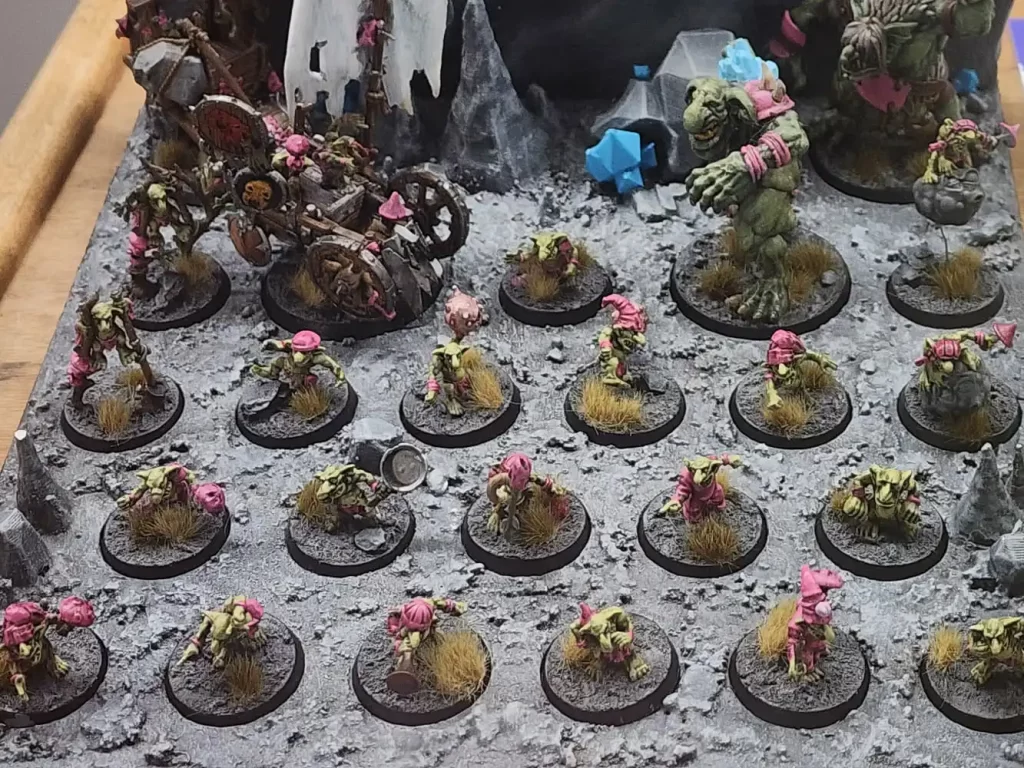
Painting is a massive part of tabletop gaming. There are members of the community that only buy teams to paint them. For some, this is the best part. For others, like Eric, it’s a necessary step to getting to the game.
“It’s an art, not a science, while the game itself is more like a science, you know?” said Eric.
To play in the league, a team is required to have at least three colours. Baz does not take quality into consideration when judging whether a team is eligible for play.
There is a vote at every tournament for the best painted team which some players consider the biggest win of the tournament.
League members can spend up to 40 hours painting a team to look just the way they want, and playing the game is just a chance to show off that hard work.
For Baz, it lies somewhere in the middle.
“I love the painting, I find it really rewarding, but the motivation comes and goes. Right now, I haven’t painted in months, but I’m proud of what I have painted,” said Baz.
The artistic side of the game is a chance for players to really show their personality and make their team their own. The pink clothes adorning the green skin of Baz’s Snotlings is a testament to this.
I got into the hobby through Eric. He knew I painted miniatures but had never played any games with them. The artistic side of the game is what hooked me in.
Two years later, I have a team of Halloween-themed football-playing monsters with a best painted ribbon sitting next to them. I’ve also created a team of Orcs themed around a college fraternity, with a team captain named “Chad.”
With so many teams to choose from, there’s always a new story to come up with or a new theme to try with your next team. These approaches mirror the many ways people approach Blood Bowl, board games, or any social hobby.
There’s always something new to accomplish and the way to reach that goal is entirely player driven. Coming off his win with the very skillful Vampire team, Eric tried out the Halflings the following season, notably one of the worst performing teams in the entire game. In the past, Baz swapped out his Snotlings for the more challenging Undead team.
While everyone benefits in their own way from rolling dice together, what truly motivates people to sign up for the next tournament is fun. Getting together and moving tiny plastic miniatures across fake grass brings people together. It’s a shared joy without guilt or obligation.
Eric is set to be one of the few Canadians in Warsaw at the Eurobowl later this year — and the entire league is behind him cheering him on.
That about wraps up our broadcast of tonight’s events, we hoped you enjoyed the game as much as we did. Don’t talk to any Ogres on the way home and remember: keep rolling!