Kids These Days
People say that the kids these days are lazy, good-for-nothings that don’t want to work, but are they lazier than any generation has ever been? Let’s find out.

Listen to this story:
The kids these days are a bunch of good-for-nothing snowflakes. All they want to do is drink matcha, party, play video games, get tattoos in languages they don’t speak, get offended at benign things, and not work. It’s never been this bad before. As if no other generation has ever taken part in drugs and rock n’ roll.
In fact, our “friends” at Fox News say Generation Z (Gen Z), born between 1997-2012, are the worst workers of all time and we should be very scared. They’re lazy, entitled, selfish, and they question authority too much. According to Fox News’s findings, 49 per cent of business leaders and managers believe Gen Zs are the worst to work with all or most of the time. In that same study, 34 per cent of managers say they would rather hire a Millennial (born 1981-1996) over Gen Z.
Shocking, I know. I’m surprised anyone wants to hire Millennials.
I’m a Millennial and I remember when they were saying the exact same thing about us. We were lazy, “too woke,” sensitive, bad with money, and selfish. Every generation before us was worried about how Millennials would turn out. They said we were doomed.
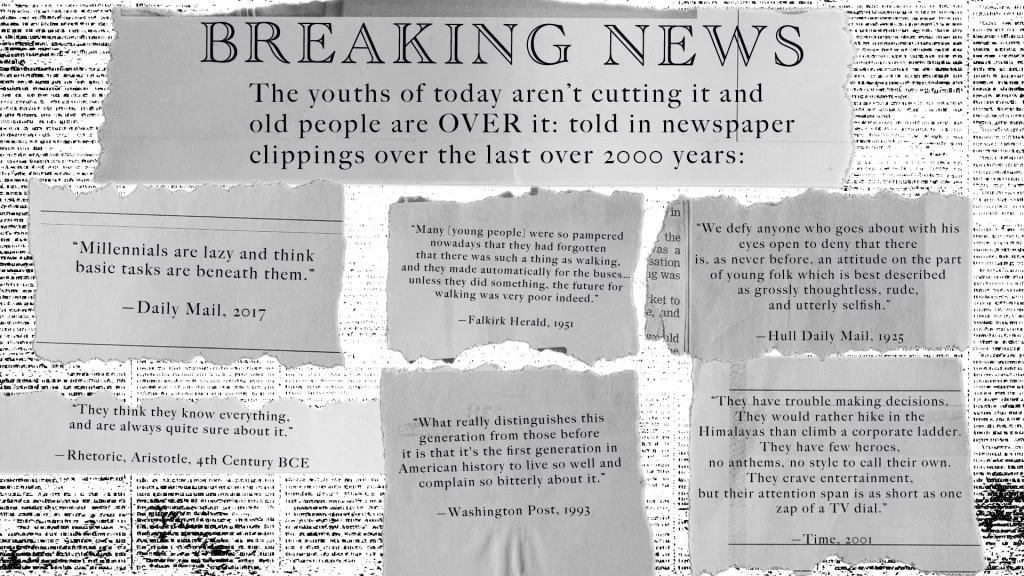
Nine years ago, when many Millennials were in their 20s and joining the workforce, the BBC wrote an article taking the critiques people had for Millennials and comparing them to similar rhetoric written about “the youth” for the past 2000 years.
Literally, 2000 years.
Horace, a first-century BCE Roman lyric poet and satirist, said, “The beardless youth… does not foresee what is useful, squandering his money.” And Aristotle said, “[Young people] are high-minded because they have not yet been humbled by life, nor have they experienced the force of circumstances.”
Old people have been saying that young people are lazy, self-obsessed, and sensitive since the beginning of the written word. It turns out that as soon as we could write, we wielded its profound power to make diss tracks.
Now, what do I mean by “old” people? A Newsweek poll conducted by Redfield & Wilton Strategies, a global polling consultancy firm specializing in opinion research, shows that Generation X (Gen X, born 1965-1980) complains about Gen Z’s work ethic the most, more than Baby Boomers (Boomers, born 1946-1964) and Millennials complain about Gen Z. In this study Gen Z said Gen X was the hardest to work with. They’d rather work with Boomers.
So, the two generations are beefing, but why would Gen X be Gen Z’s biggest hater? One factor might be that they’re the big dogs who tend to be in senior roles in the workforce. According to the Society for Human Resource Management (SHRM) , an association for HR professionals, Boomers are mostly retired, Millennials are still climbing the ladder, and Gen Z is the runt of the litter, starting their entry-level positions. As managers, Gen X, has to deal with new, young workers who don’t really know what they’re doing, and they’re coming in with a whole new set of values.
Why does any of this matter? According to a 2024 study done by online magazine Intelligent, four in five Gen Zs say negative stereotypes about their work ethic affect their experience in the workforce. Four in five also say the stereotypes are costing them jobs and promotions.
I’m sure we’ve all seen articles, TV headlines, social media posts on both sides of this argument: old people yelling about young people’s work ethic, young people fighting back wanting to be taken seriously, but neither of these stories are fully accurate.
Though some of us love a cute black and white statement, there are limitations in talking about whole generations. There is a swath of intersectionalities such as gender, sexuality, race, class, and life experience that define one person’s behaviour, never mind an entire generation. If you are going to look at just age demographics, then you should consider why young people and old people do what they do from a psychological standpoint. We also need to consider the economic changes that played a role in each generation’s views on work.
All of this begs the question: why do these damn kids act this way? And how come old people just don’t get it?
The Brain
We need to talk about perception. There’s this thing called the “Kids These Days” psychological phenomenon. It’s a cognitive memory bias that’s based on two factors: our superiority complexes and our terrible memories.
According to an American study in Science Advances conducted by psychologists John Protzko and Jonathan W. Schooler, people tend to look down on those who are bad at things they’re good at. For example, older people in the study who were avid readers said young people don’t read anymore, and more authoritarian personalities said the youth don’t respect authority. These sweeping generalizations can be disproved. The European Commission released a study in 2022 that shows people ages 16-29 read more frequently at 60.1 per cent than the 55–64-year-olds at 52.6 per cent. Protzko and Schooler’s conclusion was that people love to point out things others are bad at but they’re good at — even if they are incorrect — because it makes them feel better about themselves. We like to feel superior, especially in something we’ve worked hard at.
The study also mentions “presentism.” This is when we insert our present-day realities into our memories. Older people have cars, mortgages, spouses, kids, and grown-up jobs. Because of this, they tend to think that life has always been like this; they’ve always been this responsible over so much. But they were stupid kids once too. In some cases, older generations struggled with far stupider things than kids do these days.
When I asked my Boomer parents about their 20s, my mom joked that her generation invented drinking and driving. It turns out, she wasn’t wrong. According to the National Institute on Alcohol Abuse and Alcoholism, in 1982 alcohol-related traffic deaths made up 60 per cent of all traffic deaths that year, but in another study released by the U.S. Centers for Disease Control and Prevention in 2022, that number went down to 32 per cent — nearly half. In fact, the number of teenagers drinking and doing drugs overall has gone down since 1975. A survey conducted by the University of Michigan Institute for Social Research in 2024 showed a significant decline in grade 12 students’ alcohol and drug usage apart from cannabis. Unsurprisingly, doobies remain all the rage.
Though we’ve drawn arbitrary lines of adulthood, at 18 you don’t just magically gain the psychology of an adult. It takes longer for the brain to develop, yet for some of us, our expectations for the youth remain the same as the ones we have for older adults. Even older people put those expectations on their younger selves.
According to a study conducted by Nature Communications, a peer-reviewed scientific journal, between the ages of nine and 32 (where Gen Z currently falls), the brain is in the “adolescent phase,” which is a time of great frontal cortex development. The American Academy of Child and Adolescent Psychiatry, a medical organization, says in brain development, the amygdala develops first, before age nine. It deals with immediate reactions like fear and aggression. This area of our brains is very emotionally motivated. The frontal cortex develops slowly until around age 32. It helps counteract the impulsivity of the amygdala by giving us long-term planning skills, and our ability to reason and assess risk. The National Institute of Mental Health adds to this by saying the areas of the brain that deal with social processing can make those in their teens and 20s more focused on peer relationships and social experiences. During this time when the frontal cortex isn’t fully developed, the brain is also more susceptible to stress-related mental illnesses like anxiety and depression. This means teenagers and young adults struggle with impulse control, handling stress, and planning. They tend to overreact and misinterpret social cues and emotions, are more motivated socially than by rational thought, and do riskier things without thinking. Does any of this sound like an efficient worker to you?
At around 32, these traits tend to chill out and go into the “adult phase” of brain development, when our overall cognitive function is at its best, which is currently the phase Gen X is in. Yes, Gen X — feel free to feel superior now, but know that this phase is said to last until age 66, which is coming down the pipe for you quickly. Older people should be empathetic to the chaotic, hormonal soup that is the developing brain, especially because all of us go through this. Essentially, both young and old people are challenged with seeing life from others’ perspectives; instead, we default to our own frames of reference.
The brain is just one factor of what shapes generations in the phase of life that they’re in. Since we’re looking on a broader scale, we need to look at other sociological influences that have shaped work culture. However, as we’ve learnt, it’s unfair to compare old people with young people.
If we’re going to compare Gen X with Gen Z, we have to even the playing field and look at what Gen X was like in their 20s. Roughly, this takes us back to the 1990s.

The Economy for “The Youth”
It turns out neither Gen X nor Gen Z had it easy when it came to money. Gen X experienced a recession in the early ’90s. Julia Smith, a Labour Studies professor at the University of Manitoba (U of M) says factories, a big part of our economy and a source of unionized, fairly paid labour, were shutting down quickly and being shipped overseas because of the implementation of new free trade laws. Basically, it’s cheaper to exploit people in other countries than it is for us to do the work ourselves.
This was a new level of corporate greed. It took a while for the economy to fully recover, and the recession left a mark on the cost of living.
In the early ’90s, jobs were more difficult to come by than they were the decade before, student debts were higher, and life for those in their 20s felt bleak. Smith says these conditions caused a sense of disillusionment in Gen X that never went away. For the first time in a while, the younger generation couldn’t say they had it easier than the previous generation. I know, Boomers, you love to tell us how you used to have to walk up a hill both ways on your way to school, but Gen X statistically didn’t have as much money as you.
According to Statistics Canada (StatsCan), between 1992-2002, average yearly tuition almost doubled in one decade. “From 1990/91 to 2000/01, average undergraduate tuition fees rose 135.4%, more than six times faster than the 20.6% increase in inflation,” says StatsCan. According to the FINRA Investor Education Foundation, a non-profit financial research and education organization, student loans have been a lot harder to pay off for Gen X and the following generations compared to Boomers.
Katharine Cherewyk, a 49-year-old, Gen X, executive director and executive coach at Agriculture in the Classroom Manitoba, remembers this time of hardship in the ’90s. She was an agriculture student at U of M. “I was always stressed out… because I was on student loans. I didn’t have a lot of money, which is why I had to come home to Portage [la Prairie] from Winnipeg to work at Pizza Hut every weekend. I didn’t have a car either, so I had to bum rides,” says Cherewyk, “I didn’t feel like life was easy.”
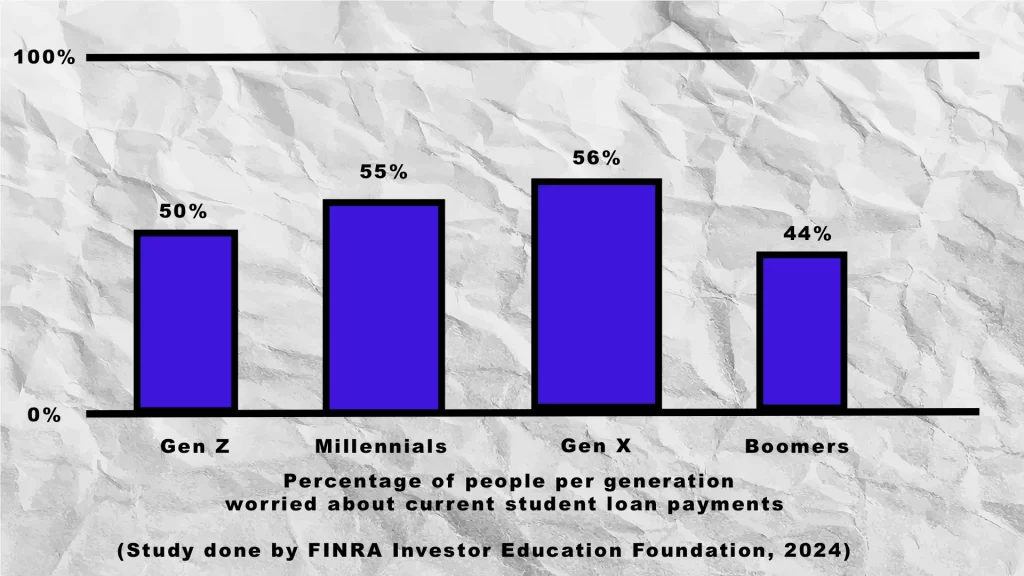
Unfortunately, for Gen Z many of these economic hardships have only gotten worse. According to StatsCan, youth unemployment has been slowly on the rise since 2022. One in five youths said they were considering moving to a different region just to find better job prospects.
StatsCan says more youth are going to post-secondary schools now as compared to 2000. On average, tuition has actually gone down in price by a few hundred dollars in the last 10 years, but student borrowing is higher than it was in the ’90s. To make matters more intense, the Canadian Occupational Projection Systems in 2023 says the number of jobs requiring you to have post-secondary or management training has risen 71.7 per cent. A high school diploma used to get you a job; now it gets you into another building with more tuition.
Caelyn Kwade, a Gen Z 28-year-old, has a BA in Linguistics, and recently left her job working in HVAC. “After COVID I must’ve applied to like 100 or 200 places,” says Kwade, “And when I finally got a job, I was getting like one shift a week, I had to stay for a while to see any savings coming in.” Part of the reason she took the job was to save money for grad school, studying marriage and family therapy, which is roughly $16,500 in tuition in total. On the job hunt again, Kwade says “I have not really seen anything that doesn’t require a degree, but I am looking for a job that pays more than minimum wage, because minimum wage isn’t livable.”
Sarah Elvins, a history professor at the U of M, talks about how both generations have suffered under late-stage capitalism. Factors such as inflation, precarious employment, growing wealth gaps, and shrinking wages have led to a sense of financial uneasiness for both employers and employees. “I would argue that in late-stage capitalism, employers are not loyal at all to their employees,” says Elvins, “and it’s not surprising that people would advocate for their own interests or jump ship to go to a new place because there are no guarantees.”
If this is the case, and both generations have experienced late-stage capitalism, how have each adapted to these conditions and how did it shape their beliefs around work as young people?
Gen X: The “Slacker” Generation
In 1991, author Douglas Coupland wrote Generation X: Tales of an Accelerated Culture. It follows three young adults who leave their corporate, middle-class lives to find something more meaningful. They move to California and take lower paying jobs that Coupland refers to as “McJobs” just to make ends meet.
At night they drink copious amounts of booze and tell each other stories about love, technology, isolation, corporate greed, and fear for their future. Coupland was writing about what he felt the youths’ aspirations and fears were at the time, and how this affected their behaviour. An article from Salon, an online news and opinion website, says that at the time, the book was important because it put young people’s fears about living in a late-stage capitalist society at the forefront of popular culture. It coined the term Gen X and defined their generation.
Davina DesRoches, a sociology professor at The University of Winnipeg, says “I think for the Gen X worker, there’s probably a sustained sense of frustration. This is a generation that grew up worried about, you know… McJobs right? The sort of low paying, no advancement, dead end, nothingness that I think a lot of them were concerned with.” Sounds depressing, right?
Ironically enough for our friends that complain about the youth, Gen X was known for being “slackers,” a term coined from a popular movie in the early 2000s where a group of friends cheat their way through university. The movie was inspired by youth from the grunge scene, a popular cultural and musical movement in the ’80s and ’90s that began in Seattle. It led to music genres like alternative rock, what some Gen Z and Millennials would consider the “emo bands” of the ’90s. We’re talking Nirvana, Pearl Jam, and Alice in Chains — popular bands from that time. Grunge was representative of a cultural sense of disillusionment and a resistance to capitalism and societal norms. Physically, it showed itself as a rebellion against traditional work environments with baggy and torn clothes, piercings, and ironic tattoos. The grunge kids rejected “the system” and fought for social rights. They were the cool, angsty kids who would say things like “whatever man, that dude’s a sellout” and write about their feelings in lyrics with “life is meaningless, I hate my Dad, and I’m going to die alone” energy.
“I wore army pants, flannel, and hiking boots and I did hang out with a bunch of anarchists who really did teach me about counter-culture,” says Cherewyk, “It really opened up my mind to like, ‘wow, there are a lot of people out there who are really mad at the government and don’t want to be ruled.’”
But older generations including Boomers perceived this attitude as lazy, entitled and lacking work ethic. This sentiment coming from the generation that coined the term “sticking it to the man,” protested corporate greed and felt the nine to five was “soul-sucking,” worshipped rock n’ roll and skipped work to camp out at Woodstock doing God knows what.
In Coupland’s book, the characters make comments on what the previous generations, like Boomers, think about them and how unfair it is: “Sometimes I’d just like to mace them. I want to tell them that I envy their upbringings that were so clean, so free of futurelessness. And I want to throttle them for blindly handing over the world to us like so much skid-marked underwear,” says the main character, Andy.
Smith says Gen X experienced corporate greed at its worst, and it created a sense of mistrust in industry. This led to a lot of them developing a heightened sense of independence and individualism. Smith comments on their attitude: “If I can’t trust ‘the man’ then I’m not going to work overtime to please the man, I’m going to clock out when I’m done, take my cheque, and leave.” Doesn’t this sound familiar to the up-and-coming generation older people so love to hate?

Gen Z: The “Snowflake” Generation
According to an article by the Royal Society for Arts Journal (RSA), the term “snowflake” refers to the youngsters that are overly entitled, easily offended, and expect special treatment. It was coined by Chuck Palahniuk in his 1996 book Fight Club. Tyler Durden, the narrator’s right-hand man, says, “You are not a beautiful and unique snowflake. You are the same decaying organic matter as everyone, and we are all part of the same compost pile.” The RSA says it’s quickly become fodder for some journalists to complain about the new generation, but why don’t we see if we can try to step into their shoes for a second?
DesRoches says because Gen X typically raised Gen Z, the children have inherited their parents’ independence streak, but it’s expanded. Gen Z has experienced gross inflation rates, pay that doesn’t pay, and corporate greed worse than what Gen X experienced. DesRoches notes that if work isn’t going to pay you for working so hard, and it may never be satisfying because you know you aren’t treated well, then you have to wonder why you’re doing it in the first place. This is where Gen Z’s values come in: proper work/life balance where they can live outside of the corporate black hole, or game the system. According to an article published in the Journal of Human Resource Management at Comenius University in Bratislava, Gen Z’s biggest barriers to staying motivated at work are a lack of interest in the job, a negative work environment, an overwhelming workload, and a lack of purpose. Many see the unfairness and hopelessness of the system and have decided to focus on things that really matter, like chasing purpose over salary. “If I’m going to be working like a dog, I might as well try to do something that I like that is doing good for other people,” says Kwade.
With an abundance of choice in work — more than any generation has ever had — Gen Z doesn’t want to settle for less pay at a place that doesn’t treat them right. Isn’t that what anyone wants? Isn’t that what Gen X wanted in the ’90s?
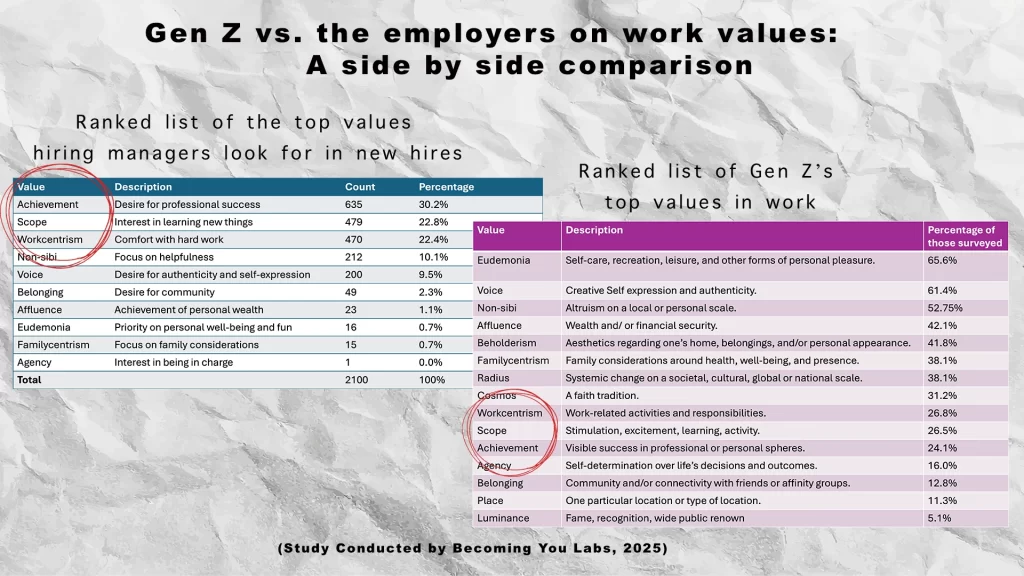
A study entitled “Hiring Managers vs. Gen Z Priorities: The Values Gap in Today’s Workforce” done by Becoming You Labs, a career development research initiative and company, shows Gen Z’s top three rated values in relation to work: self-care, creative self-expression and authenticity, and altruism and helping others. The top three rated values of hiring managers are work centrism, an excitement to learn, and visible success in professional and personal spheres, all of which Gen Z scored very low on. Now I get it: Gen Z just wants to focus on things that actually matter instead of just being productive for the sake of profit, and companies are saying “screw you for wanting things, what about me?”
How are Gen Z’s values affecting the way they choose to work? Randstad, a multinational human resource company, put out a study in 2025 that says one in three Gen Zs said that they were going to switch jobs within the next year because they feel like they aren’t progressing and the work isn’t purposeful. There was a 29 per cent decrease in entry level jobs in 2024. In her job hunt, Kwade says, “I’ve not seen any entry level jobs, like it’s all one to two years of experience.” Gen Z has found ways to compensate by creating side hustles, moving around to different jobs, and bettering their skills in using AI. Ok, that last one is questionable and some have no idea the kind of fire they’re playing with, but can you blame Gen Z? In this economy? Things are brutal, dude.
According to Fortune magazine, around 40 per cent of Gen Zs have side hustles to make some extra cash, like taking their Chad-like “gains” and turning it into a business as a professional trainer or making money off of YouTube videos detailing their morning routines. To quote Thomas Haden Church’s character from the movie Easy A, “I don’t know what your generation’s fascination is with documenting your every thought… but I can assure you, they’re not all diamonds. ‘Roman is having an OK day, and bought a Coke Zero at the gas station. Raise the roof.’ Who gives a rat’s ass?”
Gen Z is more focused on becoming a jack of all trades as opposed to a master of one. They jump from job to job to develop a wide variety of skills. “Having been someone who’s worked a lot of different jobs, I feel more secure,” Kwade says, “because I think it gives me more options, or hopefully it gives me more options, because I’m casting a wider net. The uncertainty of the future makes me want to have a breadth of skills.”
Who’s Really to Blame?
If you look back on the attitudes of both Gen X and Gen Z, there’s not much of a difference. They both wanted fulfillment and to get out of the corporate, meaningless grind in their youth. Gen X tended to have a more nihilistic view of work than Gen Z does now, but the older generations hate on them both for similar issues — they just use different terms. Both adapted to the economic disasters they were dealt by either trying to change it or trying to create their own system, like Gen Z developing side hustles or Gen X leaving the corporate world.
We could sit here criticizing each other and keeping this loop of the “kids these days” psychological phenomenon going, or we could listen to the youth and hear what they’ve been trying to say for a while:
This system isn’t working.
It didn’t improve the quality of life in the ’90s, and it doesn’t now.
Like Elvins says, late-stage capitalism places unrealistic demands on workspaces and people. This argument between generations feels like a distraction from looking at how flawed this system has become. The system pushes the youth to leave their jobs after only a year because they don’t pay well and they suck. This causes them to spend more time on their side hustle to help themselves out and find a bit of fulfillment. It also makes old people upset with young people because some kids are not willing to work themselves to death to meet the demands of the corporate world. Some old generations project their woes onto the youth because they had to cave on their “screw the man” beliefs to work painstakingly, all-consumingly hard to get to where they are now.
When my dad first became a lawyer, he would work 12-hour days on average. “Everyone did it, it’s just what was expected of you back then, that’s how you got ahead,” he says. When he started working with Gen Z lawyers, he noticed that they would go home after their eight hours. At first, it upset him, but then when he thought about all the time he missed in doing other things in life he enjoys, and seeing how some of these people have young kids to go home to, he realized that maybe his generation were the ones that had it wrong.
While young people of today and back in Gen X’s heyday didn’t always have the best ideas, they do both come in with the fresh, powerful perspective on the system that’s worth listening to. Maybe if we listen to each other, we could change this system into something more meaningful and fulfilling.
Maybe these damn kids have a point after all.