The Borrowed Name
A name is something given to you. But for almost 10 years while Luis was part of the “hidden population,” he couldn’t use his. Instead, he borrowed a dead man’s name until he could reclaim his own.
Listen to this story:
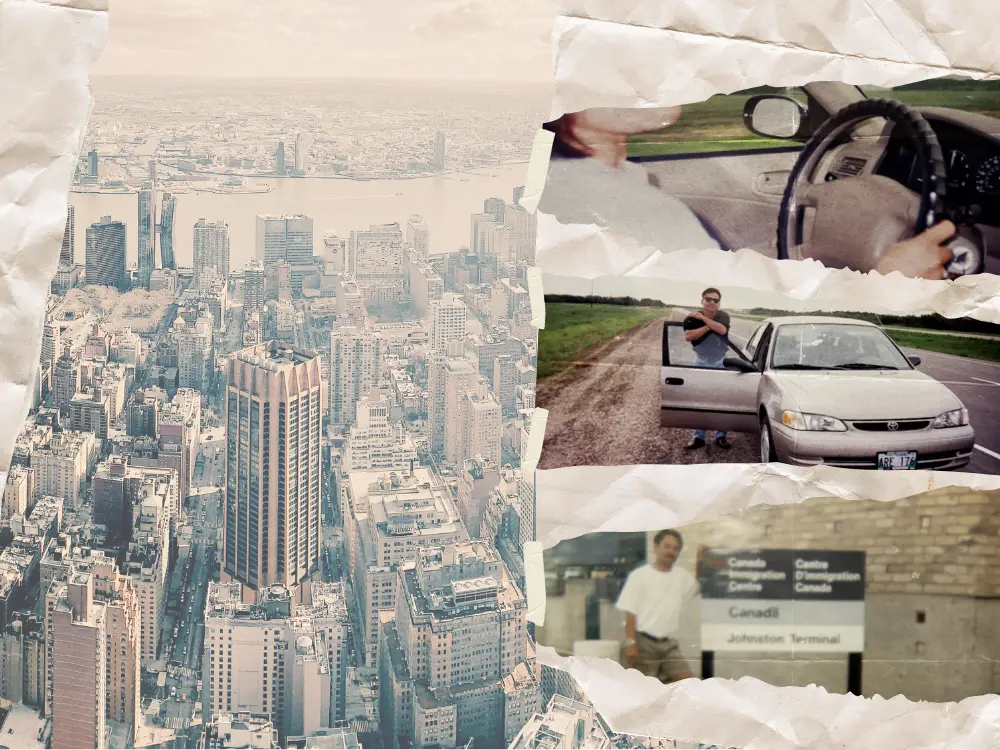
Interstate 87, 1996
Her hands were glued to the steering wheel. It almost seemed like it was her first time driving. Luis noticed her vice-grip from the corner of his eye, but thought nothing of it — he trusted her. He placed his hand on her thigh.
“Okay ka lang?” (You okay?)
No answer.
Luis himself felt unsure, worried, and scared. He was about to leave the United States for the first time since arriving eight years earlier on a travel visa, which was long past its legal six-month term. He knew once he crossed, he couldn’t go back.
The heater in the ‘95 silver Corolla hummed a dry, metallic tone, pushing back against the New York cold as they drove down I-87 from Jersey City to Winnipeg — over 2,500 kilometres. Five hours into the drive, they switched drivers. It was Miriam’s turn.
She only had her learner’s driver’s license. Luis checked it before they left, but it was his first time seeing a Canadian ID, so it seemed legit to him. Miriam tried to act natural as she drove 20 km/h below the limit. Semi-trucks and aggressive drivers swerved around them.
Out of nowhere, a 16-wheeler blasted its horn and came too close to the Corolla. Miriam swerved to the right. The tires hit a patch of black ice and lost their grip, sending the car into a sideways skid toward the ditch. Because the Corolla sat low to the ground, the front bumper dug into the rising dirt of the ditch instead of flipping. The impact — at the speed they were going — was a jarring crunch of plastic and metal that sent the steering wheel vibrating against Miriam’s grip. The front end of the car folded in on itself as it absorbed the impact. They were lifted off the ground at an angle.
Luis and Miriam looked at each other in shock, the heater still humming in that dry, metallic tone. Luis reached over to turn off the ignition and put his hands over Miriam’s, which were still clasped onto the wheel. Luis didn’t bother to check himself for bruises — his first instinct was to open the glove box.
Inside was a driver’s license with his photo, but the name belonged to a dead man — a name Luis claimed as his own to navigate a country where he wasn’t officially recognized. Beside it was a scrap of paper with Robert’s number, his contact and good friend who had helped him secure these documents.
As emergency services approached, Luis’s main concern was the fear of being deported back to the Philippines. After eight years of building a life in New Jersey, blending in and contributing to society, his invisibility had suddenly vanished. He was finally exposed to a system he had spent nearly a decade avoiding.
It’s been 30 years since that car crash, and Miriam’s retelling makes me feel like I’m watching a movie. The uncertainty of crossing the border, the crunch of the metal, and the overwhelming relief when the paramedics let them go without asking for the documents Luis was so afraid to show.
They limped that little Corolla — plastic parts dragging against the pavement — all the way to Niagara Falls to meet Robert. The car was co-signed by a woman Miriam dubbed “Mother Theresa,” another contact in the invisible chain of people who helped Luis navigate a country where he didn’t officially exist.
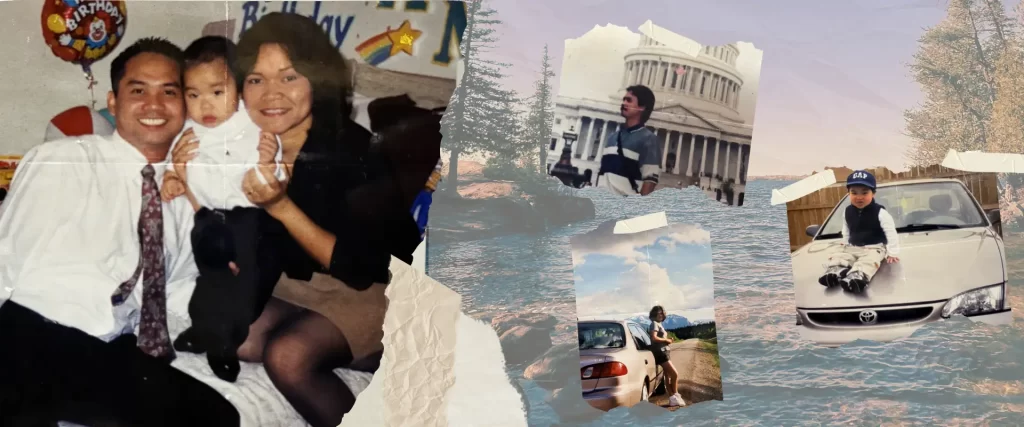
Luis and Miriam are my parents.
My father passed away in 2022. Since then, I’ve been retracing the fragments of his life — through my memories of the stories he told me and interviews with my family. Luis navigated a system that didn’t officially recognize him, and his story mirrors the struggles of thousands of immigrants in Manitoba today.
In downtown Winnipeg, community centres like the Immigrant Centre Manitoba and the Philippine Canadian Centre of Manitoba open their doors daily to newcomers seeking stability. But not everyone can walk through them.
Many undocumented or precarious-status immigrants stay away, afraid that asking for help might draw attention to their lack of papers. A report by the Canadian Centre for Policy Alternatives found that many undocumented immigrants avoid basic city services like clinics and emergency rooms. This avoidance is driven by the fear that an encounter with city staff or police will lead to their immigration status being discovered and reported to federal officials. In 2017, the Director of Immigration Partnership Winnipeg told Global News that undocumented people are even scared to go to the library, and it’s likely that in life-threatening situations they avoid calling paramedics or fire services because of the fear of deportation.
Across Manitoba, policy briefs and health studies echo the same concern: immigration status is a social determinant to health. Those without permanent or legal status are excluded from provincial health coverage, leaving them vulnerable to injury, illness, and exploitation. In the same report, the Canadian Centre for Policy Alternatives calls this group a “hidden population” that keeps the city running while living without protection or recognition. We live in a system that benefits from their labour but offers no safety net in return.
This is the Winnipeg my dad eventually became a part of. He arrived as an undocumented immigrant in a city that offers opportunity and community but also carries an unspoken divide between those who determine who gets to belong. His story of survival and connection unfolds against this larger truth: for many newcomers without legal documentation, belonging comes with risk, and safety often means staying unseen.
Luis had a support system that some newcomers may not have direct access to. While he navigated a life under a name that wasn’t his in New York and Jersey City, he was guided by Robert. Later in Winnipeg, my mom was there to support him. They eventually married, which provided Luis with a legal path to Canadian citizenship, rescuing him from the precarious situation he faced in the States. Without genuine support, people who fall within the status gap face a high risk of exploitation. The false hopes of a work permit can fall into the hands of someone looking to profit from their vulnerability.
In 2024, CBC highlighted this danger through the story of Ighor Santos, a Brazilian man who was misled into working illegally at a construction site in Winnipeg’s Leila North neighbourhood. A total of 14 illegal foreign workers faced dangerous work conditions, late payments, and verbal abuse. They were promised a work permit if they kept working. If they got hurt, they didn’t seek medical treatment out of fear of deportation.
Men like Santos are often pushed into the shadows by people they are forced to trust and believe in. For Santos, doing the right thing and blowing the whistle resulted in a deportation order, proving that for the undocumented, the risk of being seen remains as high today as it was thirty years ago.
New Jersey, fall 1989
Strong winds were stripping leaves from the trees, scattering them onto the cold pavement of a cemetery. As the autumn days were shortening, the time on Luis’s travel visa was running out — six months is not a long time.
Boots crunched on the leaves as he walked between headstones with Robert.
“Look for someone who would’ve been your age,” he told Luis. Their eyes scanned the birth and death dates on the granite stones, trying to find the right match.
“This one,” Robert said.
Luis looked down at the name — Jenuel Martinez. Moving forward, he would go by that name officially, but to his friends, he would always be Luis. In his time in New Jersey, he lived a life that was technically a lie — the name was borrowed, but the reputation he built and the work he did was entirely his own.
With Robert’s help, the lie grew more complex.
To maximize his tax returns, he claimed a child that didn’t exist — my unofficial fake sister. He did what he had to do to survive, and this new name let him explore himself. He had various jobs during his time there. He worked as a pizza cook, a tailor, and, surprisingly to me, a vault clerk at the World Trade Center. He often told me stories about these jobs when I was growing up. It was our dream to visit New York City together after I graduated, to explore the city and see the places he had experienced as a newcomer.
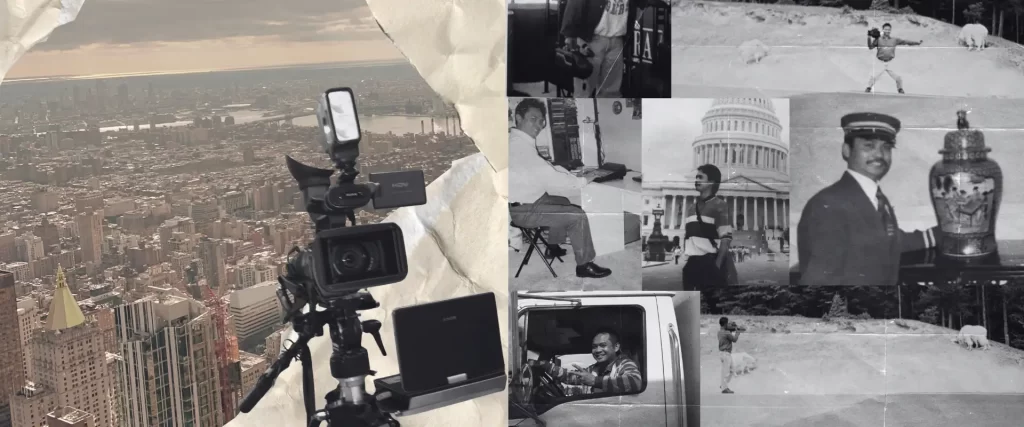
My mom told me Luis worked as a bellboy at a high-end condo where residents had money money. Every morning, he’d be in that crisp navy bellboy uniform — not a single wrinkle or stray thread — waiting for the heavy glass doors to swing open. When they did, he was ready to lead with a genuine “Good morning.”
His eyes would light up as if the person who just opened the door was the one person he was waiting to see. The way he made others feel wasn’t a performance; it was Luis. He had his way of making the distance between a wealthy resident and a farm boy from the Philippines disappear. The tips followed: $5 here, another $2 there, and $10 for taking care of the kids.
He was also a talented tailor, a skill he’d mastered back home with the titas. On the side, he offered walk-in alterations for the residents. He’d take their expensive suits, floor-length dresses, or designer pants and pin them to perfection. He made good money doing it, and his clients became friends, too. He was the guy who fixed their favourite clothes and knew their kids’ names. He was a fixture in their lives, someone they relied on and respected.
The contrasts in my dad’s life strike me. Here was a man who was making meaningful connections in this high-end community, a guy trusted with expensive wardrobes, personal items, and daily routines. He was earning a good living and building a network of people who genuinely liked him. But in his pocket, he still carried a piece of plastic with a dead man’s name on it.
Luis was like the heartbeat of that building, but to the state, he was a liability. Today, that same tension is reaching a boiling point in Manitoba and across Canada. While my dad was celebrated by the people he served and worked with, others saw him — and people like him — very differently.
In recent years, the narrative around newcomers — especially those with precarious status — has shifted. On social media, there is a trend of hostile comments that suggest immigrants take away opportunities and negatively impact healthcare and housing. A 2025 Environics Institute survey on Canadian public opinion on immigration and refugees found that 43 per cent of Canadians now believe that many claiming refugee status are not “real” refugees. This is the same sentiment you see online, social media characterizing immigrants as an economic pressure on healthcare and housing.
However, an individual’s legal status is often tied to administrative timelines rather than their intent.
Precarious status is often a result of bureaucracy, including gaps as a result of the government’s processing speed. It happens when a Permanent Residency (PR) application is delayed, or a post-graduation work permit expires while the province is still working through a backlog of files. This creates what advocates call a “status gap.”
Arsh T. experienced this gap firsthand in 2023, when his legal status was delayed multiple times, and was told he would likely have to move from Manitoba to a different province.
In 2024 the CBC reported that many international workers in Manitoba continue to face this wall, watching their legal right to work vanish as they wait for the Manitoba Provincial Nominee Program (MPNP) to catch up. But provincial nomination is just one step in the process. In Manitoba, the MPNP reviews and selects candidates based on local needs, and then Immigration, Refugees and Citizenship Canada (IRCC) has the final say. On the Government of Canada’s website, there is currently a backlog of 515,000 permanent residency applications, leaving thousands of people in a legal grey area.
For Arsh, this backlog resulted in an ultimatum: walking away from his mortgage, his job, and his sister in Manitoba to reapply through the Saskatchewan Immigrant Nominee Program, where he had zero connections, but was promised a better chance at renewal or risk being of precarious status.
“This was impossible, but I had no choice,” Arsh said. “It was expected that my wife and I had to go.”
Suddenly, a person who has been a coworker, a friend, and a family member is pushed into this incomprehensible limbo. They face an impossible choice: return to a country that may no longer be safe or have a home for them, or stay in the life they’ve built and become a “ghost,” as my father was.
The decision to stay is often practical. When an application remains in a year- or month-long queue, the choice is about managing the friction between slow-moving decision-making and families’ immediate needs or a career already in full momentum.
Two weeks before Arsh was ready to leave on October 21, 2023, MPNP did a complete reversal, telling him they would renew his status after all.
“It really makes you feel like you’re just a number,” he said. “But I’m happy I’m here with my family.”
Arsh still resides in Manitoba with his wife, and they are now expecting a child.
Winnipeg/New Jersey, 1991-1995
My mom moved to Winnipeg from the Philippines in 1991. She was sponsored by her auntie to work as a nanny for a wealthy family. This family had a vacation home in New York, and she would travel with them. That’s how my parents ended up in the same place.
They met at a party in Jersey City — mostly all Filipinos. Disco lights caught the smoke as “Be My Lover,” “Boombastic,” and “Macarena” — the anthems of 1995 — thumped through the speakers.
Like Miriam, some attendees were in the States legitimately, and like Luis, others weren’t. But who cared? It was a party.
My mom remembers looking around the room and recognizing faces she’d seen from back home in the Philippines. One was a former athlete she’d seen in advertisements for Milo, the chocolate drink mix that’s a staple for many Filipino kids. She’d later discover he, too, was friends with Luis and was also there illegally.
She vividly remembers making eye contact with Luis, and they ended up spending the entire night together. They danced, and my mom still remembers how he had a certain way with his words. “It was a natural charm,” she said to me.
My mom wasn’t looking for anything at the time, so when my dad asked her for her name, she answered, “Maria.” She didn’t give her real name to strangers.
The very next day, flowers were delivered to her apartment building with a single word written on a piece of paper, tucked into the blooms of the bouquet:
Maria
They started seeing each other. After dating for a couple of months, my mom started to understand the person behind the charm. Luis was open with her about the “shady” background of his life. She understood he was only doing what he had to do to survive and make something of himself.
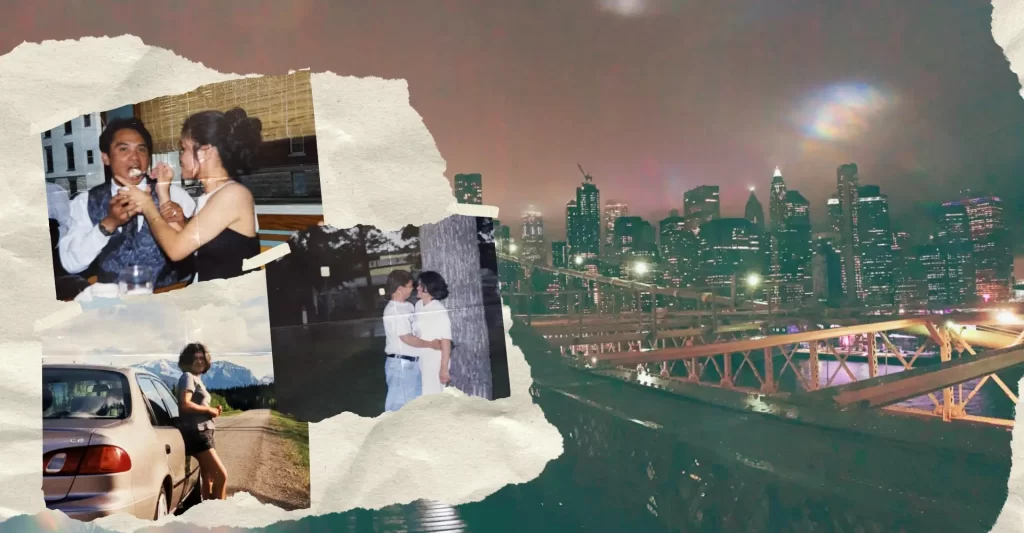
When I was growing up, he told me it had been his dream to live somewhere in America. As a kid on the rice fields, he would see planes fly over, always imagining himself going to a place he’d never been.
While Luis opened up a lot to Miriam while they were dating, there was one part of his life he kept locked away: his family.
Luis had been in Jersey City for six years at this point — he hadn’t contacted his parents or family once. No letters. No calls. For all his family knew, he was dead.
My mom still doesn’t fully understand why he didn’t connect with them, but thinks perhaps it was shame, or maybe he was too scared to send a letter from a name his parents didn’t give him.
But at the time, she offered to be the connector to his family.
“I can help you,” she told him.
She sat down and wrote a letter, finally giving his family a sign of life. She told Luis that he just had to trust her.
Luis sat at the table and watched my mom write that letter, a bridge of ink and paper back to a family — to his family — Luis was a ghost to. The letter was to Cresinta, his closest sister. On the outside, the return address was to Jenuel to protect the life he had built in the shadows. Tucked inside the envelope was his true identity:
Luis Baquiano Jr.
For Luis, watching her write words was a moment of vulnerability — he didn’t want them to know he had been living a lie. Luis was trusting her with the silence he had lived in for six years.
Miriam couldn’t fully remember the details, but Cresinta replied to that letter, and my mom and dad sponsored them to immigrate to Canada and live with us years later.
In Winnipeg today, the same vulnerability is called for every day, and the stakes are just as high. For the “hidden population” in Manitoba, every interaction with the province can feel like a chance to get caught.
There are ways to protect precarious-status immigrants, but Winnipeg hasn’t yet officially implemented an Access Without Fear policy, a policy that aims to reassure people without immigration status that they can access police services without fear of being reported, detained, or deported. Other Canadian cities like Vancouver, Montreal, and Toronto have already implemented policies to protect immigrants so they can feel confident accessing the help they need.
In Winnipeg, there are other resources to help guide immigrants on the right track. Just as my mom and Robert offered to be the bridge for Luis, organizations in Winnipeg like Manitoba Start and the Manitoba Interfaith Immigration Council (Welcome Place) serve as the “Mother Theresa” — a safe first point of contact.
Welcome Place is specifically designed to handle the complexities of refugee and immigrant settlements. They provide spaces where the fear of “getting caught” is replaced by the work of “getting on the right track.” These organizations offer legal referrals, housing and settlement, and status support.
Winnipeg, 1997 to Present
In 1997, a year after Miriam and Luis arrived in Canada, they got married, which granted Luis legal Canadian citizenship. Of course, they loved each other, but it was also a necessity.
Shortly after, he started his own business under his own name — Jun Baquiano Video Production. “Jun” was his nickname because he was my lolo’s junior. He became one of the first Filipino videographers in Winnipeg in the early 2000s, specializing in weddings, debuts, and gatherings.
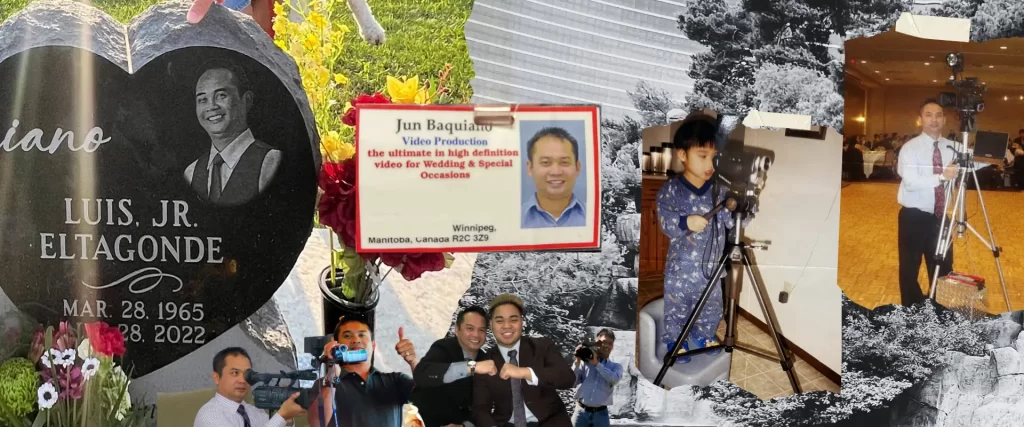
As a kid, I always thought he was the coolest dad on the block with all the gear he had: A TitleMaker 2000 for visual graphics editing, an old Sony HDV that he wielded over his shoulder, and a DIY dolly made from wheels that come on movable IKEA shelves. His resourcefulness is what I looked up to — I still do.
Starting when I was around 16, I spent years helping him, juggling the heavy gear between crowded reception halls, witnessing his impact on the community firsthand. He was conversational and made sure whoever he was recording felt comfortable. He made people feel seen. It was the same charm he had in the Jersey City condo lobby, but now it was grounded in the security of a name that was actually his.
A name is something given to you, but it’s up to you to define it. I used to wish my last name were easier to pronounce — what an ignorant thought. Today I’m proud to carry the name my dad couldn’t use for almost 10 years.
Since my dad passed away, I’ve aspired to be more like him: a lover, a dreamer, and a person who does whatever it takes. Luis used to tell people — whether they were family or a stranger — to “Take it easy.” It’s a saying I’ve adopted, another piece of my dad that I am proud to carry.