
The Life of a Fangirl
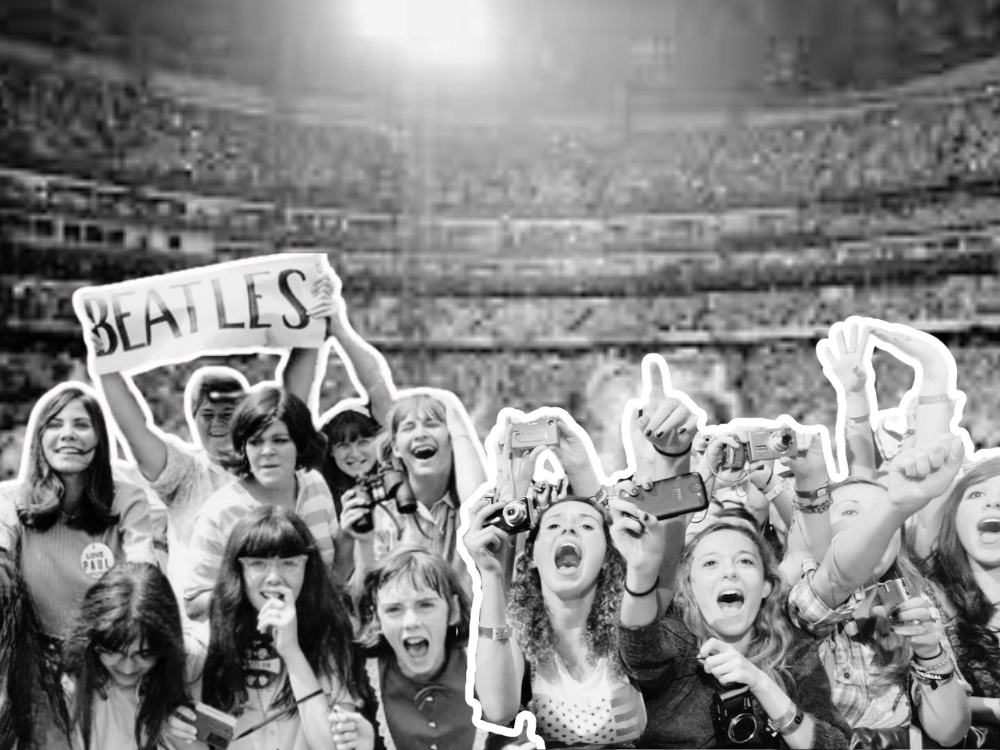
Since the Beatles, women and girls have been shamed for what they like, but female fans haven’t let that stop them. In every era, fangirls have found each other and bonded over their interests, getting together in bedrooms — and stadiums — to celebrate the things that make them shriek.
Listen to this story:
It’s November 15, 2022. I’m driving home from work with my laptop open on my passenger seat. The seatbelt is buckled loosely around it to prevent disaster. It’s connected to the hotspot on my phone so I don’t lose Wi-Fi — and my spot in line. I park quickly and race upstairs to my room, watching the little blue progress bar inch along the screen as the number goes down.
1455
915
690
441
Then, my turn.
Seats start disappearing before I can even click on them, but I manage to get two off the side of the stage. I check out, not daring to exhale until my inbox pings with the confirmation email. In a daze, I head downstairs to find my parents waiting in the kitchen, staring at me apprehensively. The pasta on the stove is close to boiling over, but my mum is focused on me.
“So…?” she says, hopefully.
“I GOT TICKETS!” I scream.
I start jumping up and down, the realization sinking in and the adrenaline taking over. My reaction is an homage to teenage me. I’m finally letting my true fangirl feelings shine after toning them down for so many years.
I’ve always been a fangirl, but a quiet one. I wrote terrible One Direction fanfics in my bedroom and remember exactly where I was when I learned Zayn left the band. My bedroom was plastered with posters from J-14 and Tiger Beat. I’ve watched the Twilight series multiple times, and I’ve read everything John Green has ever written.
I’ve been a Taylor Swift fan since 2007, when I happened to flip to the music video for her song “Teardrops On My Guitar.” From that point on, her music was the soundtrack to the big and small moments in my life, from heartbreak and loneliness to road trips and dance parties.
And yet, underneath all the moments of solace and joy was a lingering feeling of shame. Some small part of me wondered if her music actually was stupid, like many of my peers and family friends were saying. The little devil on my right shoulder agreed with their reductive comments while the angel on my left shouted, “So what!” My excitement about seeing the show was a proverbial middle finger to the rest of the world, and a thumbs up to my younger self.
When you Google “hysterical fans,” the top images are almost entirely young women and girls inside or outside concert venues. The men in these photos are usually security guards, police officers, or the artists themselves. You have to scroll for a while before landing on a photo of an enraged male sports fan, and even then, most of those look like stock images.
The word “hysteria” is inherently female. Its root word, hystera, is Greek for uterus. In the early 1900s, hysteria was considered a diagnosable mental illness that only presented in women and included symptoms like excitability, shortness of breath, and fainting. Examples of hysterical fans go as far back as 1812; young women would wait outside the poet Lord Byron’s publisher’s office, hoping for a glimpse of him, and subsequently fainting if they got one. About 150 years later came The Beatles. Fifty years after that? One Direction, Justin Bieber, Beyoncé, Taylor Swift, and so on.
Compare pictures of hysterical fans from 1965 and 2015, and the only real differences are the clothes and the addition of cellphones. In both photos, women and girls are screaming and crying, hands reaching out, trying to get a brush of a fingertip. In both eras, the headlines about these girls are the same: crazy, irrational, unstable, obsessed. Female fandom (or more simply, female emotion) has always been seen as too much. And yet, these fans shape culture, determine trends, and keep so much of the entertainment industry going, whether it’s music, television, or even sports teams.
Taylor Swift’s Eras Tour generated approximately $4.6 billion in consumer spending across the United States, and an estimated $282 million CAD for her six shows in Toronto. Her first appearance at a 2023 Kansas City Chiefs game to cheer on her now-fiancée, tight end Travis Kelce, saw a 63 per cent spike in female viewership, a 400 per cent increase in Kelce jersey sales, and a three times increase in Chiefs ticket sales on StubHub.
Yet, flash forward to 2025, and her appearance on the Jumbotron at Super Bowl LIX resulted in a wave of boos from the predominantly male crowd. But, in the years after Taylor Swift’s first appearance, the National Football League quietly started airing ads for diapers, and Travis and his brother Jason (a retired Philadelphia Eagles centre) added a “No Dumb Questions: Football 101” segment to their podcast New Heights to clarify the rules, regulations, and positions of the sport to new (mostly female) fans. This section of the entertainment industry figured it out: acknowledge us, and we will watch.
In December of 2025, an episode of a Canadian television show about a fictional hockey league broke the record for the highest fan-rated episode of TV ever, ending the 10-year reign of the finale of AMC’s Breaking Bad. Heated Rivalry, which follows a romance between characters Ilya Rozanov and Shane Hollander, appeals to women. Roughly two-thirds of Heated Rivalry’s viewership is female — the final season of Breaking Bad had a female viewership of less than 40 per cent.
Heated Rivalry is now the most watched series on Crave, ever. Following the release of the show in November 2025, the National Hockey League saw a 20 per cent increase in ticket sales, and an increase in single ticket and first-time ticket buyers. In January 2026, after the announcement that the second season of the show is being filmed in Ottawa, the Ottawa Senators released commemorative jerseys with the main characters’ last names on the back. The jerseys sold out online twice, with orders coming in from around the world. While it’s hard to say how long these new fans will stick around for, they’ve made it clear that listening to them is good PR, and a good business move. Maybe women’s interests aren’t such a joke.
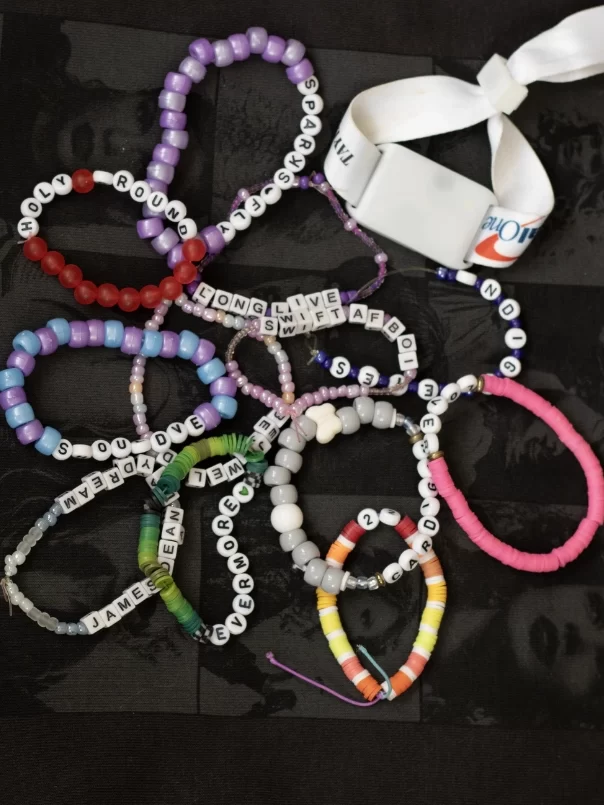
The Eras Tour kicked off in March 2023 in Arizona. I told myself I was going to stay off social media to avoid spoilers, but my resolve barely lasted a day. TikTok users were livestreaming the concert or reacting to other people’s livestreams, screaming with each set change, song intro, and costume reveal. With every show, the rest of the world saw how invested the fans were, from the outfits and the friendship bracelets to the crowds outside the stadiums.
With each tour stop, the excitement ramped up — not just for the music, but also the community. Fans didn’t hold back, showing off stitched, beaded, and bedazzled outfits, many of which were handmade. I loved seeing what people were wearing on social media and added countless pictures to my ‘Eras Tour Outfit Inspo’ Pinterest board.
With every show, my friends and I would speculate which two surprise songs she might play during her acoustic set, commiserating when we inevitably crossed a favourite off the list, consoling each other with the next best thing (“at least she hasn’t played “Dear John” yet”), only for it to get crossed off the week after. We would frantically text back and forth about theories or potential special guests, and logging onto TikTok felt like having a thousand other friends to speculate and theorize with. I felt seen and understood, even if I was just in my bedroom, trying to imagine what it would feel like once I finally made it to my show.
A 1976 essay by Angela McRobbie and Jenny Garber coined the term “bedroom culture” to describe the differences between young men’s and women’s leisure activities. As Mary Celeste Kearney critiques in “Productive Spaces: girls’ bedrooms as sites of cultural production”, McRobbie and Garber’s separation of activities is rooted in the domestic roles and purity culture inherent in that time. Young men were out in the world, going to concerts, hanging out in big groups, while young women tended to be in their bedrooms talking, practicing different ways of applying makeup, and listening to music. McRobbie and Garber saw these activities as private. Women were free to enjoy whatever they wanted within their bedroom walls, so they became safe spaces where women could think and talk freely with one or two friends. Kearney argues that bedroom culture has since expanded. Girls aren’t just enjoying media privately in their bedrooms now — they’re also creating it and posting it on social media.
I see both views of bedroom culture in my childhood. While my brother would play on the front street with his friends, my friends and I would be up in my room talking about boys, movies, and music, and playing dress-up with our closets. Thanks to the advent of the internet, the “bedrooms” are a lot bigger, but the core principle remains. Fandoms come together to create spaces hidden away from the front street of the internet; these online spaces are like a cozy bedroom, even if technically they can be seen by billions of people.
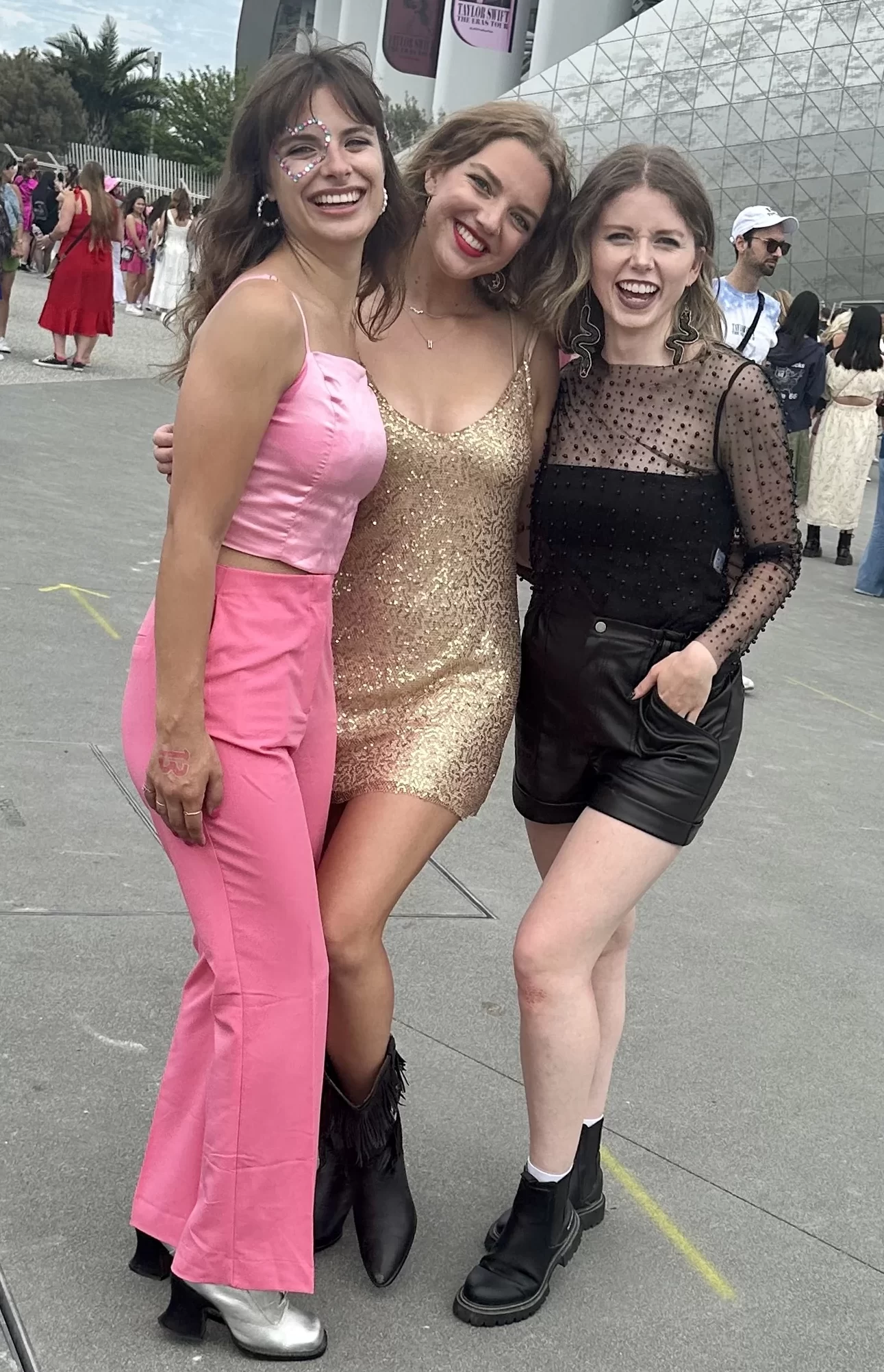
It’s August 8, 2023. My friends and I venture out from our Airbnb in Los Angeles. We run along Venice Beach, trying, to no avail, to get some of our excitement out. We check the time every few minutes, panicking that it might have suddenly skipped forward. After speed walking home, we put on some music, turn up the volume, and start getting ready. Makeup products, brushes, and mirrors cover the dining room table — the closest surface to the windows, where we have the best light. Hair straighteners and curling irons are plugged in at the bar across the room, so no one is confined to the bathroom at the other end of the house, away from all the fun. Finally, after about a thousand just-making-sure-it’s-perfects, we put on our outfits: gold, black, pink, light blue, and deep navy, each one a representation of our favourite album.
We order an Uber and make our way to SoFi Stadium. The closer we get, the quieter we become. We bought these tickets nearly ten months ago, swearing we wouldn’t believe we’d gotten them until we were actually there. And suddenly, we’d arrived.
SoFi Stadium seats 70,000 people, yet walking around the outdoor concourse before the show felt like being in my bedroom. I felt comfortable and safe. I traded friendship bracelets with girls from across the globe, all of them more than happy to take your picture, genuinely compliment your outfit, and ask about your lipstick shade. The world calls Swifties obsessive, annoying, and too much. Countless Reddit threads rant about how “crazy” they are, but what I saw was the truest expression of freedom and fandom I’ve ever seen. Joyful, uninhibited, and judgement free.
In August 2013, Crazy About One Direction, a documentary about the band’s biggest fans, aired on BBC. The documentary followed a handful of superfans from across England, who will “stop at nothing to get close to the boys,” according to the film’s introduction. Most girls in the documentary were interviewed in their bedrooms. The walls plastered with posters, pictures, and concert paraphernalia, their laptops open to their online fan accounts. The interviews were spliced with clip after clip of teenage girls screaming and sobbing on the street, running after cars, and camping outside of venues and hotel rooms, which the film referred to as “the hunt,” comparing a bunch of teenagers to a pack of rabid, wild animals.
The documentary received immediate and widespread negative feedback from fans, who were (rightfully) upset at the sweeping generalizations the film made. The hashtag #ThisIsNotUs started trending on X, in an effort to reassure the band that their fans weren’t what the documentary made them out to be.
In her book Fangirls: Scenes from Modern Music Culture, journalist Hannah Ewens interviewed both fans who were included in the documentary and fans who were interviewed, but whose interviews didn’t make the final cut. The girls who were included spoke about the backlash they received for perpetuating the fangirl stereotype, and the girls who weren’t included said it was because they “weren’t crazy enough,” and recalled the producers who interviewed them egging them on to say more
Daisy Asquith, the documentary’s creator, responded to the backlash in an interview with the BBC, saying, “their response to the film is so much more extreme than anything I chose to include….I think the response itself is proof that we didn’t just pick the most extreme fans there are.” It’s a classic tale: give someone a label and then be shocked when they wear it.
The attitudes held by the Crazy About One Direction creators, and, arguably, society at large, existed long before One Direction ever did. In a 1992 essay about Beatlemania in The Adoring Audience: Fan Culture and Popular Media, the writers argue that Beatlemania was the first mass movement of the 1960s with women at the forefront. In what was a highly sexualized society, women and girls were expected to represent and enforce purity and goodness. But The Beatles presented a chance for young women and girls to shed that role. It was an uprising. Girls could no longer be confined to their poster-plastered bedroom walls. The pent-up frustration and repression had to go somewhere, but it was not without hatred in response; the women who flocked to The Beatles or who “screamed themselves into hysteria,” according to a 1964 article in British culture magazine The New Statesman, were characterized as the “dull, the idle, the failures, and the least fortunate of their generation.”
One of the earliest theories on fandom — written by a fan (username obsession_inc) on Dreamwidth, an open-source content publishing and social networking site — argued that males and females express different types of fandom. The theory became foundational in fan studies, and goes something like this: Boys and men exhibit affirmational fandom, meaning that the knowledge about the thing stays within the confines of the thing. Every song title, factoid, or stat is committed to memory, all while staying within the canon, resulting in the “oh, you’re a fan? Name five songs” test.
Conversely, women and girls exhibit transformational fandom, meaning we take the thing and our knowledge of the thing, and then take it further. We write Harry Potter universe fanfiction that is more than double the length of the final novel, we build a shrine to Harry Styles’ vomit on the side of a highway in Los Angeles, we create and run fan accounts with millions of followers, and we decode easter eggs for hours.
obsession_inc’s theory operates with a strict binary, and while the world of fandom (and the world at large) isn’t as binary as many once thought, Mark Stewart’s work in Participations Journal of Audience and Reception Studies argues that this theory gave society a framework for how to define “appropriate” and “inappropriate” fan behaviour. For example, it’s perfectly acceptable for a male football fan to know all his favourite player’s stats; his hometown, his high school and college teams, or his injury history, but it’s weird for me to know the equivalent details about my favourite singer. Fantasy football teams are normal, but fanfiction is weird.
In an interview with Refinery 29, professor and author Sarah Banet-Wiser argues that the diminishing and dismissing of fangirls is likely because those on the outside feel intimidated.
“If there is a fandom that is made from mostly women, where men would have to earn their way in rather than just be entitled to membership, it is seen as quite threatening,” she said.
“So what do you do in the face of that? You say that that community is worthless and hysterical and you cast aspersions on it, to delegitimize it, because you are not invited.” Unfortunately, some female fans have been subject to the most extreme version of this.
In Fangirls, Ewens interviewed former Chief Crown Prosecutor Nazir Afzal following the 2017 bombing of the Manchester Arena during an Ariana Grande concert. He concluded that the attack was specifically aimed at women and girls.
“The vast majority of people who were injured were women and girls… [the attacker] could’ve chosen KISS, who were playing a concert a couple days before, or a wrestling event that same week — two male audiences — instead, he went for an event that would’ve had teenage girls,” he said.
Afzal called this gender terrorism — acts of terrorism that reinforce gender stereotypes and aim to keep women “in their place.”
The bombing was later confirmed to be the work of ISIS, a group that regulates, controls, and terrorizes women and girls. If your goal is to control, enforce gender stereotypes on, or even kill women and girls, what’s the biggest “girly” event you can target?
A pop concert.
During the August 2024 European leg of the Eras Tour, three shows in Vienna, Austria, were cancelled following the discovery of an alleged terrorist plot. My cousin Olivia was supposed to be at the first one.
She was in Austria as an exchange student in 2016, so she jumped at the chance to reunite with her host family and friends for the first time since 2018 and see her favourite artist.
The evening before the show, Olivia and her friends were driving into the city after making last-minute friendship bracelets and hand-stitching the finishing touches on their outfits when they found out that all three shows had been cancelled.
“We were in shock,” she said.
“We knew there was some sort of plot, and they had been arrested, so no one thought it would get cancelled. I started laughing because it was just so unbelievable.”
A few hours later, the reality started to sink in. “There was definitely the feeling of ‘wow we could’ve died’,” she said.
“We had floor seats, so we probably would’ve been in the middle of it all.”
After that came the anger, when they learned the group responsible for the attack had a similar motivation to the group that targeted the Ariana Grande concert in 2017.
“It was so surreal,” said Olivia. “A bunch of girls in glitter pisses you off so bad you have to kill them? You hate women that much?”
Because of the motivations behind the attack, ‘girlhood over terrorism’ became a slogan across Vienna. Swifties couldn’t go near the stadium, so instead, they gathered at Corneliusgasse — renamed “Cornelia Street” for the weekend — to swap bracelets, sing songs, and commiserate.
“It was insane, surreal, and kind of heartbreaking,” she said. “People who lived on the street had their windows open and were blasting her music from their speakers, just wanting to support all the girls in glitter.”
Fandom presents an opportunity for deeply meaningful experiences, and the community around fandom is an essential part of that. In her Refinery29 interview, Banet-Wiser also argued that these communities are especially important in a society that doesn’t often validate young women’s feelings:
“To share space with likeminded people… means that whatever hate or misogyny is being directed at you isn’t about you,” she argues. “It’s about men feeling threatened and… like they’re entitled to this space.”
Jen Zoratti, a reporter for the Winnipeg Free Press, grew up as an alt-rock fan and felt she often had to prove herself as one because her male peers felt threatened.
“A woman liking something [men] like shatters their self-image. It becomes a ‘what does that say about me’ type thing,” she says.
Women are made fun of for being fans of things marketed and geared towards us, but when we try to enter male spaces or male-dominated fandoms, we’re made fun of yet again. The term “fangirl” exists because being the type of fan who chases after cars and camps out in front of buildings is more interesting and newsworthy than the reality.
As the lights go down in the stadium, the countdown clock pops up on the screen, and I feel all the air leave my lungs. I’ve seen countless videos on social media, but as I watch the numbers go down, it doesn’t look real. As the countdown hits ten, I realize I’m having an out-of-body experience. I try my hardest to be present for the show, to commit the performances and special moments to memory, barely pulling out my phone to document it.
Instead, the opposite happens. I remember hardly anything from the show. But, in the few videos I do have, you can hear me and my best friends scream-singing every lyric. You can hear the joy in my voice and see it on my face in the photos from that night. During that show, singing in unison with 70,000 other people, I felt invincible.
I sometimes still feel embarrassed about being such a die-hard Swiftie. But then I think, why?
Why do I think it’s stupid to like what I like? Isn’t everyone a fan of something? And isn’t it sad if you aren’t? Who are any of us to judge?
But many do. Loudly. Is it because our culture has told us we should police each other? Is it the entertainment industry? Is it plain old misogyny?
The answers to these questions are complex. It is easy to dismiss people when you characterize them as fangirls: crazy, obsessed, and too much. But at the same time, someone wants to sell us posters, commemorative jerseys, and the same album pressed in seven different vinyl colours, each with its own limited-edition cover. Fangirls are judged by some and seen as a powerful economic force to take advantage of by others. But, in the midst of this paradox, is the community. Inside, it’s about the power of camaraderie, of feeling seen.
And yes, sometimes, it is about the glitter.


