
Stimming Out
How does a late-diagnosed Autistic navigate professionalism in a world built for allistics?
A girl in my Grade 5 class used to jump. She wore blue, purple, and pink striped socks, dark blue sneakers, and blue jeans. I can still picture the lower half of her outfit because I was glued to her movement. When she jumped, she would tense her body, hold her arms tight to her sides, and clench her hands in the space between her chest and her chin. I would watch her. Staring at her feet, her face, her hands. She was happy, and her brown hair bounced. I always wondered what she was doing. I wondered what it would feel like, but I wouldn’t dare to let myself. Instead, I sat on my hands and let my body shake with all its energy.
I’m incessantly looking for clues on how other people perceive me. Report card day in elementary school felt like Christmas but without all the painfully sticky tape and new pyjama hems cutting into my soft ankles. My teachers usually declared me “a pleasure to have in class,” “very bright,” and “gives positive contributions.” Awesome. I nailed it every year. But there were clues. In Grade 1, my teacher reported I spoke out of turn and struggled to let other classmates make their own decisions. A certified bossy pants, if you will. Other times I’d follow an instruction literally or ask a follow up question for clarification, but was taken by my teachers as questioning their authority.
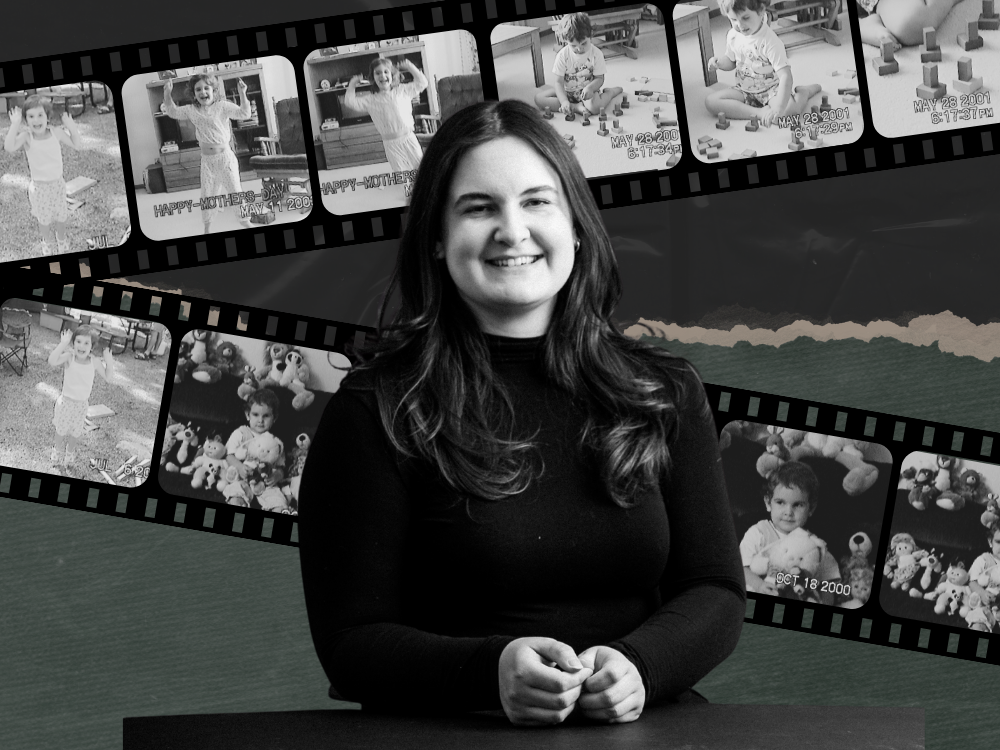
Now when I look through hours of video footage of my childhood, I see I was a squirmer. Never still. My body didn’t used to ask for my permission to move. We were in sync. I would wriggle my joints against low-pile blue carpets and trace my fingers over the pattern impressions it left in my palms. Press, push, run, tug, blurt, thunk, bounce. My Grade 3 teacher would glide in her wooden rocking chair and read aloud as the class surrounded her feet, bordered by carpet edges. Third grade taught me to sit, stay.
Two years ago I got a formal, bank-breaking diagnosis of autism spectrum disorder (ASD). I’ve been uncovering my own traits and presentation of my Autism. There’s been a few moments where I’ve had the time to research the history, culture, and emerging voices in the autistic-led autistic advocacy community.
“Indistinguishability” — as a lover of words, I’m glad I found this one while reading Loud Hands, Autistic People, Speaking. Indistinguishability is in the same vein as “good sick,” a term andrea bennett describes in their article On Being Bipolar. Good sick is when bennett presents their bipolar disorder in socially acceptable ways to obtain and sustain buy-in from healthcare professionals, employers, and friends. Presenting in acceptable ways grants people like us with a form of social currency. Understanding,accommodations, access to basic needs, and even friendships. Not long ago, I thought I wanted to be a “good autistic,” but really, it was indistinguishability I was striving for. Or rather it was placed upon me, but the mask is too heavy to bear.
I’m sitting across from Sunday Queskekapow in the crowded coffee shop, and I’m looking into a mirror. I watch as they run their palm against their thigh over and over and over and over. I don’t worry about this. I know they’re also attempting to ease the sounds of dishes, voices, traffic, background music, and the elderly woman who keeps glancing in our direction on my right-hand side. The elderly woman’s gaze holds a little longer than I’m comfortable with. I wonder if I make allistic people uncomfortable.
Sunday’s face is animated, with flickering eyebrows in sync with their words. Their full smile flashes as they retell a story, while their eyes stay locked onto something, or someone, just past my left shoulder.
Sunday is working as a Northern First Nations Two-Spirit Trans youth activist for AuDHD and 2SLGBTQIA+ people. Sunday’s special interest for activism in Northern Indigenous communities began in their early teens, around the age of 15. They helped with their community’s first pride float, and volunteered for a conference to connect their neighbouring communities. Since then, Sunday says, “it’s literally never stopped.”
Sunday has a lot to say about their special interest:
“There’s a lot of effective colonization in our communities. Autism and neurodiversity are not new concepts in Indigenous communities, but the names themselves are new. There’s not a lot of education on what it means to be autistic, and there are a lot of great Elders that are supporting that.”
When it’s my turn to speak, Sunday has a flat affect. Levelled eyebrows meet mine and I doubt if what I’m saying is even worth talking about. Have I lost their interest in the time it takes for a microsecond and micro-expression to meet? I cannot read their face. I decide that’s okay with me.
Sunday is a Two-Spirit Néhinawak and Métis Settler from Ohpáskowayáhk, and a band member with Kínoséwi-Sípiy (Norway house Cree nation). They’re currently working to help make Sweat Lodge ceremonies more accommodating to more than just neurotypicals. Sweat Lodge ceremonies are inherently uncomfortable due to the level of heat, and close proximity to others. Sunday’s work is about helping AuDHD folks differentiate between discomfort and harm, so people can fully participate, and participate safely.
Sunday shared with me that it was hard for them to see their work as a special interest at first because it was both their identity and their job:
“The way that I would go off about it with people… I would have to recognize that other people won’t find this as interesting as I do and I actually made a lot of people uncomfortable. Like ‘yo, your ancestors did some crazy shit dude,’ and I’m not trying to make them feel bad,it’s just really interesting that this happened, and that’s why things are the way that they are now. Then people are like ‘yeahhh… that’s so interesting…”
Exclusion on the merit of being weird and different seems to be the most pervasive and acceptable form of exclusion. I think allistics, my peers included, believe choosing to ostracize and distance themselves from people who are outwardly displaying observable Autistic traits is a valid response. Bullying someone on the basis of having a different mind is as oppressive as if they had a different skin colour. The impatience I’ve witnessed in people speaking with an Autistic person who’s monologuing and dodging eye contact, would be inexcusable if an allistic person used a wheelchair, or had any other form of physical disability.
In middle school, I noticed the kids who were different than my peers, and how they were treated. I didn’t want to be socially ostracized like they were. So, I hid all the parts of myself that would out me as Autistic. I’m still left wondering which parts of the mask are safety and which are shame.
Today my college instructor tells me I’m a strong student, and my classmates are glad to have me in their group. I wonder if I couldn’t or didn’t mask so hard — if I didn’t have that privilege — would the same things be said about me?
My conversation with Sunday was my favourite way to have a conversation. We volleyed monologues back and forth. At one point, Sunday talked about context and autistic identity:
“I know there’s a huge correlation with queerness and neurodiversity, so to hear that from Elders that you would have been respected in our communities, for one, being Two-Spirit, but also being able to think differently than others and having that perspective that goes hand-in-hand with the Two-Spiritness as well. Especially for AFAB folks, I feel like a lot more people are recognizing that autism takes a lot of different forms and it’s not just, you know, cis male symptoms.”
I’m sitting in my college classroom. After zoning out, I realize my hand sits at the top of my head, clenched in a fist, gripping my hair. I make sure to not move too quickly as I take my hand off my scalp. I tousle my hair as girls do. How much time has passed? I can smell the fruity metallic aerosol product coming off my fingernails. I don’t let myself look around the quiet classroom.
When Sunday switched from Indigenous Studies to a more “professional program,” they found it harder. The new program didn’t allow them to miss three days of classes, regardless of doctors’ notes. This new program also had group projects and presentations, which meant Sunday had to disclose their Autism diagnosis to ensure they weren’t docked marks for not making eye contact with the audience. Indigenous Studies hadn’t been like that, and Sunday says they had a hard time switching from a de-colonial faculty to a professional program:
“I’ve felt way safer and way more like services were accessible than having to put on this colonial presentation of ‘I’m professional because I look you in the eye and I wear a suit and I can not read off my slides.’”
I too understand feeling out of place in “professional” settings. Simply sitting in this tiny wooden chair, during this coffee shop’s peak hour, my body is tense.
“I’ve always kinda done the rocking or even rubbing onto my knee. I don’t think I’m aware of it a lot of the time. I get worried about it in those spaces of professionalism,” Sunday says.
I was 25 when I realized I was suppressing my body’s innate craving for movement. Only when I watched the videos my father so meticulously filmed of me did I realize I used to love to jump. My father had documented my life so beautifully, and wholly. Some videos feature slow-motion pans of my bedroom, my Bratz dolls aligned in a perfect scene. Nothing was ever out of place or strewn about in the middle of play. Everything was set up exactly the way I liked it. I brought these videos from my childhood — organized into properly labelled folders on my laptop — to my diagnosis assessment as evidence of my Autism. To my surprise my psychologist loudly said “Oh my god,” over my shoulder as she watched.
“Is this not typical?” I asked.
“Absolutely not.”
As an adult, I found my ways to socially acceptably show my overwhelm. I saved my jumping spells for dark rooms behind closed doors, with no witnesses besides my aching gut. In the first year of my professional program in college, I spent my evenings in my dark bedroom under a 25-pound blanket just so I would have enough energy to function the next day.
My mind and body hit their limits in the second term. I started experiencing borderline burnout and bordering shutdowns each day. I had nowhere to escape to during the eight hour days when painfully bright LED lights hummed into my skull. I’d cling my schedule to my body, and ground myself with my noise canceling earbuds. I’d already spent around eight months in the building, but the disorientation never subsided like it did for my peers. What class is this? What are we talking about? How did I get into this room? When does this class end? What class is this? How do I get out of here? Is someone talking to me? What does my face look like right now? I can’t hear anybody. How did I get into this room?
The college didn’t have a quiet room, or sensory-friendly space. Safe spaces, and safe people, are lifelines for Autistics. They can mean a world of a difference in managing discomfort, sensory overwhelm, physical and mental pain, shutdowns, and meltdowns.
“I think it’s silly…. I think it’s just really inaccessible. I think it’s really contradictory, considering that [the professional program I’m in] is known to be anti-oppressive and anti-discriminatory, and having those frameworks, and they claim accessibility but when it comes down to it, they’re not. They’re still an institution and they are still having a lot of colonial mindsets as to what professionalism exactly is,” said Sunday.
As a teen, I developed stomach pains that would become chronic. After my diagnosis, I started allowing my body to move and worked in therapy on my alexithymia, the disconnect between one’s body and their emotions. The stomach pains are less frequent.
Eloping to the Accessibility Services room became my only solace during this season of my college experience. I’d push the heavy clear glass door on the second floor, barely able to read the writing on the door through the tears in my eyes. Heather, who works at the front desk, and I are on a first name basis. She loves birds like I do.
I have tried multiple times to have access to a quiet room on campus. What I desperately needed was a place for me to be free of on-lookers of my stimming, a space I knew was safe. Safe for me to be alone. Safe for me to unmask. Safe for my body to release its painful tension. Safe for me to self-regulate so I can re-join my peers after a meltdown. Nobody wants to witness a woman in a blouse, black slacks, and shiny loafers, jumping up and down repeatedly, crying, and flapping her hands. It’s just not, “professional.”
I bounced around different spare rooms Heather and my accessibility advisor Dale were able to find for me. It was re-iterated that the student accessibility services couldn’t offer this form of accommodation for me.
One day I came into the accessibilities office, needing some place to go. Heather guided me into an office and told me I can have this room for the day. “Nobody will walk in or bother you,” she says to me as she writes on a pink sticky note and puts it on the outside of the door. In blue cursive pen the note reads “Do not enter.”
I flick off the lights in the empty office and crawl underneath the absurdly large mahogany coloured boardroom desk. It’s dark and quiet. I lug my backpack on top of my body for heavy sensory input. It’s no weighted blanket, but it will have to do. My heartrate is finally beginning to slow when a voice approaches and the door opens. As quickly as it opens, it shuts again. With the back of my head to the door, I never see the intruder. I take a deep breath. I wait until I can’t hear any more voices, crawl out from under the desk, dust off my pants, and leave. I’ll never use this room again.
Now when I have my meltdowns at the college, I get to do so in the counselling waiting room, as students and staff members pass by me on their lunch breaks. None of us acknowledge the other. I wish I was invisible.
When telling Sunday about my experiences, I was self-conscious about making the conversation about me, but I was free from the normal worries I have when talking to allistics. We offered experiences back and forth with ease, and took turns staring off into space. It felt like connection.
“In Indigenous spaces in academia, I’ve always been open to leave the class and always been open to warnings with sound. There’s a lot of safety nets that were put in place. I found that in the Indigenous community, being different, especially being neurodivergent, they really cater to it, which I really appreciate, and it’s just recognized more, which was not the case when I switched to [my professional program]. My instructors were generally accommodating, but just having to disclose in order to get those accommodations is what makes it inaccessible” said Sunday.
Heather, from accessibility services, kneels in front of me and pulls a tissue from the box. She softly folds it between her index finger and her thumb, creating a soft pad. She brings the pillowed tissue to my cheeks and gently dabs my tears, and along with it, my concealer. “Oh my sweet girl,” she repeats. I wonder if she’s a mother. She remembers I don’t like the sound machine on, so she turns off the babbling brook on the table beside us. My left hand sits in my hair at the nape of my neck, clenched in a fist. The roots of my hair are pulled taut, getting damp by the second from my palm sweat. Now I know where my head is in relation to my body. I feel some sort of feedback.
”I don’t have anywhere to go.” I say.
“What do you mean?”
I asked Sunday how they ground themselves when they feel overwhelmed:
“I go for a walk, I put my phone down for a second, and go outside and touch the trees and I’m reminded of not only the pleasure of feeling something different, but also where I come from and being connected to that nature aspect, and it’s very grounding.”
Today I’ll jump. I’m at home, Tame Impala’s new single “End of Summer” plays in my earbuds. I can’t hear my feet landing on the ground. But it doesn’t matter, I won’t let myself make any noise even in this still house. The vibrations are hardly noticeable as I shoot myself into the air through the balls of my feet. My eyes are closed softly. I’ve never tensed my eyelids. My hands cannot tell my digits apart as my wrists fling them over and over and over and over. After seven minutes and twelve seconds the song ends. It’s on repeat, and starts again. I’ll jump some more.


